A large reservoir-based solar plan takes shape
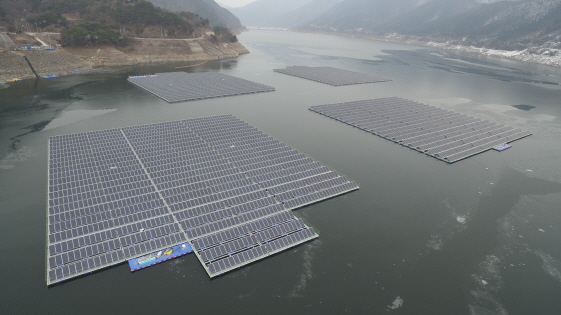
South Korea is planning a significant expansion of floating solar, with the state-run Korea Rural Community Corp. aiming to grow installed capacity on agricultural reservoirs from 105 megawatts today to 3 gigawatts by 2030.
The scale of that target makes it one of the more consequential floating-solar development plans now on the table. It also reflects a specific land-use strategy: instead of competing directly for scarce ground space, the buildout would place solar arrays on existing reservoir surfaces tied to the country’s agricultural water infrastructure.
According to pv magazine, KRC has identified 2,333 of its 3,428 agricultural reservoirs as suitable for floating solar development, meaning more than two-thirds of the sites under its control could potentially host projects.
Why floating solar is attractive here
Floating solar has long appealed to countries where land is constrained, expensive, or politically difficult to repurpose. Reservoirs offer ready-made surfaces, grid-adjacent infrastructure in some cases, and the potential to combine energy generation with existing water-management systems.
For South Korea, the approach also creates a new revenue stream for public infrastructure. KRC says income from the planned expansion could help address an annual shortfall of about KRW 200 billion, or roughly $135.2 million, in agricultural water supply and management costs.
That budget angle matters. The proposal is not framed only as a clean-energy initiative. It is also a financing mechanism for maintaining and operating essential rural water assets.
A revised profit-sharing structure
One of the more interesting elements in the plan is the updated revenue-sharing model. Under the new arrangement described by KRC, proceeds would be divided equally among power generators, the corporation itself, and local farming and fishing communities.
That replaces an earlier structure in which generators captured a larger share of returns. The change appears designed to improve local acceptance and distribute financial benefits more visibly among the communities directly affected by the installations.
Community economics often determine whether infrastructure plans advance smoothly or become politically difficult. Floating solar can raise concerns about water use, ecological effects, visual change, and access for residents whose livelihoods depend on nearby reservoirs. A clearer local-benefit formula does not eliminate those issues, but it can shift the politics of siting.
The first big tenders
KRC says it plans to complete tenders for private operators at Asan Lake and Ganwol Lake in the first half of 2026, with about 500 MW planned at each site. Those projects alone would account for roughly 1 gigawatt, or about one-third of the 2030 target.
That concentration suggests the plan is not merely aspirational. Large flagship sites can establish procurement patterns, supply chains, and operating experience quickly if the tenders result in actual construction.
At the same time, the gap between identified potential and deployed capacity remains substantial. Moving from 105 MW in operation to 3 GW in four years requires not only contracting but permitting, financing, engineering, grid integration, and public buy-in across many locations.
What the plan signals for the energy sector
The South Korean proposal reinforces several broader trends in solar development. First, countries are increasingly looking beyond conventional utility-scale ground mounts as prime land becomes harder to secure. Second, governments are tying renewable deployment more directly to infrastructure modernization and regional economic policy rather than treating it as a standalone climate measure.
Floating solar also has a strategic advantage in public narratives. It can be presented as efficient use of already managed surfaces rather than as a new competitor for housing, industry, or farmland. Whether that advantage holds in practice depends on environmental review and local reception, but it is politically useful.
For developers and equipment suppliers, a 3 GW pipeline creates a meaningful market signal. Reservoir deployments come with distinct engineering needs, including float structures, anchoring systems, corrosion management, and maintenance practices tailored to inland waters. A sustained buildout can therefore strengthen a specialized supply chain rather than just add generic megawatts.
The challenges ahead
The article summary does not detail environmental constraints, but large floating-solar programs typically face questions about water quality, ecosystem impacts, fisheries, and operational resilience under changing weather conditions. Grid connection and seasonal reservoir management can also complicate deployment.
Those issues will determine how much of the mapped potential becomes real capacity. Technical suitability on paper does not guarantee smooth execution across thousands of sites.
Still, the scale of KRC’s reservoir assessment suggests this is more than a one-off pilot strategy. The corporation is positioning its water infrastructure as a platform for energy generation at national scale.
A sign of maturing solar policy
What stands out in South Korea’s plan is the effort to align three goals at once: renewable expansion, public-infrastructure finance, and local benefit-sharing. Many energy projects stall because they succeed on one dimension while failing on another. This proposal tries to bind them together from the outset.
If the tenders at Asan Lake and Ganwol Lake move forward on schedule, they will be an early test of whether that formula can hold up in execution. If it does, South Korea could become one of the most important reference cases for reservoir-based floating solar over the rest of the decade.
For now, the headline is clear. A country with limited land and extensive managed water assets has decided floating solar is no longer a niche add-on. It is becoming part of the core buildout plan.
This article is based on reporting by PV Magazine. Read the original article.
Originally published on pv-magazine.com