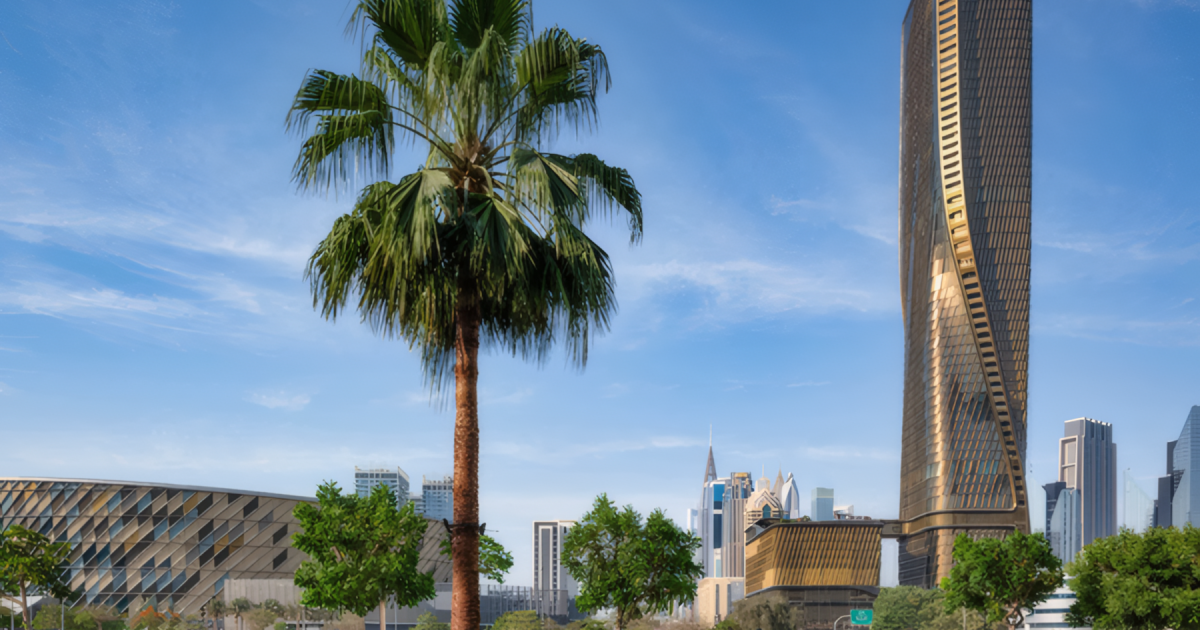
A different kind of supertall arrives in Dubai
Dubai’s skyline is full of reflective glass towers, but the newly completed Wasl Tower takes a different route. Designed by UNStudio with engineering input from Werner Sobek, the 302-meter building combines a twisting profile with a ceramic exterior made from thousands of terracotta fins. The result is both a visual departure and a climate strategy aimed at reducing cooling demand in one of the world’s hottest urban environments.
That makes the project more than a new landmark. It is a test of whether high-rise architecture in extreme climates can move beyond the default sealed-glass model and incorporate regionally responsive materials at supertall scale.
Terracotta as performance infrastructure
The building’s most distinctive feature is its ceramic “cloak,” which wraps the glass tower in sculpted terracotta fins. According to the source report, these elements provide shading, reduce heat radiation and capture high winds, helping cut cooling loads by about 10% compared with older towers in the city.
That matters because most iconic tower design has long prioritized image over thermal logic. In hot climates, heavily glazed envelopes can force buildings into energy-intensive dependence on air conditioning. Wasl Tower does not abandon glass, but it places a second climatic layer in front of it.

An old material adapted for a high-rise future
Terracotta is not a new material in the region, and that is part of the point. UNStudio’s approach reworks a traditional material for high-rise performance rather than treating sustainability as something achieved only through futuristic composites or hidden mechanical systems.
This is one reason the project stands out in the current architecture conversation. It suggests innovation in tall buildings may come not only from structural daring or digital lighting systems, but from revisiting basic questions of shade, surface and heat with more discipline.
Design identity and environmental function align
The tower’s twist gives it a distinctive silhouette, but the facade carries most of the deeper architectural significance. The terracotta texture makes the building read differently from the smooth, mirror-like towers around it, while also serving a practical environmental role. That alignment between identity and function is harder to achieve than it looks. Many buildings can claim sustainability features; fewer make those features central to the architecture rather than ancillary to it.
Wasl Tower also includes a custom lighting system developed with Arup Lighting, allowing the facade’s appearance to shift subtly over time. Even that detail reinforces the project’s broader ambition: create a tower whose outer layer is active, expressive and climatically purposeful.

Why this matters beyond Dubai
Extreme heat is no longer a niche design condition. As cities face rising temperatures, the assumptions that shaped the global glass tower begin to look increasingly inefficient. That is especially true in places where cooling demand already dominates building energy use.
Seen in that context, Wasl Tower is part of a wider architectural recalibration. It does not reject high-rise urbanism or luxury development, but it does show how facade design can absorb more of the environmental burden instead of passing it directly to mechanical systems.
The larger lesson for skyscraper design
The simplest reading of Wasl Tower is that it is an eye-catching new skyscraper near the Burj Khalifa. The more important reading is that it treats exterior architecture as environmental equipment. The tower’s ceramic fins are not decoration added after the fact. They are a performance layer intended to mediate solar exposure and cooling demand in a harsh desert climate.
If more tall buildings follow that logic, the significance of Wasl Tower may extend well beyond its height. It would mark a shift in what counts as innovation in skyline architecture: not just building higher or stranger, but building in ways that acknowledge climate as a first-order design constraint.
This article is based on reporting by New Atlas. Read the original article.

Originally published on newatlas.com