A rethink of how running shoes are built
Running shoes are high-performance products, but they are also notoriously difficult to recycle. A new research effort from Germany’s Fraunhofer group is trying to change that by asking a deceptively simple question: what if a running shoe could be made almost entirely from a single material?
The concept is being pursued through the ZiProMat project, which focuses on what the source describes as a “programmable monomaterial” approach for athletic footwear. The goal is not merely to reduce waste around the edges of the footwear business. It is to attack one of the industry’s most stubborn problems: modern running shoes are engineered from many different materials that perform well together but are hard to separate and reuse at the end of the product’s life.
Why current footwear is hard to recycle
The source outlines the problem clearly. Typical running shoes combine a woven-fabric upper, a sole system that mixes soft foam with harder rubber, and additional plastic elements. That layered approach helps manufacturers tune cushioning, rebound, support, and durability. But it also creates a recycling challenge, because the finished product is made of dissimilar parts that are difficult to recover into feedstock for another shoe.
Existing recycling pathways therefore tend to fall short of a true closed loop. The source notes that some brands collect old shoes and shred them into particles that can be used in products such as playgrounds or running tracks. That keeps material out of landfills for a time, but it is downcycling rather than full recycling. The original shoe is not turned back into a new shoe.
This matters more as the running market grows. The source says global footwear manufacturing has increased significantly over the past 15 years. It also notes that a typical running shoe lifespan is at most 800 kilometers, meaning frequent runners may replace pairs every four to six months. The combination of rising production and short replacement cycles creates a large stream of material that current product design has not made easy to reclaim.

One material, different structures
The Fraunhofer-led answer is to use thermoplastic copolyester elastomer as the core material for the shoe and to achieve different performance characteristics by changing structure rather than switching substances. In other words, instead of combining many materials with distinct properties, researchers aim to tune the same material into multiple functions.
That is the heart of the monomaterial idea. A running shoe still needs conflicting qualities across its geometry. The source explains that the heel should be soft and shock-absorbing, the midsole should support a smooth stride transition, and the forefoot should be firm enough for push-off. In conventional footwear, those differences often come from separate materials. In the ZiProMat approach, they would come from different structural configurations of the same material.
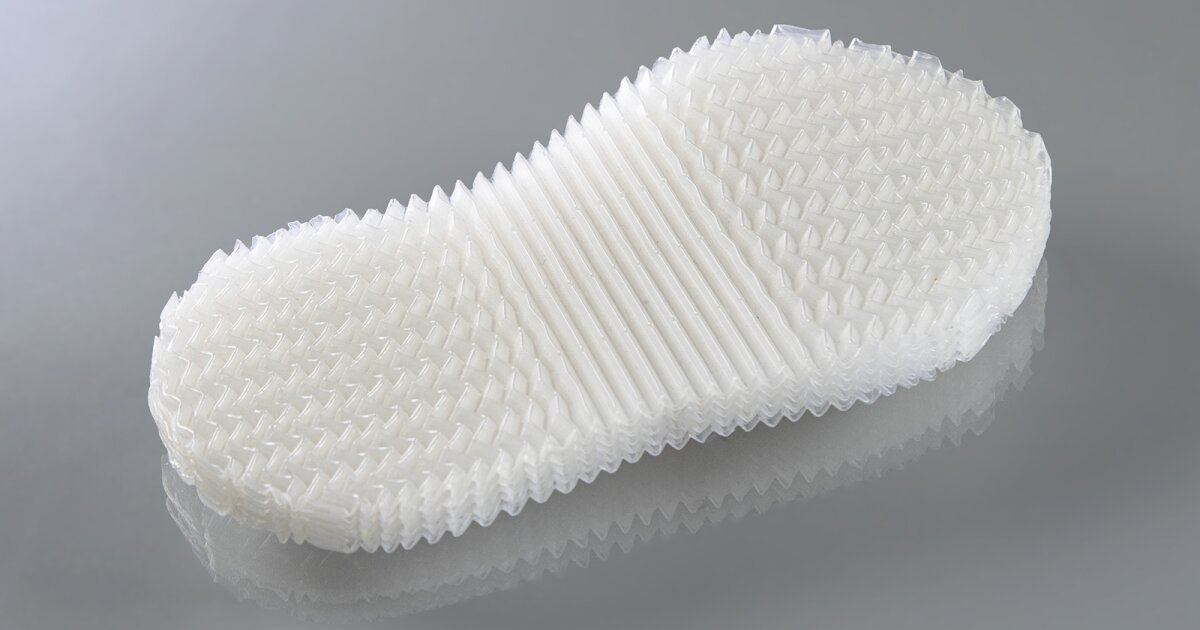
The supplied example is a sample sole made entirely from sheets of the elastomer arranged in ribs and ridges. That detail suggests the design effort is focused as much on geometry as on chemistry. If successful, the project would show that advanced structural design can substitute for some of the multi-material complexity that has become standard in performance footwear.
Performance versus sustainability is the real test
The footwear industry has not ignored sustainability, but the source makes clear that performance has remained the leading priority. Major brands compete on making shoes lighter, faster, and more energy efficient. That competition has encouraged the use of complex material stacks optimized for feel and speed, not for end-of-life recovery.
That is why the ZiProMat concept is notable even at a research stage. It does not simply propose a greener material inserted into the same old product logic. It proposes a different manufacturing philosophy, one where recyclability is designed in from the beginning because the product is largely made from one recoverable material family.
The challenge, however, is obvious even from the source alone. Running shoes are demanding products. They need comfort, durability, responsiveness, and biomechanical consistency. A recyclable shoe concept only becomes meaningful if it can deliver acceptable athletic performance while preserving the easier recovery pathway promised by monomaterial construction.

Why the project matters
The broader significance of the work lies in what it says about sustainable product design. Many industries are now confronting the same problem: high-performance goods often depend on composites and multi-material assemblies that are hard to recycle cleanly. The running shoe is a compact case study in that tension.
Fraunhofer’s research points toward a route where performance engineering and circular design do not have to be treated as mutually exclusive. The project does not yet prove that fully recyclable performance footwear is ready for mass adoption. But it does establish a serious technical direction: using structure to create variation in function while keeping the material base as simple as possible.
If that direction succeeds, it could help shift footwear recycling from downcycling toward something closer to a real loop. For runners, manufacturers, and sustainability researchers, that would mark a meaningful step beyond the current model of high-performance shoes that are difficult to turn into high-performance shoes again.
This article is based on reporting by New Atlas. Read the original article.
Originally published on newatlas.com