Electronic threads aim to hide medical monitoring in plain sight
Wearable health technology has become common, but visibility still matters. Smart watches and rings are now normal accessories for many people, yet some users remain reluctant to wear devices that visibly mark them as patients or draw attention to monitoring. A new line of research from Tufts University targets that problem by moving electronics out of rigid gadgets and into something much closer to fabric itself: thread.
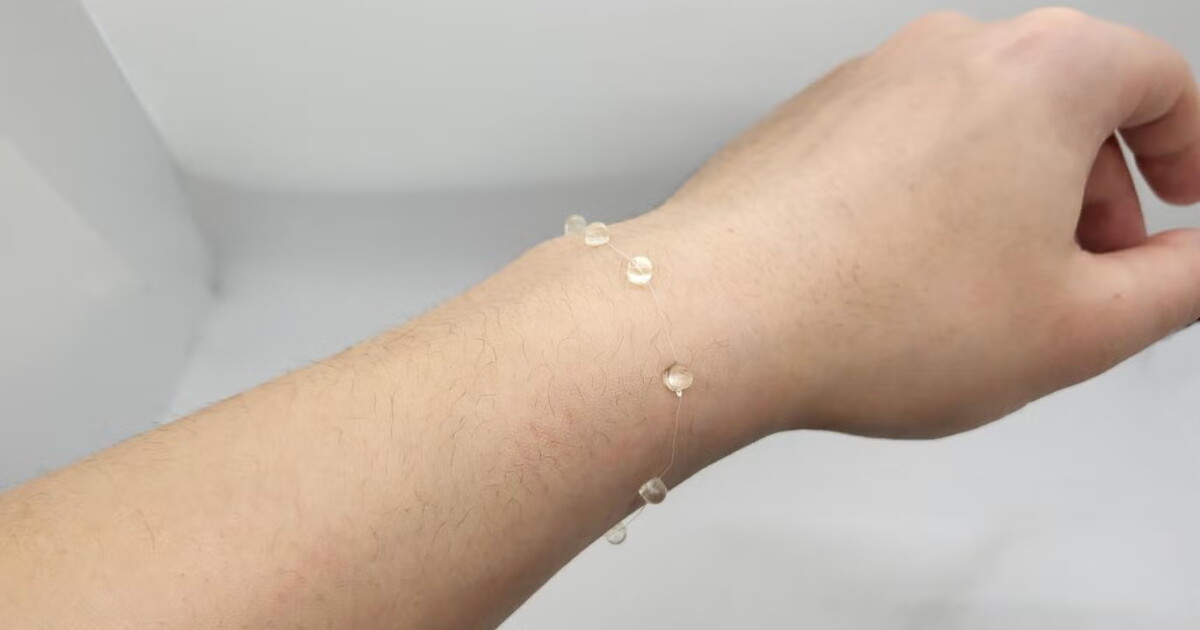
According to the supplied source text, Tufts researchers led by Professor Sameer Sonkusale described a system of flexible “thread-ectronics” in a paper in Applied Materials and Interfaces. The idea is to build integrated circuits from thread-based components including sensors and transistors, creating monitoring systems that are thin, light, flexible, and unobtrusive enough to blend into clothing or even attach directly to the body.
The pitch is straightforward. If health sensors become less noticeable, they may also become easier to accept in everyday life. That matters for medical monitoring, where long-term use often depends as much on comfort and social acceptance as on sensor accuracy. The source text frames the work around stigma and user reluctance, arguing that some people may avoid visible assistive or monitoring technology even when it would help them.
From flat patches to fiber-like circuits
The most notable shift in this work is the form factor. Many wearable bioelectronics today are built as patches, bands, or modules mounted onto textiles. The Tufts approach instead pushes circuitry into free-form threads that can be arranged into complete circuits while remaining bendable and stretchable.
The source says the researchers demonstrated flexible organic eutectogel transistors arranged in a complete thread-based circuit. That configuration is intended to survive coiling, stretching, and bending without breaking, which is a key requirement for clothing-integrated electronics. Conventional electronics struggle when repeatedly flexed with the body, especially in garments used for exercise, work, or recovery. By contrast, thread-based systems are meant to move naturally with the wearer.
Sonkusale summarized that shift in the source text by saying that moving electronics from planar patches to free-form threads opens a path to wearable bioelectronics that behave more like fibers than hardware. That framing matters because it suggests a practical design philosophy: instead of asking users to adapt to the device, design the device so it disappears into normal movement.

What the prototype could detect
The Tufts team used the system to detect subtle physiological signals. In the examples described in the source text, a sensor placed at the temple could detect blinking, while a sensor on the thorax could detect changes in respiration. Those are relatively simple but important proof points. Blinking can be useful in contexts tied to fatigue, stress, or neurological status, and respiration is one of the most basic indicators of physical condition.
The source also says the researchers showed that the thread-ectronic sensors could amplify subtle signals that, in context, might indicate stress, illness, and related physiological changes. That does not establish a finished diagnostic device, but it does suggest that the platform can capture low-amplitude signals in a wearable format that is less intrusive than many current alternatives.
Because the claims in the supplied material stay at the level of signal capture and early use cases, the most defensible interpretation is that this is enabling hardware rather than a validated clinical product. The technology appears to expand where sensors can be placed and how comfortably they can be worn, which could support future monitoring systems if reliability and manufacturing challenges are addressed.
Why textiles could matter more than gadgets
Embedding sensing capability into thread changes the deployment options. The source text says designers could incorporate the circuits into clothing including athletic wear and workwear, environments where fragile body monitors are often impractical. That is one of the more commercially significant angles in the story. If circuits can be sewn into garments rather than strapped onto users, monitoring could become more continuous and less disruptive.
There is also a skin-contact path. The supplied text says the thread-ectronics could be attached directly to the skin to transmit environmental or somatic telemetry aimed at improving healing, health, or athletic performance. In that framing, the same platform could serve medical, occupational, and consumer applications depending on sensor configuration.
That breadth is both an opportunity and a challenge. A thread-based respiratory monitor for recovery care does not face the same design or validation requirements as a sports-performance garment. Still, the shared technical advantage is clear: a flexible circuit architecture that can survive ordinary motion while staying close enough to the body to capture useful signals.

Where the idea could go next
The source hints at one especially interesting extension: using the electronics like sutures to monitor healing or physiological status. That would push the concept beyond clothing and into medical procedures, where integrated sensing could offer clinicians a less bulky way to track recovery. The text does not provide development details for that use, so it should be treated as a potential direction rather than an established application.
More broadly, thread-ectronics fit into a larger trend in wearables: shrinking the distinction between device and material. Instead of making smaller boxes, researchers are trying to make sensing an attribute of fabric, skin interface, or structure. If that transition succeeds, future wearables may be judged less by how many features they advertise and more by how thoroughly they vanish into everyday life.
That is the real significance of the Tufts work described here. The story is not just about another biosensor. It is about a different physical model for wearable electronics, one that could make health monitoring more comfortable, more adaptable, and less socially conspicuous. For users who need long-term monitoring but do not want to look monitored, that may be as important as the sensing itself.
This article is based on reporting by New Atlas. Read the original article.
Originally published on newatlas.com