Schiphol pilots a different way to move jets on the ground
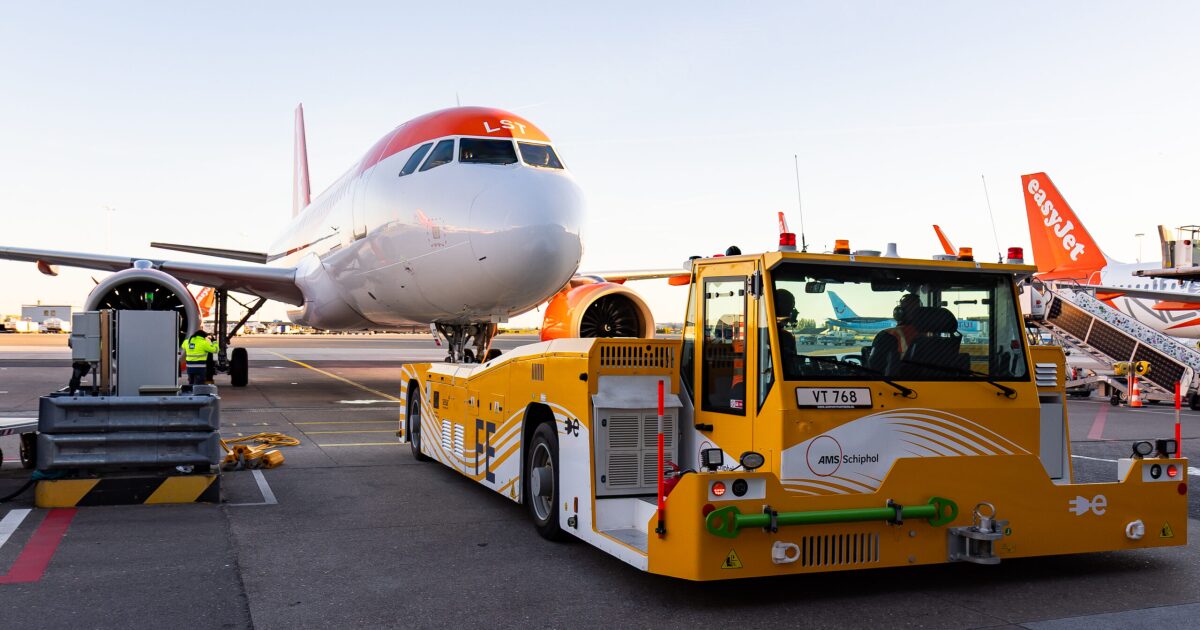
Amsterdam Schiphol Airport is rolling out a pilot program for TaxiBot, a semi-robotic ground tug designed to let pilots move aircraft around the airport without using the planes’ main engines. According to the supplied source text, the goal is to cut both costs and emissions by replacing conventional engine-on taxiing with an “engines-off” process for part of the journey between gate and runway.
This is a practical innovation rather than a futuristic one. It does not change the aircraft in the air. It changes what happens on the ground, where large commercial jets often burn a surprising amount of fuel simply to get into position for departure.
The inefficiency TaxiBot is trying to solve
Under standard procedures, an aircraft is pushed back from the gate by a tug while its auxiliary power unit provides onboard electrical power and compressed air. The pilot then starts the main engines, brings them to stable idle, and taxis under the aircraft’s own power to the runway threshold. That system is familiar and operationally mature, but it is also inefficient.
As the source text explains, using large jet engines to move an aircraft slowly across the tarmac requires far more power than the task itself demands. The result is unnecessary fuel burn and significant emissions during a phase of flight that is not actually flight at all. At a major hub such as Schiphol, that inefficiency accumulates quickly.
The airport group says roughly 68.8 million passengers pass through Schiphol each year. Even modest savings per aircraft movement could therefore add up at meaningful scale if the concept proves operationally reliable.

How TaxiBot works
TaxiBot is built by Smart Airport Systems in cooperation with TLD and Israel Aerospace Industries. The system is described as semi-robotic and pilot-controlled. That distinction matters because it tries to integrate into existing cockpit responsibility rather than fully outsourcing movement decisions to a separate operator. The tug connects to the nose gear, and the pilots steer the aircraft while the vehicle supplies the motive power needed for taxiing.
The source text notes that TaxiBot still carries a human crew, but only for safety. In other words, the concept aims to preserve normal pilot control while reducing reliance on the aircraft’s engines until takeoff is closer at hand.
Why this may be more deployable than past ideas
Attempts to decarbonize or optimize aircraft ground movement are not new. The source text points out that some earlier approaches depended on expensive and specialized airport systems that effectively pulled airliners around like trams. Those ideas often struggled because the infrastructure burden undermined the economic case.
TaxiBot appears more practical because it works as a mobile vehicle that can fit into existing airport operations more easily. That does not mean adoption will be frictionless. Airports need dependable turnaround timing, compatibility with different aircraft types, and procedures that do not create bottlenecks. But the appeal is obvious: avoid burning jet fuel for low-speed ground movement when a dedicated tug can do the job more efficiently.

The environmental and operational stakes
The supplied excerpt says the system could slash aircraft ground emissions by 80%. Even without independent validation details in the available text, the basic direction of the claim is plausible because main engines are far larger and less efficient for taxi work than a specialized tug. The environmental benefit is not only carbon-related. Lower engine use on the ground can also mean less local pollution and less noise in and around airport operations.
The operational payoff may be just as important. Airlines remain intensely sensitive to fuel costs, and airports face pressure to reduce emissions without compromising throughput. TaxiBot sits at that intersection: it is a ground-operations tool with potential climate and cost benefits, rather than a long-horizon aircraft redesign that depends on decades of airframe change.
A test worth watching
The Schiphol pilot is a useful example of how transport decarbonization often advances: not only through revolutionary vehicles, but through targeted changes to inefficient routines. Taxiing is easy to overlook because it feels peripheral to flying, yet it is repeated constantly across major airports and therefore represents a genuine opportunity for improvement.
If TaxiBot performs well under real scheduling pressure, it could strengthen the case for wider adoption at other large hubs. If it introduces delays or handling complications, the promise will remain limited. Either way, Schiphol’s pilot is addressing a real operational problem with a solution close enough to today’s workflows to matter now, not just in theory.
This article is based on reporting by New Atlas. Read the original article.

Originally published on newatlas.com