A crowded market gets a serious new entrant
The electric enduro market is moving quickly, and Radian’s newly launched EXR shows why competition in the segment is starting to look more credible and technically ambitious. The Dutch company’s first production motorcycle arrives with headline numbers that place it directly into the conversation around high-performance electric off-road machines, but its more important claim may be about usability rather than raw output.
According to the published specifications, the EXR delivers about 70 horsepower and roughly 1,060 Nm of torque at the rear wheel through an Internal Permanent Magnet motor with a carbon-sleeved rotor. Those are eye-catching numbers on their own, especially for a company making its first bike. But the product’s real differentiator may be its battery architecture: a dual-battery system that Radian says can be swapped in under 30 seconds without tools.
Why battery swaps matter in off-road riding
Electric motorcycles often win attention on performance, instant torque and low maintenance, yet they still face a practical challenge that gasoline bikes solved long ago: when energy runs low, riders want to get moving again quickly. Charging works for many use cases, but enduro riding is not always one of them. Off-road riders can be far from infrastructure, riding in bursts, climbing hard terrain and pushing machines in ways that compress usable range.
That is why Radian’s InfiniPack system matters. A sub-30-second tool-free swap changes the operating model of the motorcycle. Instead of waiting for a recharge, riders can treat energy more like a consumable module, replacing it quickly between sessions or during longer rides. If the system works as claimed in field conditions, it addresses one of the biggest barriers to electric adoption in demanding off-road environments.
The EXR’s 8.6 kWh battery capacity is listed with an off-road range of roughly 60 to 115 kilometers. Real-world range in enduro use will always depend heavily on terrain, riding style and conditions, but the inclusion of quick swapping changes the equation. The question becomes less about whether a single pack can cover every ride and more about whether the platform supports fast, repeatable turnaround.
Performance plus adjustability
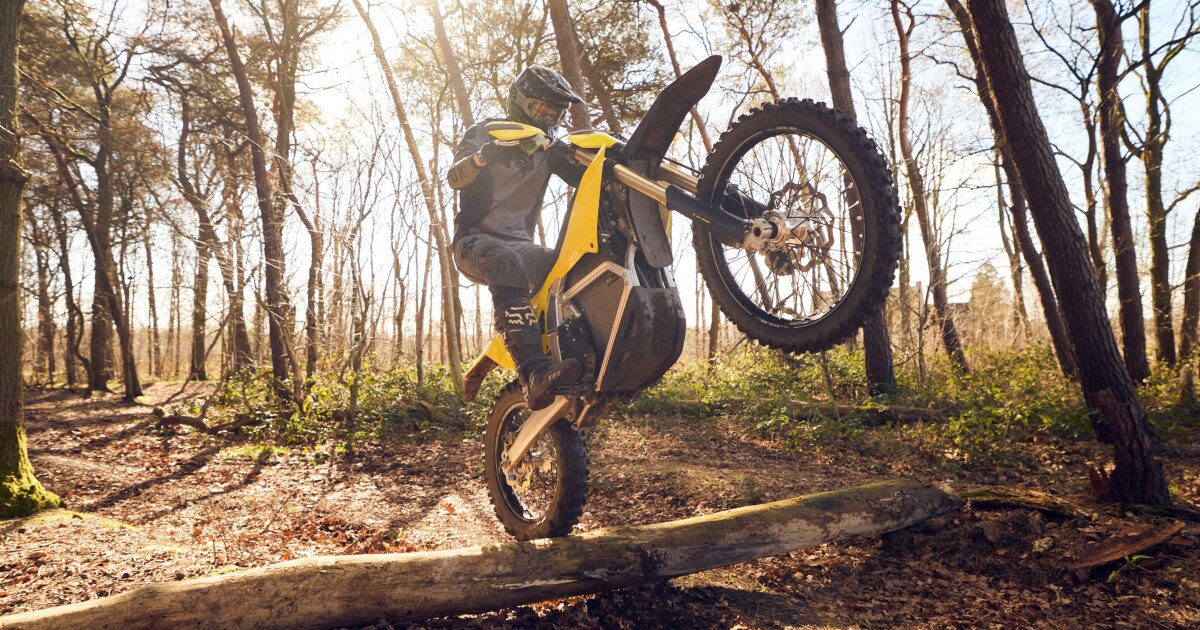
Radian says the EXR was designed around control as much as power. That framing is important because enduro riders care about how torque is delivered, how a bike behaves on different surfaces and how easily it can be tuned for skill level or terrain. The company says nearly all of the bike’s riding characteristics can be adjusted, allowing it to be configured for varying conditions and preferences.
That level of adjustability fits a broader trend in electric motorcycles. Software-defined behavior is becoming as important as hardware specs. Riders increasingly expect the ability to shape throttle response, traction characteristics and power delivery in ways that internal-combustion bikes do less elegantly. The EXR also includes a reverse gear, another feature that is becoming more common in e-motos and is especially useful when maneuvering on difficult ground.
The bike’s small display is described as glove-friendly, and its headlight doubles as a charging indicator, details that show attention to practical use rather than spec-sheet theater alone. These are not the features that sell a motorcycle in a headline, but they matter in a category where riders notice every ergonomic compromise.
The Stark Varg effect
No electric enduro launch in 2026 exists in a vacuum, and the EXR is inevitably being measured against Stark Future’s Varg platform. Stark helped define what a mass-produced high-performance electric enduro could look like, and competitors are now responding not by imitating the concept loosely, but by trying to leapfrog it on particular features. In Radian’s case, battery swapping is the clearest attempt to do exactly that.
The source material explicitly positions the EXR as a challenger to the Stark Varg, and that framing makes sense. The market is maturing from novelty to rivalry. Once one company establishes a benchmark for performance, others start competing on use-case friction, ownership convenience and ride adaptability. That is a healthier competitive pattern than a field dominated by concept bikes or underpowered alternatives.
Built from racing roots
Radian’s background gives the launch added credibility. The company’s origins trace back to 2017 with Electric Superbike Twente, and the team won the 2018 MotoE championship in its first season before Radian was established as a standalone motorcycle company in 2021. That lineage does not guarantee commercial success, but it does suggest the engineering culture behind the EXR is grounded in performance development rather than marketing alone.
Racing programs often teach lessons about thermal management, control systems, packaging and rapid iteration that transfer well into premium electric motorcycles. For a first production model, those lessons can make the difference between an impressive prototype and a machine riders trust repeatedly under stress.
What the launch says about the market
Priced at €14,450 in Europe, the EXR enters a category that is still premium, performance-oriented and not yet mainstream. But that is exactly where innovation usually consolidates first. If electric enduro bikes are to move beyond early adopters, they will need to prove not only that they are fast, but that they reduce operational compromises. The EXR is an example of how manufacturers are starting to attack that problem directly.
Its launch suggests the next phase of the segment will be defined less by proving that electric dirt bikes can be exciting and more by showing they can be practical under demanding use. Fast swaps, highly adjustable ride behavior and race-informed engineering all point in that direction. Whether the EXR becomes a category leader remains to be seen, but it clearly signals that electric off-road competition is entering a more serious and technically differentiated stage.
This article is based on reporting by New Atlas. Read the original article.
Originally published on newatlas.com