
Seawater is abundant, but the chemistry is the challenge
Researchers at the US Department of Energy’s Pacific Northwest National Laboratory are advancing a set of processes aimed at turning seawater into a more practical source of critical materials. The work centers on a simple but consequential fact: the oceans contain enormous quantities of useful elements, including magnesium, lithium, nickel, platinum-group metals and rare-earth metals, but they are highly diluted and difficult to recover economically.
The new effort is notable because it does not rely on a single extraction method. Instead, the laboratory is developing three related approaches that treat seawater not just as a mineral source, but also as a chemical feedstock for other mining processes. That broader framing matters. Rather than claiming an immediate replacement for conventional mining, the project suggests seawater could support future supply chains in several ways, from direct recovery to processing assistance.
According to the source material, scientists involved in the work say that as little as 0.1% of the world’s seawater contains enough critical elements to meet humanity’s energy needs for 50,000 years. That figure is best understood as a statement about scale, not present-day recoverability. The practical question is whether extraction can be done with enough efficiency, selectivity and cost control to matter at industrial levels.
Three routes to the same goal
The first route focuses on directly extracting magnesium compounds from seawater. PNNL says it can pull magnesium hydroxide from seawater while bypassing several of the more complex steps used in conventional production. Magnesium is strategically important for lightweight alloys, industrial chemistry and other manufacturing uses, so any simplification in the production chain could be meaningful if it lowers cost or energy demand.
The second route uses a byproduct stream that is already growing worldwide: desalination brine. Instead of treating that concentrated residue as waste, the process converts it into acids and bases. Those chemicals can then be used as leaching agents to help extract metals from land-based ores. In other words, seawater is not only a source of minerals itself, but also a way to produce reagents that may improve conventional mining workflows.
The third route involves seaweed, which can accumulate certain minerals from seawater that would otherwise remain too dispersed to pursue directly. This biological pathway is especially interesting because it suggests a low-concentration harvesting strategy in cases where electrochemical or purely chemical separation may be inefficient.
Taken together, the three approaches reflect a systems-level strategy. One process targets direct recovery, another upgrades waste streams into useful chemicals, and a third uses biology as a selective collector. That mix could prove more resilient than betting on a single breakthrough.

Why this matters for energy and supply chains
Critical minerals have become a central issue for the energy transition because they sit inside batteries, magnets, electronics, catalysts and advanced industrial systems. The source text ties the research to long-term energy needs, which is logical given the role of these materials in electrification and clean-energy infrastructure. If future mineral demand continues to rise, countries and companies will be under pressure to secure more diverse sources of supply.
Seawater is attractive precisely because it is not geologically scarce in the way many terrestrial deposits are. The oceans are vast, globally distributed and already intertwined with industrial infrastructure through ports, coastal power systems and desalination plants. That creates the possibility of co-locating extraction with existing assets, especially where brine streams are already available.
The research also hints at a more circular industrial model. Desalination creates concentrated brines that can be difficult to manage environmentally. If those brines can be converted into useful acids and bases, or otherwise integrated into resource recovery, part of the waste-management problem becomes an input stream for mineral processing. That does not eliminate environmental concerns, but it could improve the material efficiency of water and mining systems that are often treated separately.
Not a new idea, but a renewed one
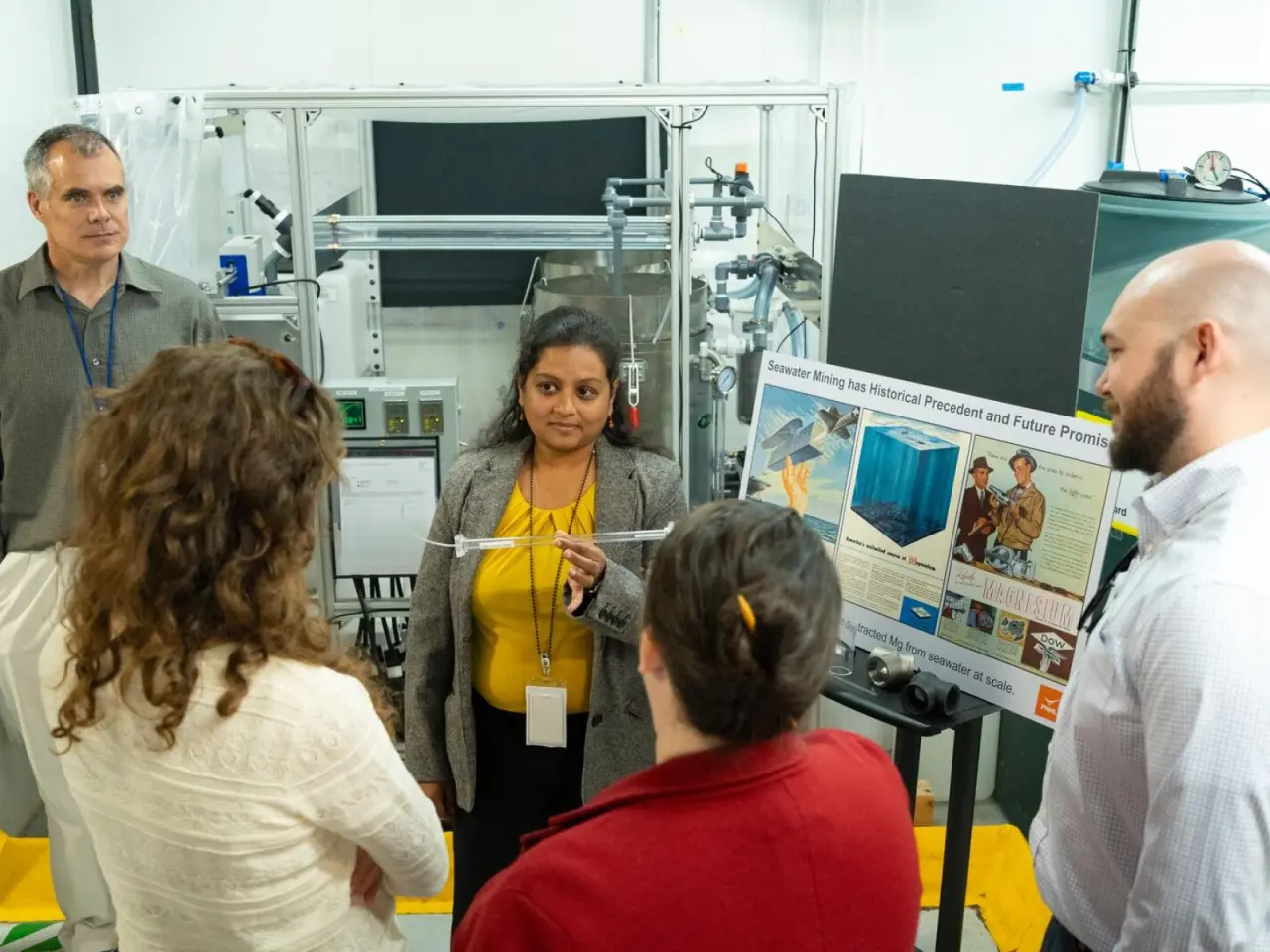
The idea of recovering minerals from seawater is not entirely new. The source text notes that the United States mined magnesium from seawater for 50 years before turning to imports in the 1990s. That historical detail is important because it shows seawater extraction has precedent; the difficulty has been competitiveness, not basic feasibility.

What appears to be changing now is the strategic context. Governments are more focused on mineral security, battery supply chains and industrial resilience than they were when import dependence seemed acceptable. New electrochemical tools, membrane systems and materials-processing methods may also make some forms of extraction more practical than they were in earlier decades.
Even so, no one should confuse laboratory recovery with a solved supply problem. The source text shows that PNNL has recovered several target materials using seawater or chemicals generated from it, but it does not establish full commercial viability. Scaling these methods will require proof on throughput, energy consumption, durability, separation efficiency and cost relative to land-based mining and recycling.

The bigger industrial test
The strongest case for this work may be that it expands the menu of options rather than promising a single revolution. Direct magnesium recovery could serve one market. Brine-derived acids and bases could support another. Seaweed-based accumulation could prove useful for specific trace materials. The commercial future will likely depend on where each process fits best, not on whether seawater instantly becomes a universal ore body.
That said, the strategic appeal is obvious. If seawater can supply even a modest portion of future critical-mineral demand, it could help reduce pressure on vulnerable supply chains and lower exposure to geopolitical bottlenecks. For energy systems that depend on large volumes of specialized materials, optionality itself has value.
PNNL’s work therefore deserves attention less as a splashy promise than as a practical research program aimed at resource diversification. The oceans already hold the elements. The real race is to develop extraction methods that are selective, scalable and economically credible enough to move from scientific possibility to industrial relevance.
This article is based on reporting by New Atlas. Read the original article.
Originally published on newatlas.com