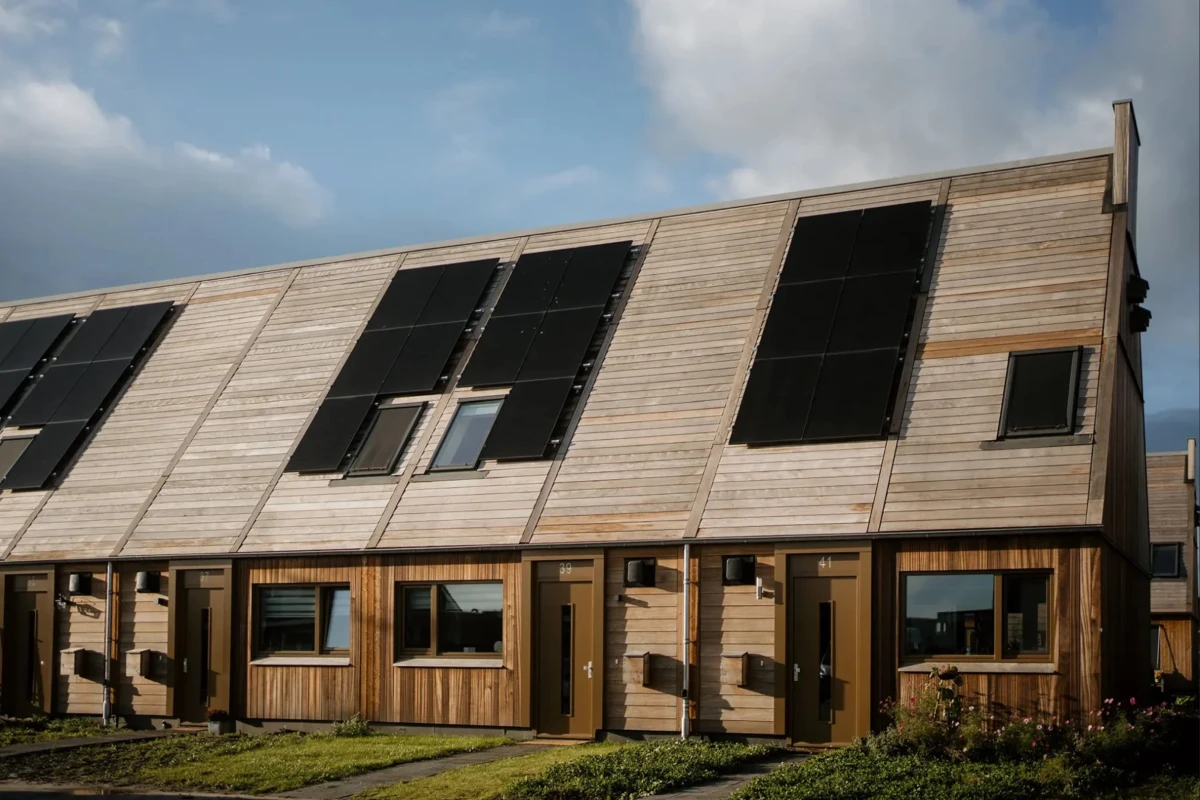
A small housing project with a big materials argument
A 12-home development in Marknesse, the Netherlands, is being presented as a prototype for carbon-negative affordable housing. Designed by Dutch architecture firm ORGA and commissioned by housing association Mercatus, the project uses prefabricated timber and a high percentage of bio-based, circular materials in an attempt to do more than merely reduce emissions. The firm says the neighborhood stores more carbon than it generates.
That is a significant claim in a sector under mounting pressure to cut embodied carbon. Construction is difficult to decarbonize because the climate cost of a building is often baked in long before residents move in, through materials such as concrete, steel, and fired brick. The Marknesse project targets that problem directly by substituting natural and renewable materials wherever possible.
Reworking a local architectural language
The homes reinterpret the region’s traditional “Delft Red” look, historically associated with red clay brick and orange-red roof tiles. ORGA’s redesign keeps the recognizable visual identity while replacing high-carbon materials with alternatives intended to be lower impact. That matters because climate-friendly housing often struggles when it appears to reject local aesthetics or ask communities to accept visibly experimental forms.
Here, the pitch is different: preserve the familiar silhouette and neighborhood character, but change what the buildings are made from. The result is positioned less as eco-exceptionalism and more as a practical update to a local vernacular.

The material strategy
According to the supplied source text, the project achieves a 76% share of bio-based and circular raw materials. Nearly everything in the homes is made from renewable materials except the concrete foundation and certain necessary components such as windows and fasteners. The core construction method uses prefabricated timber produced off-site and assembled on-site, a choice intended to reduce construction time and limit local environmental disruption.
The houses also use breathable wall systems with a self-regulating indoor climate. That feature points to a broader design logic in low-carbon construction: material choices can be asked to do more than reduce emissions. They can also improve thermal behavior, comfort, moisture control, and construction speed when designed as an integrated system rather than a checklist of substitutions.
Affordable housing, not just a showcase
The project is described as affordable rental housing for first-time buyers and low-income households. That is crucial. Many low-carbon building demonstrations remain isolated prestige projects, impressive in design terms but too expensive or idiosyncratic to scale. By attaching carbon goals to standard housing need, ORGA and Mercatus are making a stronger argument about replication.
There are also smaller ecological touches, including wooden chimneys that can serve as nesting sites for bats. While modest relative to the carbon claims, such additions suggest a wider design approach that treats housing as part of a local ecosystem rather than a sealed human-only object.
What this project does and does not prove
The development is still a prototype in the broader market sense. One successful neighborhood does not resolve the biggest constraints facing bio-based housing, including supply chains, regulation, insurance, financing, and labor familiarity. The continued use of concrete for foundations also shows how difficult full decarbonization remains, even in ambitious projects.
But the Marknesse homes matter because they move the conversation beyond energy-efficient operation and toward embodied carbon at the materials level. If a housing project can remain affordable, visually contextual, and faster to assemble while materially cutting its climate footprint, it becomes easier to imagine similar models spreading into mainstream procurement.
That is the deeper innovation here. The project is not simply a novel set of houses. It is a test of whether low-carbon materials can become ordinary enough to reshape the baseline for everyday residential construction.
This article is based on reporting by New Atlas. Read the original article.
Originally published on newatlas.com