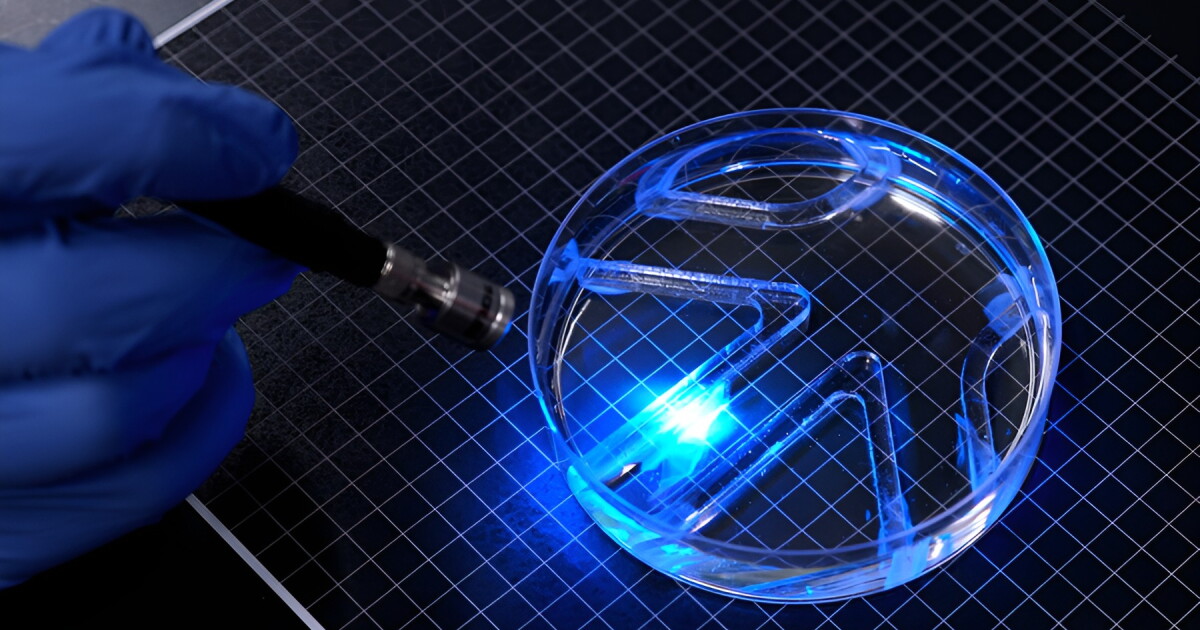
MIT researchers have built a soft swimming robot about the size of a stick of chewing gum that gets its propulsion from living muscle tissue and its steering from a beam of light. In a recently reported test, the device navigated a simple water-filled maze inside a large Petri dish while a researcher aimed a handheld light at its fins to guide it. There are no motors, no batteries and no onboard electronics — just engineered cells attached to a flexible gel, doing the work that actuators normally would.
How a sheet of muscle drives a swimmer
The robot's body pairs a flexible gel with a single layer of muscle cells. Those cells have been genetically modified so that they contract whenever light strikes them. The result is a fin that beats on command: direct a beam at one of the robot's two fins and it flexes; move the light to the other fin and the machine turns, combining forward motion with a change of heading. Because the trigger arrives from outside the dish, every steering decision is made by the person holding the lamp rather than by software running aboard the robot.
Scale matters here. Each fin measures 15 mm (0.59 in) long, 7 mm (0.28 in) wide and just 0.5 mm (0.02 in) thick — a sliver of tissue thin enough to flex repeatedly but sturdy enough to push against water's resistance. "It takes a lot of force to move through water versus air," said study author Ritu Raman, an associate professor of mechanical engineering at MIT. "The robot's quite strong, given its size."

From wrinkled gel to aligned fibers
Getting the muscle to pull effectively required a materials change. In the team's earlier design, the very soft fibrin gel that supported the cells tended to wrinkle as the muscle contracted against it, wasting the force the tissue generated. The researchers replaced that foundation with a stiffer gelatin-based gel and stamped square-bottomed grooves into its surface. Those grooves gave the cells a physical cue to follow, encouraging them to line up and fuse into fibers that could pull together rather than tugging in competing directions.
The payoff was a more organized layer of muscle that translated cellular contraction into cleaner motion. Rather than fighting a buckling substrate, the fibers could transmit force into the fin itself.
An exercise regimen for engineered tissue
Muscle improves with use, and the MIT team applied that principle to their robot. They stimulated the tissue with light for 15 minutes a day at a rate of two pulses per second, effectively putting the cells through a workout. Measured against an unstimulated control group, the trained tissue produced a fourfold increase in how far the fin could displace. The muscle also proved durable: it kept working without being anchored for more than 30 days, a meaningful span for a living material that must survive repeated contraction.
That combination — stronger output plus extended endurance — is what makes a biohybrid swimmer plausible at all. Living tissue is fragile, requires nutrients, and degrades if conditions shift, so any demonstration of month-long function without an anchor is as much a materials result as a robotics one.
Four body lengths a minute
Speed is not the selling point. At its fastest, the robot traveled roughly four body lengths per minute. It is tiny, slow and, as its creators acknowledge, nowhere near ready for the open ocean. In the demonstration, it moved and turned through a simple maze while a researcher guided it by hand, which showcases controllability more than autonomy — the robot still depends on someone outside the dish to decide where it goes.
What the platform does offer is a different design philosophy. Because light does the signaling and muscle does the moving, the machine can be built without the rigid components, wiring and power supplies that conventional underwater robots carry. A thin, gel-and-tissue body could, in principle, be simpler and cheaper to produce than a motorized equivalent — the direction the MIT team suggests its work points toward.
Biohybrid swimmers, then and now
Light-controlled, muscle-powered swimmers are not entirely new. Earlier biohybrid machines — devices that combine living tissue with engineered parts — have used cells both to generate movement and to change direction. In 2016, researchers demonstrated a robotic ray propelled by light-sensitive rat heart cells. In 2022, a fish-shaped robot built with human heart cells swam under its own power. The MIT device adds to that lineage, with a design oriented around external optical control and a muscle layer engineered for alignment and endurance.

Questions the demonstration leaves open
The maze run is a proof of control in a controlled environment, not a field trial. Several hurdles remain unaddressed. The robot needs an operator with a light source, so autonomy would require new sensing and decision-making, which the current design deliberately avoids by keeping everything offboard. Keeping living cells alive, fed and functional outside a lab dish is a separate problem from making them contract. And while the tissue kept working for over 30 days without being anchored, it is unclear how that performance would hold up in dirty, moving, temperature-variable water.
Scaling is another open question. A larger swimmer would need proportionally more muscle, more light, and more force to move through a denser medium, and the fin geometry that works at 15 mm may not translate upward. For now, the achievement is narrow and real: a gum-stick-sized machine that swims, turns and endures for a month, driven by cells that answer to light.
The takeaway
MIT's robot is less a prototype vehicle than a demonstration of what engineered tissue can do as an actuator. The combination of a stiffer grooved gel, aligned muscle fibers and a deliberate training routine produced a swimmer strong enough to beat its fins through water and steady enough to keep going for a month. Whether that translates into softer, cheaper swimming machines for real environments remains to be shown — but the blueprint is now on the table.
This article is based on reporting by New Atlas. Read the original article.
Originally published on newatlas.com