A cheaper interceptor for an expensive problem
Countering drones with fighter aircraft has become one of the more awkward cost mismatches in modern air defense. A medium or large drone can threaten troops, infrastructure, or other aircraft, but the missiles typically used to bring it down can cost far more than the target itself. BAE Systems is now pitching a lower-cost alternative built around an existing precision-guided rocket system, arguing that it could help fighters engage drones without burning through high-end air-to-air munitions.
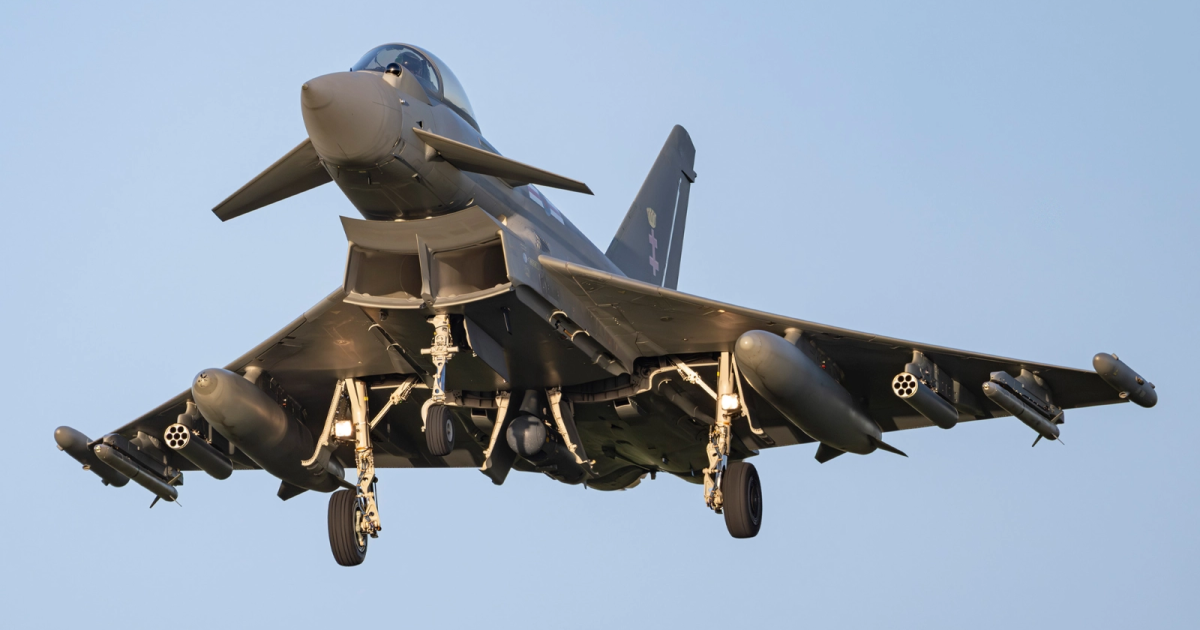
The company recently tested the Advanced Precision Kill Weapon System, or APKWS, from an RAF Typhoon at the flight test development center in Warton, Lancashire, according to New Atlas. The concept is straightforward: instead of using a missile such as an AIM-9X Sidewinder, which the report says can cost more than US$500,000 per shot, a Typhoon would fire a guided 70-mm rocket adapted for precision attacks. The goal is not to replace every air-to-air weapon on the aircraft, but to give operators a more economical option for a class of targets that is growing fast in number and importance.
Why the drone fight is changing air combat economics
Drones have moved from niche systems to central tools in recent conflicts, and that shift is forcing militaries to rethink how they defend airspace. The challenge is not only technical. It is also financial and industrial. Air forces need methods that can keep up with large numbers of targets while preserving scarce stocks of more advanced missiles for the threats that truly require them.
The article frames the answer as part of a layered defense model. In that approach, no single system handles every incoming threat. Instead, different layers deal with different ranges, speeds, and sizes of targets. If drones survive one layer, another can engage them. Fighters were not designed primarily as cheap drone hunters, but they can still become useful pieces of that layered architecture if their weapons are adapted to the mission.
That matters because stockpile pressures are now a major strategic issue. Countries are trying to expand munition inventories quickly, and every expensive missile fired at a relatively low-cost drone adds strain to procurement budgets and supply chains. A fighter carrying a more affordable precision weapon could, in theory, help close part of that gap.

How APKWS changes a standard rocket
BAE Systems’ answer relies on converting a 70-mm unguided rocket into a precision-guided missile. The conversion uses what the company calls Distributed Aperture Semi-Active Laser Seeker technology, or DASALS. Instead of placing a seeker in the nose, the system puts four optical sensors on the leading edges of four deployable wings.
That design choice is central to the system’s cost case. By moving the sensors to the wings, the rocket does not need a traditional nose-mounted seeker, which simplifies the conversion. The article says this allows the rocket to keep its original standard warhead and fuse while gaining guided capability. In practice, that means operators can turn an existing, simpler munition into something more precise without redesigning the entire round.
According to the report, the result delivers accuracy of 80% within a 2-meter laser target spot. The article presents that as a key reason the weapon is being promoted for anti-drone use. If a fighter or another platform can maintain the necessary laser designation, the guided rocket could become a practical way to prosecute relatively small or moderately sized airborne targets at lower cost.
What the Typhoon test suggests
The recent test is important because it moves the concept from paper to aircraft integration. The Typhoon is a 4.5-generation fighter built for high-performance air combat, and using it as a launch platform for APKWS shows how militaries are trying to repurpose existing aircraft for new battlefield demands. Rather than waiting for an entirely new anti-drone weapon or aircraft, companies and air forces are looking for ways to adapt systems already in service.
That is a recurring theme in defense technology right now. Speed matters. Threats evolve faster than clean-sheet procurement cycles, so many of the most interesting developments involve modifying legacy or current platforms for new missions. The APKWS approach fits that pattern well: use a known aircraft, pair it with a lower-cost guided munition, and create another layer in the anti-drone toolkit.
The article does not claim that APKWS is a universal answer. In fact, it emphasizes the opposite. There is no single panacea for drone attacks, especially as drones diversify in size, sophistication, and tactics. Some threats will still demand higher-end missiles or ground-based defenses. But if fighters can take on certain drone targets with cheaper guided rockets, that could help stretch inventories and reduce the penalty of deploying advanced aircraft against relatively simple systems.

The broader significance
The most meaningful part of this development may be what it says about military priorities rather than the rocket alone. Air combat is increasingly being shaped by asymmetric economics. One side can launch drones in quantity; the other side cannot rely indefinitely on expensive interceptors for every engagement. Any credible response has to address both lethality and affordability.
BAE’s test points toward a pragmatic version of that response. It does not require inventing a wholly new category of weapon. Instead, it upgrades an unguided rocket with a seeker arrangement designed to hold down complexity and preserve the original warhead and fuse. If that formula works reliably in service, it offers a way to add precision without paying the full price of a conventional air-to-air missile every time.
There is also a strategic logic in tying low-cost guidance to established platforms. Fighters such as the Typhoon already offer speed, altitude, sensors, and reach. In a layered air defense network, those characteristics can be valuable even against less sophisticated targets, provided the munition economics make sense. APKWS is being positioned as a tool that could make that equation more sustainable.
What to watch next
- Whether further testing shows consistent anti-drone performance from Typhoon launches.
- How military customers weigh APKWS against traditional air-to-air missile use for drone defense.
- Whether similar low-cost guided rocket concepts spread to other combat aircraft and layered defense systems.
For now, the test highlights a simple but increasingly urgent defense reality: in the drone era, the side that solves the cost-per-kill problem may gain as much advantage as the side with the fastest jet or the longest-range missile.
This article is based on reporting by New Atlas. Read the original article.
Originally published on newatlas.com