A large eVTOL clears an important coordination test
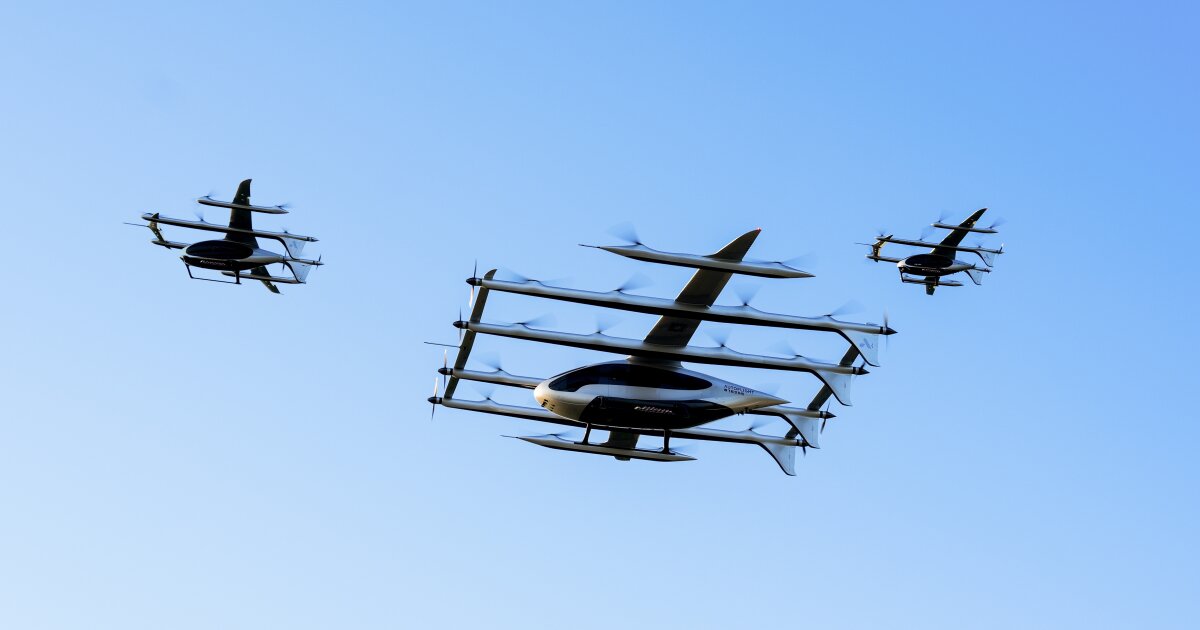
AutoFlight says it has completed a heterogeneous three-aircraft formation flight involving its V5000 Matrix and two V2000-series aircraft, a test meant to validate communications, route planning, flight coordination, and safety control across different VTOL platforms. For an industry often judged by renderings and future promises, the milestone matters because it shifts attention from aircraft size alone to coordinated system behavior.
The V5000 Matrix already stands out on sheer scale. According to the company details cited in the source text, the aircraft spans 20 meters, stretches 17.1 meters in length, and has a maximum takeoff weight of 5,700 kilograms. By those dimensions, it is larger than most of the passenger-focused eVTOL designs that have dominated the category. While many competitors are optimized for two to four passengers in urban shuttle missions, AutoFlight is aiming at a heavier platform with different mission potential.
The formation flight suggests the company is trying to prove not only that a big electric VTOL can fly, but that it can operate as part of a coordinated fleet environment. That is a different and more demanding proposition than a single-aircraft demo. Communication links, deconfliction, route synchronization, and safety logic all become more important once several aircraft share a mission profile.
Why this test matters beyond the headline
eVTOL development has often centered on certification timelines, battery limits, and passenger use cases. AutoFlight’s latest demonstration adds another dimension: interoperability across aircraft classes. In the reported mission, a 5-ton platform flew in coordination with two smaller 2-ton vehicles, which implies an interest in multi-vehicle operations rather than isolated point-to-point transport.
That could matter for both logistics and commercial services. A mixed fleet can be more flexible than a single model line, allowing operators to match aircraft to route length, payload, or passenger profile. The company’s stated validation goals, especially cross-platform communication and safety control, align with that more networked operational picture.
It also helps distinguish the V5000 from the wave of urban air taxi concepts built around short-range city hops. The Matrix appears intended for more than rooftop commuting. The source material describes an all-electric passenger version seating up to 10 people in a premium configuration, with an electric range of 250 kilometers. That points toward regional mobility ambitions, not just urban shuttle service.

Scale is an advantage and a complication
Being the largest publicly known, full-scale crewed eVTOL in development by footprint is a useful branding position, but it is also a technical burden. Bigger aircraft promise more capacity and broader use cases, yet they intensify demands on propulsion, structural design, systems integration, and certification. Every gain in cabin space or payload tends to multiply engineering complexity.
That is why system-level tests like this formation flight are valuable. They do not solve the hard certification problem, but they show the company is thinking beyond static specifications. A large aircraft that can coordinate reliably with other vehicles begins to look less like a one-off demonstrator and more like a building block in a broader aviation network.
The timing also matters. AutoFlight said it recently kicked off the airworthiness certification process for the Matrix, and earlier this year the passenger version reportedly completed a full transition flight from vertical takeoff to fixed-wing cruise in China. Put together, those milestones sketch a development path that is advancing on several fronts at once: vehicle performance, operational behavior, and regulatory progression.
The eVTOL market may be diversifying
The broader eVTOL sector has often been discussed as if one template will define the category. In reality, it is fragmenting into multiple possible markets: urban passenger transport, regional mobility, cargo, emergency services, and specialized logistics. The V5000 fits that diversification trend. Its size and configuration suggest a bet that the sector’s future will not be limited to compact air taxis.
If that bet is right, operators may end up valuing range, cabin flexibility, and fleet coordination as much as pure urban convenience. A larger aircraft capable of forming part of a mixed-vehicle network could be attractive in settings where infrastructure is limited and mission requirements vary. The formation flight is therefore significant not only as a technical exercise, but as evidence of the operating concept AutoFlight is trying to validate.
At the same time, the industry remains difficult terrain. Large claims are common, while certification and commercialization remain slow. Competitors at smaller scales are already grappling with the realities of financing, regulation, and production. A bigger aircraft has to clear the same gates while carrying greater complexity.
A milestone, not a conclusion
AutoFlight’s three-aircraft formation test does not settle the question of which eVTOL models will eventually win market share. But it does demonstrate a level of maturity that deserves attention. The company is no longer talking only about an unusually large aircraft. It is showing how that aircraft might behave alongside other platforms in a coordinated environment.
That is a meaningful step because aviation systems are judged by how they operate in context, not just by how they fly alone. If the V5000 Matrix is to matter commercially, it will need to fit into real networks, real routes, and real fleet operations. This test begins to address that problem.
For now, the clearest takeaway is that the eVTOL field is widening. Alongside the crowded race to build small urban air taxis, companies like AutoFlight are pushing a different idea: larger electric aircraft, more varied missions, and operations designed around mixed fleets. The V5000’s latest flight suggests that concept is moving from concept art toward operational proof.
This article is based on reporting by New Atlas. Read the original article.
Originally published on newatlas.com