Audi makes an unexpected move into halo-car territory
Audi has unveiled the Nuvolari, a hybrid supercar that the company says will be the fastest and most powerful production vehicle in its history. The launch surprised automotive watchers because it arrived not as another concept, but as a production model: a limited run of 499 cars priced above half a million pounds, or about $670,000.
The basic proposition is clear. Audi is using a shared platform relationship within the Volkswagen Group to create a much more extreme flagship, borrowing core architecture from Lamborghini’s Temerario while giving the new car its own body, tuning, and aerodynamic character. The result is a car positioned closer to hypercar territory than to the company’s traditional performance lineup.
Shared bones, different ambitions
The Nuvolari uses the same mid-mounted 4.0-liter twin-turbo V8 and three electric motors found in the Temerario. But according to the source material, Audi has tuned the system for slightly higher output, taking total power to 1,001 bhp at 10,000 rpm. Claimed performance figures include 0 to 62 mph in 2.6 seconds, 0 to 125 mph in 6.8 seconds, and a top speed of 217 mph.
Those numbers do more than advertise straight-line pace. They place the Nuvolari at a different symbolic level for Audi. The company has long sold fast RS models and previously offered the R8, but this car is presented as a more expensive, more technically aggressive statement piece.
The battery is also larger than the Temerario’s, with a stated gross capacity of 7.3 kWh versus 3.8 kWh in the Lamborghini. That suggests Audi wanted the electrified side of the powertrain to be more than a compliance feature. Even in this part of the market, hybridization is increasingly being used to add both performance and technical distinction.
Design as brand repositioning
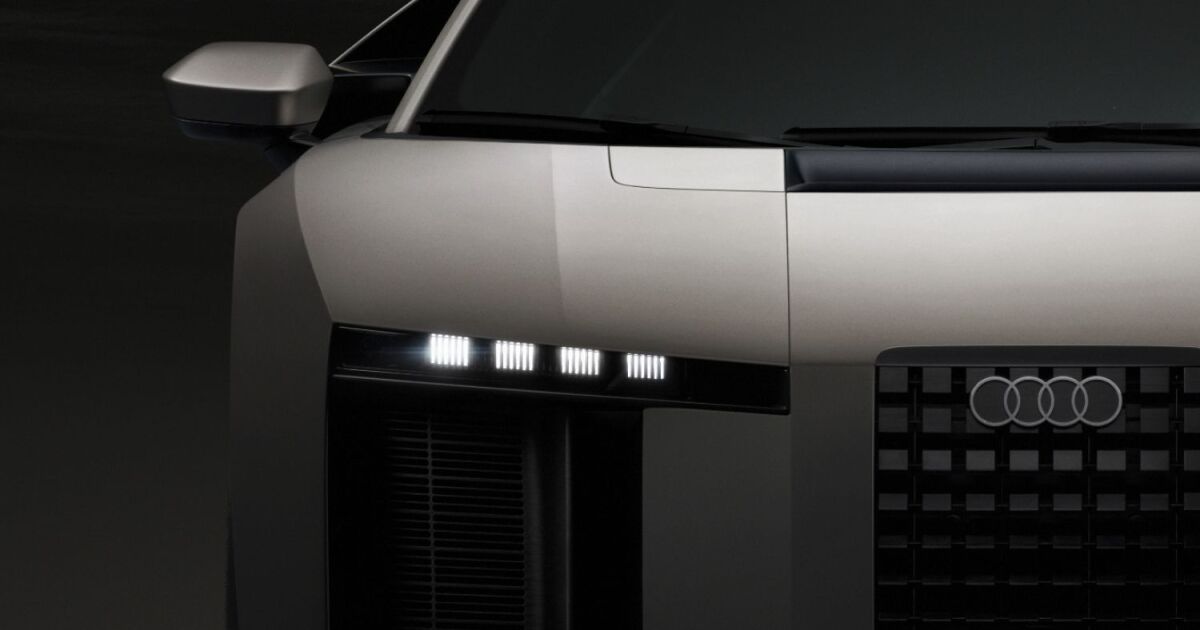
Visually, the Nuvolari is described as futuristic, carbon-bodied, and more dramatic than its Lamborghini sibling. New Atlas frames the styling as a deliberate surprise, and the car’s active aerodynamic elements reinforce that intent. Audi says the model uses precisely adjustable aero panels and a rear wing that react quickly to maintain stability.
That matters because halo cars do branding work beyond sales volume. A 499-unit production run cannot move the company financially in the way SUVs or mainstream EVs do. But it can reset perception. Audi appears to be using the Nuvolari to show that it can still launch a combustion-based, electrified performance flagship while the wider industry works through slower and less straightforward transitions to full battery-electric lineups.
Why a hybrid flagship, and why now?
The Nuvolari’s arrival also reflects a broader industry pattern. Rather than treating electrification as a binary switch from combustion to battery-electric vehicles, more manufacturers are using hybrid systems to deliver immediate gains in output, drivability, and emissions positioning. In ultra-high-performance cars, electric motors can sharpen torque delivery and deepen the engineering story at the same time.
For Audi specifically, the move may also be a way to preserve emotional appeal at the top of the range. EV programs have become central to most premium brands, but supercars still carry outsize cultural importance. A hybrid halo model lets Audi talk about future-facing technology without abandoning the drama associated with mid-engined exotics.
A rare car with a strategic job
The Nuvolari is not a mass-market turning point. It is an image-building machine, and the numbers around it make that explicit: a price in the upper six figures, a production cap of 499, and performance claims designed to place it among the most extreme road cars available under a mainstream luxury badge.
Still, it may prove influential inside Audi’s portfolio. High-end flagships often preview how a brand wants to balance software, electrification, lightweight materials, and active aerodynamics before those themes filter downward. Even when the exact hardware does not spread, the message does.
- Audi says the Nuvolari is its fastest and most powerful production car ever.
- The hybrid system produces a claimed 1,001 bhp and 217 mph top speed.
- The car shares core underpinnings with Lamborghini’s Temerario.
- Production is limited to 499 vehicles priced above half a million pounds.
In that sense, the Nuvolari is not just a fast car. It is Audi making a public argument about where performance prestige still comes from in a hybrid era: shared platforms, aggressive tuning, active aerodynamics, and enough scarcity to turn engineering into mythology.
This article is based on reporting by New Atlas. Read the original article.
Originally published on newatlas.com