One of AI infrastructure’s biggest inefficiencies is not computation, but heat
Data centers consumed an estimated 485 terawatt-hours of electricity in 2025, and roughly 30% of that went to cooling rather than computing, according to source material describing new work from researchers at the University of Illinois Urbana-Champaign. That overhead has become harder to ignore as AI systems push chip power densities upward and rack-scale deployments get hotter, denser, and more expensive to operate.
A new direct-to-chip cooling approach built around 3D-printed pure copper plates aims to attack that problem directly. The researchers say their technology could reduce cooling-related electricity consumption across a data center from around 30% to just 1.1%.
If that figure holds in practice, it would amount to one of the more consequential hardware efficiency gains emerging around AI infrastructure.
Why cooling is now a strategic bottleneck
Modern accelerators consume enormous amounts of power and, by the basic physics of electronics, dissipate nearly the same amount as heat. The source text points to a single NVIDIA GB200 chip operating at 1,200 watts. Multiply that across thousands or hundreds of thousands of devices and the thermal management challenge becomes central to the economics of the facility.
This is why cooling is no longer a background engineering detail. It affects data center design, energy procurement, siting, uptime, and the pace at which denser compute clusters can be deployed. As AI demand grows, cooling constraints increasingly shape what can be built at all.
That makes any technology promising order-of-magnitude gains worth serious attention, especially if it can be integrated into existing direct-to-chip cooling architectures rather than requiring an entirely new class of facility.

What the new system changes
The reported advance combines a mathematical design algorithm with additive manufacturing to produce pure copper cooling plates that outperform conventional cold plates. The most important detail is not just the material, but the internal geometry the method can create.
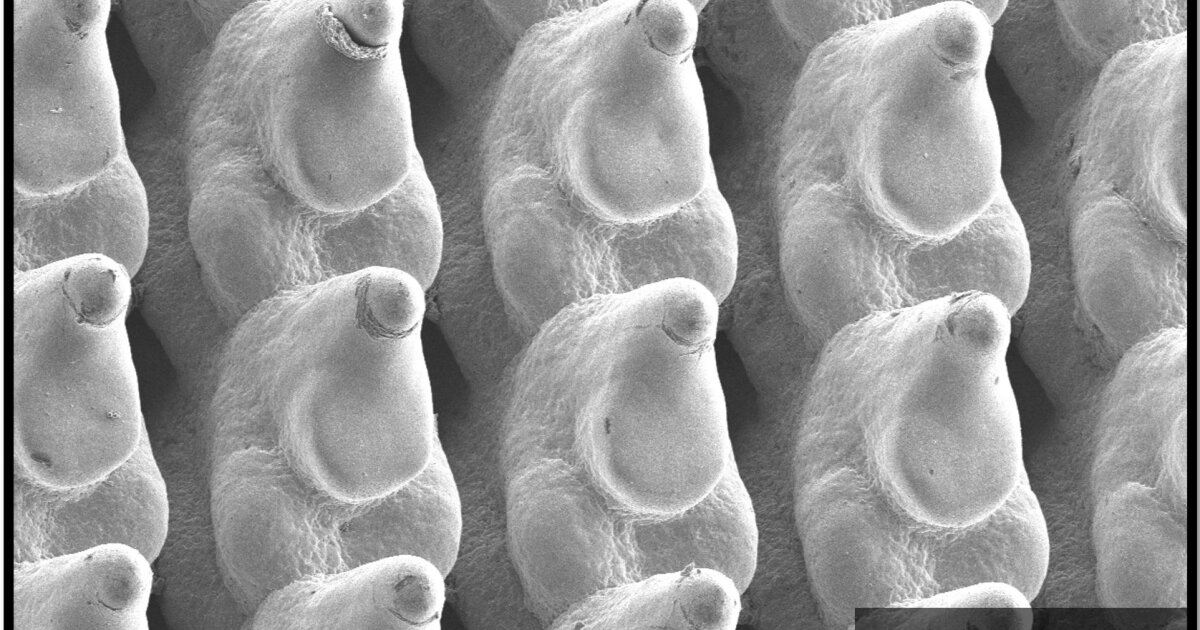
According to the source text, microscope imagery shows tiny fin structures on the plate surface. Those kinds of fine features can dramatically improve heat transfer by increasing effective surface area and controlling how coolant moves across the hottest zones.
Traditional manufacturing places limits on the shapes engineers can build inside a cooling component. By pairing computational design with 3D printing, the researchers are trying to close the gap between what thermal models say would work best and what fabrication techniques can actually produce.
The result is a cold plate architecture designed for the realities of high-power chips rather than adapted from older thermal management assumptions.
Why the claimed savings are so large
The headline figure comes from reducing the energy cost of removing heat, not from reducing the chips’ own power draw. In a typical large data center, cooling systems consume power through pumps, chillers, air handling, and other support infrastructure. If heat can be extracted far more efficiently at the chip level, less work is needed across the rest of the thermal stack.
Direct-to-chip liquid cooling is already attractive because it bypasses many of the inefficiencies of air cooling. Improving the cold plate itself makes that approach more potent. The researchers say the new plates could bring cooling’s electricity share down to about 1.1%, a dramatic improvement over current norms.
For operators, that would translate into lower operating costs, better power usage effectiveness, and potentially more headroom to deploy compute in energy-constrained environments.
Why this matters beyond the lab
AI infrastructure is increasingly colliding with energy policy, utility planning, and public scrutiny. Data center growth is stretching local grids, complicating decarbonization efforts, and prompting companies to seek new power strategies. Efficiency gains at the cooling layer therefore have broader significance than a typical component improvement.
If cooling can be made radically more efficient, operators may be able to extract more useful compute from the same power envelope. That could delay some capacity bottlenecks and make advanced facilities easier to site in regions where electricity supply or grid interconnection is constrained.
It could also reduce the non-compute energy penalty that has made AI’s expansion appear especially power hungry. A third of power devoted to thermal overhead is a tempting target. Cutting most of that away changes the conversation.
What remains uncertain
The source material frames the work as a scientific advance rather than a deployed commercial product. That means scale-up, durability, manufacturability, cost, and compatibility with production data center systems are still open questions.
Hardware breakthroughs often look strongest at the prototype or subsystem level before the complications of supply chains, maintenance, coolant chemistry, and long-duration reliability enter the picture. Additive manufacturing in pure copper is also a specialized capability, and widespread deployment would depend on whether the economics work at volume.
Even so, the direction is clear. Cooling has become a first-order computing problem, and geometry-aware, manufacturing-enabled thermal design is emerging as a credible way forward.
The bigger picture
The AI boom has pushed attention toward models, chips, and power contracts. But the physical systems that keep those chips alive may end up determining how much compute the industry can afford to run. Thermal management used to be treated as infrastructure plumbing. It is now part of the frontier.
This copper-plate approach is compelling because it addresses a hard limit with a pragmatic toolset: better design, better fabrication, and better heat transfer where it matters most. It does not promise to make compute free or erase data center energy demand. It promises something more valuable: a way to waste much less of that energy managing heat.
In the near term, that is exactly the kind of innovation hyperscalers, cloud operators, and AI infrastructure builders are looking for.
This article is based on reporting by New Atlas. Read the original article.
Originally published on newatlas.com