A controlled indoor environment is becoming a more powerful tool for autonomy research
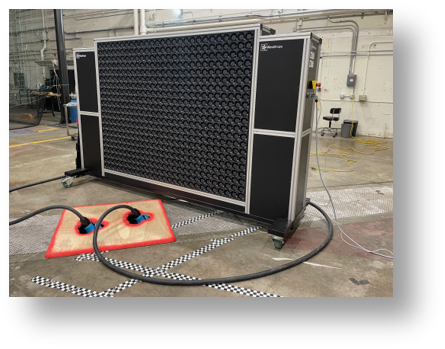
NASA is drawing attention to a set of indoor testing facilities at its Unmanned Autonomy Research Complex, or NUARC, built to support low-speed and hovering flight research under more realistic and repeatable conditions. At the center of the announcement is a large programmable WindShaper fan array that can generate steady winds, gusts, and wind gradients through a Python-based control system.
The significance of that capability is practical. One of the hardest parts of developing autonomous flight systems is not just achieving stable flight in ideal conditions, but proving performance when the air itself becomes messy, variable, and disruptive. Outdoor testing can provide realism, but it is difficult to reproduce exactly. Indoor facilities can provide control, but often at the cost of realism. NASA’s setup is aimed at narrowing that gap.
What NASA says the system can do
The WindShaper described by NASA is a 9-foot by 7-foot dynamic fan array made up of 1,134 fans arranged into 567 “wind pixels.” Each fan can be programmed through Python scripting, allowing researchers to build specific airflow conditions instead of relying on whatever the weather offers. NASA says the system can operate from 0 to 16 meters per second and can replicate steady winds, gusts, and gradients, the kinds of conditions that matter for hovering vehicles and low-speed autonomous platforms.
That level of configurability makes the facility useful for more than simple endurance testing. It supports scenario design. Researchers can introduce repeatable disturbances, compare vehicle behavior run to run, and evaluate how control software responds to environmental change. For autonomy work, that matters because reliability is often determined by edge cases rather than average performance.
Why a companion measurement system matters
NASA also highlighted a companion tool called the WindProbe, intended for quick surveys of the flows produced in the lab. The probe uses the facility’s OptiTrack motion capture system to extract the position and orientation of a five-hole cone probe at its tip. In plain terms, the setup helps researchers measure the airflow field more precisely across the test space rather than merely assuming the programmed wind pattern is the wind pattern the vehicle actually encounters.
That measurement side is easy to overlook, but it is essential. Flight research depends not only on generating conditions but on validating them. If developers are training or testing an autonomous system against a model of airflow that is incomplete or inaccurate, the value of the experiment drops. A well-instrumented indoor environment turns the lab into a more trustworthy proxy for the real world.
What this means for drone and autonomy development
The timing fits a broader shift in aerospace research. Uncrewed systems are moving into more complex missions, more varied environments, and more demanding safety expectations. Whether the end use is inspection, logistics, urban operations, defense support, or scientific measurement, one core problem remains constant: aircraft have to stay stable and responsive when conditions change suddenly.
A programmable wind facility does not replace outdoor flight testing, but it can improve the quality of development before teams reach that stage. It allows tuning, validation, and failure analysis in a setting where the environment can be precisely repeated. That is especially valuable for hovering craft and other platforms where small aerodynamic disturbances can have outsized control effects.
A quiet but useful piece of infrastructure
NASA’s announcement is not a mission launch or a major hardware debut. It is an infrastructure story, and those are often underestimated. But test infrastructure shapes what kinds of systems can be built, how quickly they can be refined, and how confidently engineers can characterize behavior under stress. In that sense, facilities like NUARC matter well beyond a single program.
They help shift autonomy research from demonstration toward disciplined engineering. The more precisely researchers can generate and measure difficult flight conditions, the better they can understand what an autonomous system actually knows, how it reacts, and where it fails. That is the kind of progress that rarely produces dramatic headlines on its own, but it is often what makes later breakthroughs possible.
- NASA highlighted indoor testing at the Unmanned Autonomy Research Complex.
- The WindShaper array can generate programmable winds, gusts, and gradients via Python.
- A companion WindProbe and motion-capture setup help validate airflow conditions for research.
This article is based on reporting by NASA. Read the original article.
Originally published on nasa.gov