GM Empower Event: Three Major Announcements
On June 9, 2026, General Motors held an exclusive event in San Francisco where it unveiled three transformative energy initiatives. The announcements included vehicle-to-grid (V2G) capability for existing customers without new hardware, a universal charging interface called Energy Pass, and a major push into sodium-ion grid-scale battery storage. This article focuses on the sodium-ion storage announcement, which marks a strategic shift in GM's energy business.
Sodium-Ion: The Right Chemistry for Grid Storage
With AI data centers and surging electricity demand putting new pressure on the grid, the conversation around batteries is shifting. For years, the focus was almost entirely on electric vehicles—higher energy density, faster charging, lighter weight. Those metrics still matter for cars. But when utilities, hyperscalers, and power providers talk about energy storage, their priorities look different. They need reliable, affordable power that can be delivered over long periods in real-world conditions, often with minimal maintenance.
That shift is exactly why GM is moving forward with next-generation sodium-ion battery cells purpose-built for grid-scale storage. The company announced the effort in partnership with Peak Energy, supported by an investment from GM Ventures. It's a deliberate bet on matching the right chemistry to the right application rather than forcing one solution across every use case.

How Sodium-Ion Works and Its Advantages
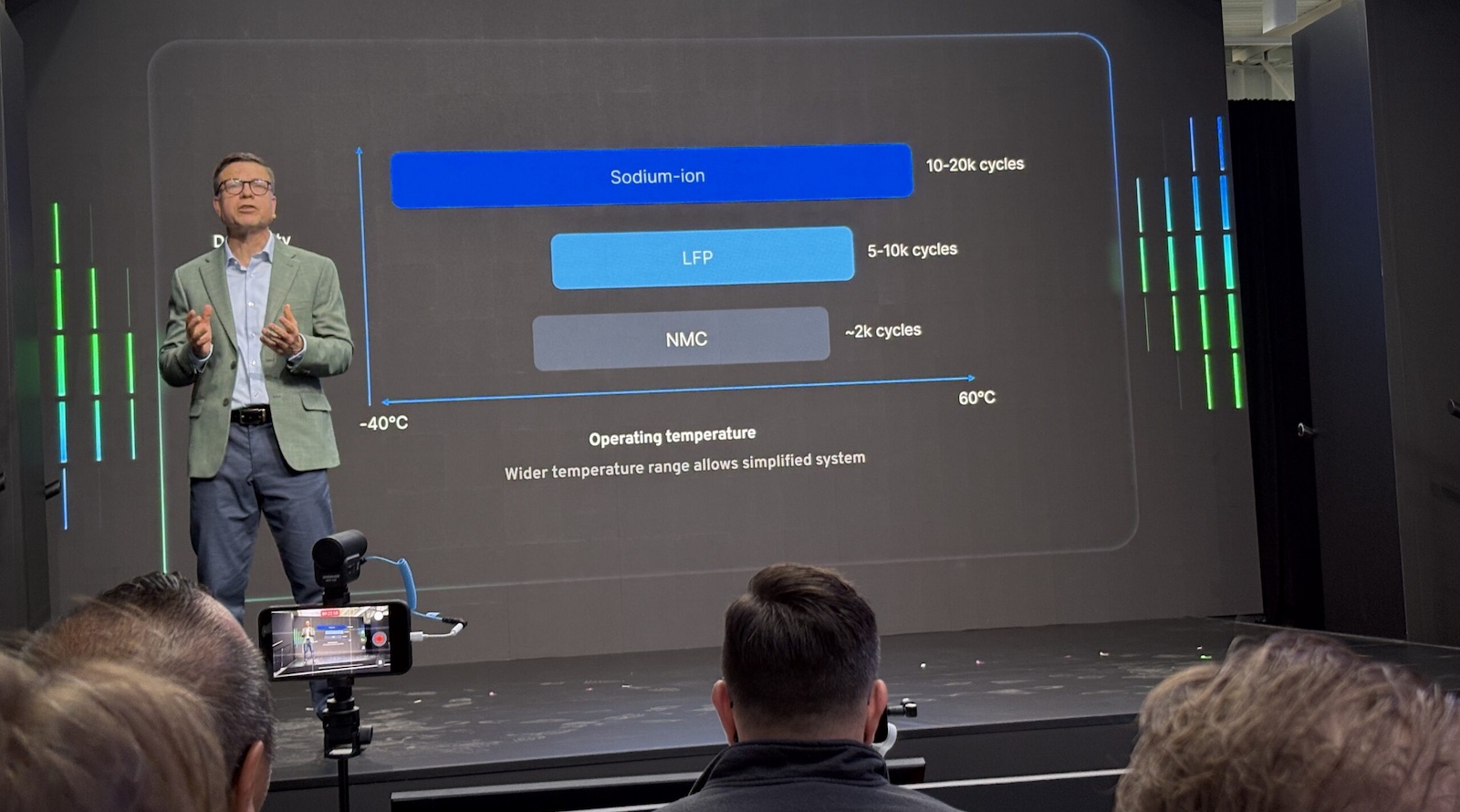
Sodium-ion chemistry works on the same basic principle as lithium-ion chemistry—ions move between electrodes during charge and discharge. Sodium and lithium sit in the same column on the periodic table, which gives them useful similarities. But the differences matter for stationary storage. Sodium-ion cells can handle a wider temperature range and deliver more cycles. That opens the door to systems that may not need active liquid cooling, which removes a lot of hardware, maintenance, noise, and parasitic energy losses. In large energy storage installations, those simplifications can add up to meaningfully lower total cost of ownership over 20-plus years.
Leveraging GM's Battery Expertise
GM's approach stands out because it builds directly on the battery expertise the company has developed for vehicles. The work is centered in Warren, Michigan, where GM has a centralized battery R&D operation. The same team advancing lithium-manganese-rich (LMR) chemistry for future EVs is now applying that know-how to sodium-ion for the grid. Prototyping of purpose-built sodium-ion cells for stationary use is scheduled to begin this year at the Wallace Battery Cell Innovation Center. Because sodium-ion cells share important architectural similarities with lithium-ion cells, GM can leverage existing manufacturing processes and supply chains, accelerating time to market.
Implications for the Grid and Energy Transition
This announcement comes at a critical time. The U.S. grid is under strain from rising electricity demand driven by data centers, electrification, and extreme weather. Grid-scale storage is essential for integrating renewable energy sources like solar and wind, which are intermittent. Sodium-ion batteries offer a cost-effective and durable solution for long-duration storage, helping to stabilize the grid and reduce reliance on fossil fuels. GM's entry into this space signals that automotive battery technology can be adapted for stationary applications, potentially lowering costs and accelerating deployment.
Partnership with Peak Energy
GM's partnership with Peak Energy, a company focused on energy storage solutions, combines GM's manufacturing scale and battery know-how with Peak Energy's expertise in grid-scale systems. The investment from GM Ventures provides additional resources to commercialize the technology. While specific financial terms were not disclosed, the collaboration aims to bring sodium-ion storage products to market within the next few years.
Looking Ahead
GM's sodium-ion initiative represents a significant step in diversifying energy storage technologies. By focusing on stationary storage, GM is addressing a growing market that demands reliability, longevity, and cost-effectiveness. The company's ability to repurpose its automotive battery R&D for grid applications demonstrates the versatility of its engineering capabilities. As prototyping begins later this year, the industry will be watching closely to see how quickly GM can scale up production and deploy these systems to support the nation's energy infrastructure.
This article is based on reporting by CleanTechnica. Read the original article.
Originally published on cleantechnica.com




