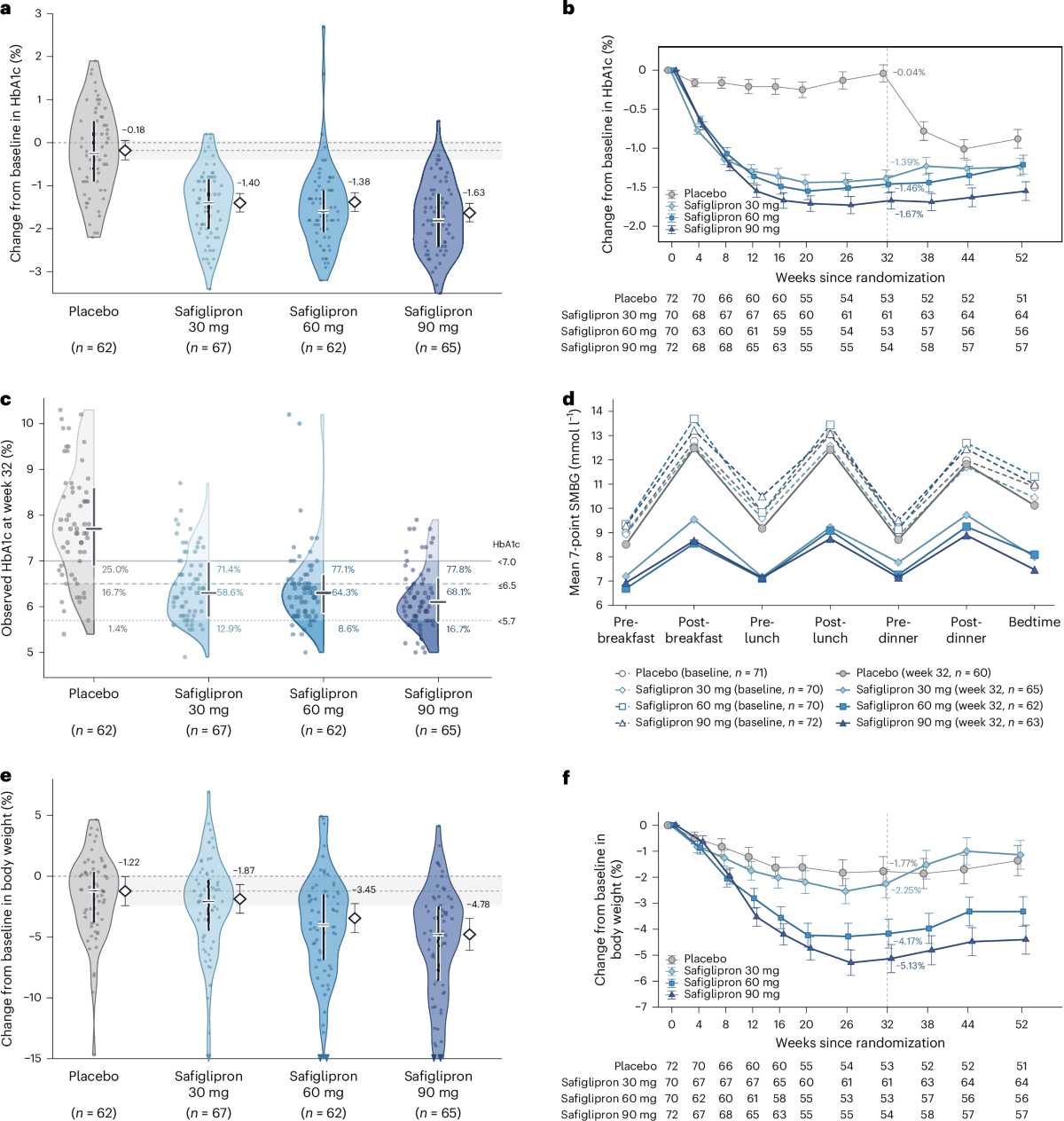
A once-daily oral pill for type 2 diabetes has matched an established tablet on blood-sugar control in a late-stage clinical trial, according to a paper published in Nature Medicine on 5 October 2026. The study reports that safiglipron, an oral small-molecule GLP-1 receptor agonist, was non-inferior to dapagliflozin for HbA1c reduction at all doses tested, and superior at one of the dose levels evaluated. The trial was randomized, double-blind and controlled against an active comparator rather than a placebo, a design choice that sets a considerably higher bar for the investigational drug.
Those headline findings come from the published summary, which is brief. Even in abbreviated form, however, the result points to a shift that has been anticipated for years: GLP-1 therapy moving from injection to a conventional oral tablet, and doing so in a head-to-head contest with one of the most widely prescribed oral diabetes medicines in the world.
What the trial set out to do
The study is described as a randomized, double-blind, active-comparator-controlled phase 3 trial in type 2 diabetes. Each of those labels carries weight. Randomization limits selection bias. Double blinding means neither participants nor investigators knew who received which treatment, which matters when subjective side effects such as nausea are common in this drug class. An active comparator means every participant received a genuine glucose-lowering medicine, so no one was assigned to an inert control.
Dapagliflozin was the comparator. It belongs to the SGLT2 inhibitor family, is taken once daily by mouth, and lowers HbA1c by prompting the kidneys to excrete more glucose in urine. Because it is well established, inexpensive in many markets and supported by outcome data in selected patient groups, it represents a demanding benchmark for any newcomer.

Two mechanisms, one endpoint
The GLP-1 route
GLP-1 receptor agonists imitate a gut hormone released after eating. They amplify glucose-dependent insulin release, slow the passage of food through the stomach and act on appetite centers in the brain, which is why the class is associated with weight loss as well as glycemic control. Historically these drugs have been peptides, and peptides are fragile: they are digested in the stomach, so they have been given by injection. Making them into pills has been a long-running chemistry problem.
The SGLT2 route
SGLT2 inhibitors take a completely different path. They block a transporter in the kidney that normally reclaims filtered glucose, so sugar leaves the body in urine. The effect does not depend on insulin secretion or on the pancreas at all, which is part of why the class complements other therapies. A drug that works through incretin signaling and a drug that works through renal glucose excretion are not simply substitutes; comparing them tells researchers about magnitude of effect, tolerability and practicality.
Why an oral small molecule matters
An oral GLP-1 agonist that is a small molecule, rather than a peptide, is notable for reasons that go well beyond convenience. Small molecules are generally simpler and cheaper to manufacture at scale than peptides, less dependent on complex supply chains and cold storage, and easier to distribute in regions where injectable biologics are hard to deliver. They also sidestep injection anxiety, which remains a real barrier to starting therapy for many patients.
Existing oral peptide versions of this class have come with administration rules: taken on an empty stomach, with a limited amount of water, followed by a waiting period before eating. A small molecule is not bound by the same absorption constraints, at least in principle. If safiglipron proves tolerable and durable, it could widen access to a drug class that has been defined as much by its logistics as by its biology.

The limits of the published summary
It is important to be precise about what the available record does and does not establish. The summary states non-inferiority on HbA1c at every dose tested and superiority at one dose level. It does not, in the material reviewed here, disclose the number of participants enrolled, the duration of treatment, the size of the HbA1c differences, the magnitude of any weight change, discontinuation rates, or the frequency of gastrointestinal side effects.
The summary's phrase on superiority is also truncated where it reads "superior at 9," so the specific dose or timepoint it refers to cannot be confirmed from the record available. Readers should treat that particular figure as unresolved until the full paper is examined.
- Primary endpoint: HbA1c reduction, with non-inferiority declared at all tested doses.
- Comparator: dapagliflozin, an established oral SGLT2 inhibitor.
- Design: randomized, double-blind, active-comparator-controlled, phase 3.
- Route: once-daily oral administration.
- Not yet clear from the summary: patient numbers, effect sizes, tolerability and long-term outcomes.
What happens next
Non-inferiority on a surrogate marker is a meaningful milestone, but it is rarely the end of the story. Regulators typically want to see the full dataset, including safety in larger and more diverse populations and, increasingly, evidence about cardiovascular and kidney outcomes rather than HbA1c alone. Dapagliflozin already carries outcome benefits in certain groups, which raises the bar for any challenger hoping to displace it in guidelines.
Long-term tolerability will also come under scrutiny. Gastrointestinal effects are the signature complaint across GLP-1 therapies, and how a once-daily small molecule behaves over months and years, rather than weeks, will shape how it is used in practice. So will the question of sequencing: whether an oral GLP-1 becomes a first-line option, a step after metformin, or a partner to an SGLT2 inhibitor rather than a replacement for one.

The bottom line
For a field that has spent years chasing a pill-sized version of injectable GLP-1 therapy, a phase 3 non-inferiority result against a widely used oral drug is a genuine landmark. The headline is simple. The details, as always, will decide how much of it reaches patients.
This article is based on reporting by Nature Medicine. Read the original article.
Originally published on nature.com