A new phase 2 trial has tested a multidisciplinary treatment pathway for people with resectable or borderline resectable non-small-cell lung cancer (NSCLC), combining durvalumab with chemotherapy before a planned local treatment decision.
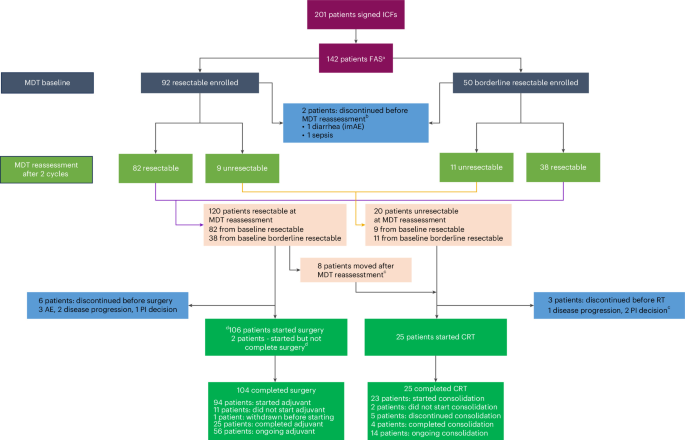
The MDT-BRIDGE study enrolled 142 participants who received neoadjuvant treatment. At baseline, 64.8% were considered to have resectable disease and 35.2% had borderline resectable disease. The trial used repeated multidisciplinary assessments during the preoperative period to determine whether patients should proceed to surgery or, if their disease was judged unresectable, receive chemoradiotherapy followed by durvalumab.
A pathway designed for changing surgical eligibility
NSCLC treatment plans can be complicated when a tumor sits near the boundary between operable and inoperable disease. Rather than treating those classifications as fixed, MDT-BRIDGE evaluated whether multidisciplinary review during neoadjuvant therapy could guide patients toward the appropriate next stage of care.
Patients received the AEGEAN regimen of perioperative durvalumab plus neoadjuvant chemotherapy when managed toward surgery. Those who became unresectable after neoadjuvant chemoimmunotherapy could receive chemoradiotherapy followed by consolidation durvalumab, a pathway based on the PACIFIC regimen.
The study's primary endpoint was overall resection rate, reported descriptively without formal hypothesis testing. Investigators also tracked event-free survival, progression-free survival, pathological complete response in the resectable cohort, circulating tumor DNA clearance and safety.

Most participants reached local treatment
The overall resection rate was 74.6%, with a 95% confidence interval of 66.7% to 81.6%. Among people who underwent surgery, the R0 resection rate was 96.2%, meaning no microscopic tumor remained at the surgical margin under the study's reporting criteria.
In total, 131 of 142 participants, or 92.3%, received either surgery or chemoradiotherapy after neoadjuvant treatment. Of those, 106 had surgery and 25 received chemoradiotherapy. The result is notable because more than one-third of the enrolled population had borderline resectable disease at the start of the study.
After local treatment, 117 participants, or 82.4%, received additional durvalumab: 94 as adjuvant treatment after surgery and 23 as consolidation treatment after chemoradiotherapy.
Safety remains part of the treatment trade-off
The reported safety results underscore that the route selected after neoadjuvant treatment matters. During adjuvant or consolidation durvalumab, maximum grade 3 or 4 adverse events occurred in 7.4% of resected patients and 17.4% of patients treated with chemoradiotherapy.
Treatment discontinuation because of adverse events occurred in 8.5% of the resected group and 13.0% of the chemoradiotherapy-treated group. These are not direct comparisons of the two approaches, but they show the different burdens that may accompany the local-treatment paths used in the trial.

What the trial adds
The findings support the feasibility of integrating multidisciplinary reassessment into neoadjuvant chemoimmunotherapy for a mixed population of resectable and borderline resectable NSCLC. Rather than relying solely on an initial treatment classification, the approach allowed clinicians to direct participants to surgery or chemoradiotherapy as their status evolved during treatment.
Because MDT-BRIDGE is a phase 2 study and its primary endpoint was descriptive, its results do not by themselves establish superiority over other treatment pathways. Still, the trial provides evidence that a coordinated strategy can deliver surgery or chemoradiotherapy to a large share of patients while continuing durvalumab after local treatment when appropriate.
For NSCLC programs, the broader implication is operational as well as clinical: multidisciplinary review is not simply a pre-treatment checkpoint. In this study, it functioned as an ongoing decision process that linked systemic therapy, surgical assessment, radiation treatment and follow-up immunotherapy.
This article is based on reporting by Nature Medicine. Read the original article.
Originally published on nature.com