A New Window Into the Menopause Transition
Menopause has long been understood as a hormonal milestone, defined clinically by the end of menstrual cycles and the steep decline in circulating estrogen. A study published online in Nature Medicine on 22 September 2026 suggests the transition leaves a far broader trace in the body — one that can be read in the proteins circulating in a woman's blood, and one that appears to correspond with patterns of brain aging and dementia risk.
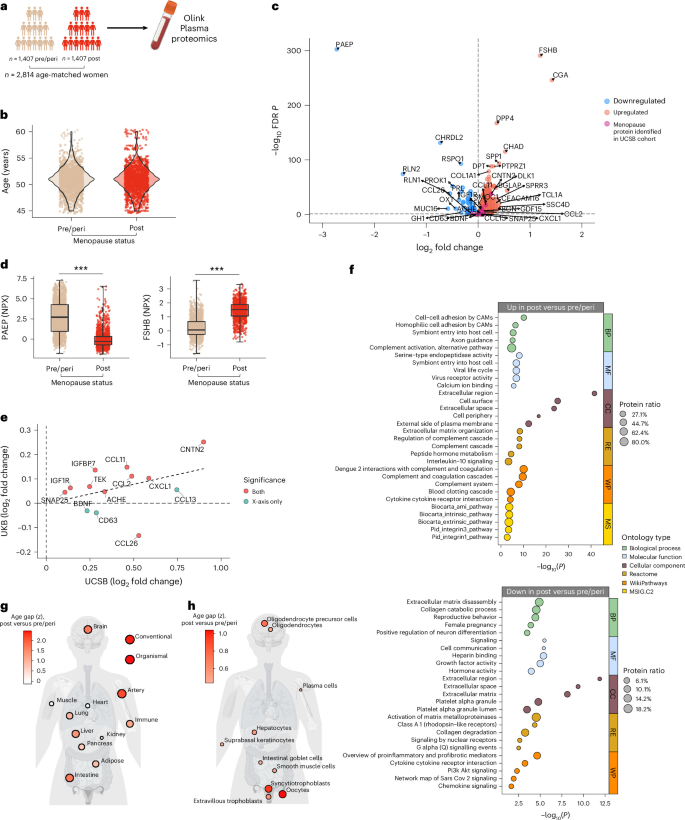
The research leans on proteomics, an approach that measures large panels of proteins simultaneously rather than tracking a single biomarker at a time. Because proteins reflect the activity of genes, the state of tissues, and the signaling molecules that shuttle between organ systems, a proteomic profile functions something like a molecular snapshot of the body at a given moment. The study's central claim is that the snapshot taken around menopause carries information about the brain.
That framing matters. If blood proteins can register the neurological consequences of the menopause transition, clinicians may eventually gain a low-cost, minimally invasive way to monitor brain health during a life stage when risk profiles shift.
What the Study Examined
According to the published abstract, the analysis drew on proteomic data from nearly 15,000 women enrolled across several cohorts. Pooling multiple cohorts is significant in this kind of work: it broadens the range of ages, backgrounds, and health histories represented, which makes any recurring pattern harder to dismiss as an artifact of one group or one research site.
The investigators focused on how protein signatures associated with menopause relate to measures of brain aging and to dementia risk. The headline finding is that the relationship is not incidental — menopause-associated protein patterns map onto indicators of brain aging, and those same patterns track with dementia risk.
- Scale: nearly 15,000 women, spanning multiple study cohorts.
- Method: blood-based proteomics, capturing many proteins at once rather than a single marker.
- Outcome of interest: the alignment between menopause-related protein signatures and brain aging and dementia risk.
- Venue: Nature Medicine, published online 22 September 2026.

Why Blood Proteins Are Relevant to the Brain
For decades, the search for early dementia signals has been constrained by the difficulty of sampling the brain directly. Imaging is expensive and not universally available; cerebrospinal fluid requires a lumbar puncture. Blood, by contrast, is easy to collect, easy to repeat, and already part of routine care.
The complication is that the brain does not simply leak its contents into the bloodstream in a readable form. What blood proteomics offers is an indirect readout — a composite signature assembled from proteins involved in inflammation, vascular function, metabolism, and cellular repair, some of which are known to participate in processes relevant to neurodegeneration. When a signature like that shifts systematically at menopause, it raises the possibility that the transition is not only a reproductive event but a systemic one with neurological dimensions.
This is where the study's contribution sits. Rather than asking whether a single protein changes with menopause, it asks whether the aggregate protein profile of menopause resembles the aggregate profile of brain aging — and reports that it does.
Menopause, Dementia Risk, and the Case for Earlier Attention
Women are disproportionately affected by Alzheimer's disease and other dementias, and one longstanding hypothesis holds that the midlife hormonal transition contributes to that imbalance. Direct evidence has been difficult to assemble, partly because dementia symptoms emerge decades after menopause, leaving a long gap that is hard to bridge with any single measurement.
Proteomic mapping offers a way to bridge it. If a blood signature measurable around the time of menopause carries information about later risk, it becomes a candidate for the kind of midlife screening that current tools cannot provide. The study does not claim that menopause causes dementia; it reports an association between menopause-linked protein patterns, brain aging, and dementia risk. That distinction is central, and it is the kind of association that demands follow-up before it changes practice.
What the Findings Could Influence
- Risk stratification: identifying women whose proteomic profiles warrant closer neurological monitoring.
- Timing of intervention: sharpening the debate over when, during the menopause transition, preventive strategies might be most useful.
- Biomarker development: supplying candidate protein signatures for validation in prospective studies.
- Clinical conversations: giving clinicians a concrete, data-driven reason to discuss brain health alongside hot flashes, sleep disruption, and bone density.

The Limits of What Proteomics Can Show
Observational proteomics is powerful at detecting patterns and limited at assigning causes. A protein signature that aligns with both menopause and brain aging could reflect a shared upstream driver, a cascade in which one process feeds the other, or a third factor — such as age, vascular health, or metabolic status — that influences both.
Nearly 15,000 women is a substantial sample for this field, but cohort data are collected at discrete points, and menopause is a transition that unfolds over years. How precisely a proteomic snapshot can locate a woman within that transition remains an open question, as does whether the same signatures hold across different populations and ancestral backgrounds. Prospective follow-up, in which protein profiles collected at midlife are tested against dementia diagnoses years later, is the natural next step.
The Larger Shift
What makes this study notable is less any single protein than the reframing it supports: menopause as a systemic transition whose molecular footprint extends to the brain. For researchers, that opens a bridge between women's health and neuroscience that has been narrower than the epidemiology would suggest. For clinicians and patients, it points toward a future in which a routine blood draw during midlife might carry information about cognitive trajectory — not a diagnosis, but a signal worth acting on.
The findings are associational, the biological mechanisms remain to be worked out, and the path from a proteomic signature to a clinical test is long. Still, mapping the menopause transition onto brain aging is a meaningful step: it turns a vague suspicion about women's elevated dementia risk into a measurable, testable question — and it gives the next generation of studies something specific to look for in a vial of blood.
This article is based on reporting by Nature Medicine. Read the original article.
Originally published on nature.com