A Consensus Guideline for Personalized Bacteriophage Therapy
A new consensus statement published in Nature Medicine on 21 September 2026 offers clear, practice-oriented recommendations for the safe and standardized use of personalized bacteriophage therapy. Bacteriophages — viruses that selectively infect bacteria — have attracted growing attention as a promising option for treating difficult-to-treat bacterial infections, particularly where conventional antibiotics have failed. Yet the field has been held back by the absence of agreed-upon rules governing how such treatments should be selected, prepared, administered, monitored and documented.
The guideline is the work of the guideline group “Personalized Bacteriophage Therapy” of the Association of the Scientific Medical Societies in Germany (AWMF). It was developed under the leadership of the German Society for Infectious Diseases and within the AWMF’s established methodological framework — a structure that gives the recommendations a formal footing within German medical practice rather than leaving them as informal expert opinion.
The Obstacles That Prompted the Work
Clinical implementation of phage therapy in many countries faces multiple hurdles. The authors point to a lack of consensus on general principles for phage therapy as a central problem, alongside unresolved questions about infrastructural requirements, procedures for quality-assured phage selection and preparation, clinical administration, monitoring and documentation.
Existing guidance, according to the statement, provides only limited practical direction across the entire translational pathway. It also lacks inspection-ready specifications capable of supporting both the pharmacies that must prepare a therapeutic product and the clinical sites that must deliver it. Those gaps, the authors argue, impede safe and transparent clinical use as well as effective regulatory oversight.
A parallel problem concerns research itself. The statement notes that no established processes exist for identifying the research questions that will be key to advancing clinical phage research in the future — meaning the field risks accumulating isolated studies rather than pursuing a coordinated agenda.

What the Guideline Covers
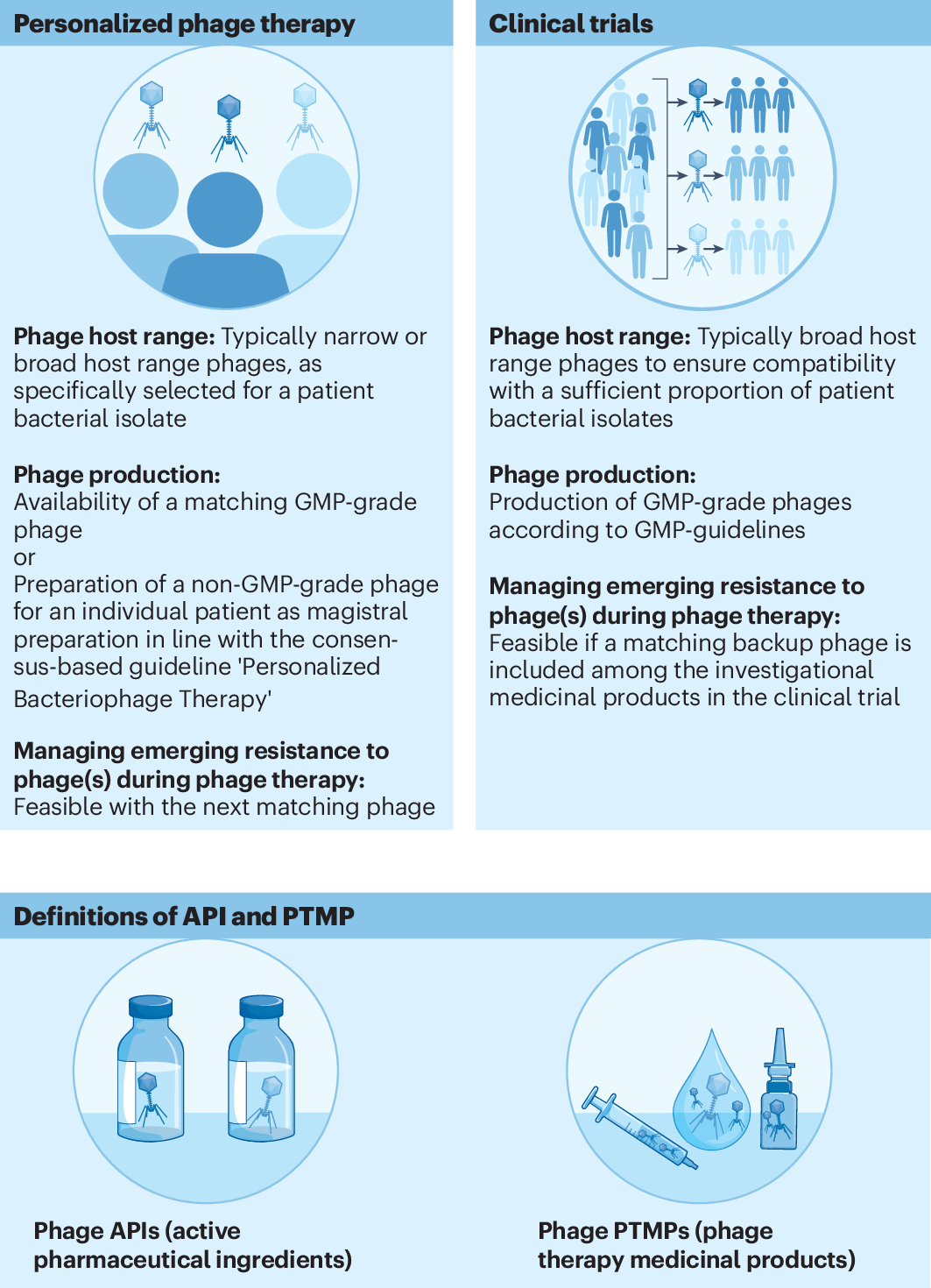
By design, the document spans the full translational pathway rather than a single stage of it. Its recommendations are organized around the questions that clinicians, pharmacists and regulators must answer before a personalized phage preparation reaches a patient.
- General principles: shared foundations for when and how personalized phage therapy should be considered.
- Infrastructure: the facilities and organizational requirements needed to support clinical phage work.
- Phage selection and preparation: quality-assured procedures for choosing phages and producing preparations.
- Clinical administration: practical direction on delivering therapy to patients.
- Monitoring and documentation: structured follow-up and record-keeping intended to make outcomes traceable.
The emphasis on documentation and monitoring is notable. Personalized therapy is, by its nature, difficult to standardize — each case may involve a different bacterial target and a different phage preparation — so the guideline’s value lies in making the process around the therapy consistent even when the therapy itself is bespoke.
Inspection-Ready Specifications
One of the more consequential elements is the push for specifications that can withstand inspection. Pharmacies preparing phage products and the clinical sites administering them have, in many jurisdictions, operated without a shared reference point. Inspection-ready specifications supply that reference point, and in doing so they give regulators something concrete to assess.
That matters for oversight. A regulator cannot easily evaluate a therapy whose selection criteria, preparation methods and documentation standards are defined differently at every site. The authors frame the absence of such specifications as a barrier not only to quality but also to the transparency that patients and oversight bodies reasonably expect.
Who Authored the Statement
The author list reflects the breadth of the undertaking, drawing together specialists in infectious diseases, microbiology, pharmacy and phage research from Germany, Belgium, France, the United States and beyond. Silvia Würstle leads the author group, joined by Simone C. Lieberknecht-Jouy and Annika Y. Classen among the coordinating contributors, with Maria J. G. T. Vehreschild also serving on the authorship team.
Contributors include Pieter-Jan Ceyssens and Jean-Paul Pirnay, both of whom have worked extensively on phage therapy frameworks in Belgium, as well as Mathieu de Jode and Shawna McCallin. Also among the authors are Paul E. Turner and Benjamin Chan, phage biologists based in the United States, and Tristan Ferry, an infectious disease physician in France. The roster extends to specialists in pharmaceutical law such as Timo Faltus and clinicians such as Christian Willy and Martin Witzenrath, alongside colleagues spanning microbiology, hygiene and clinical infectious disease.

Why This Matters Beyond Germany
Although the guideline was developed within AWMF’s national methodological framework and led by German infectious disease specialists, its subject is inherently international. Phage therapy research and compassionate-use treatment occur worldwide, and the patients who might benefit often carry infections that no approved antibiotic can resolve. A shared set of expectations for selection, preparation and documentation could ease cross-border collaboration and make results from different centers comparable.
The authors also signal that the guideline is meant to serve as a living reference for research. Identifying priority questions is treated as part of the work rather than an afterthought — a recognition that the evidence base for phage therapy is still being assembled.
What the Document Does Not Claim
The statement is a consensus document. It sets out recommendations for safe and standardized use rather than reporting the results of a clinical trial, and its authority derives from the methodological process behind it and the breadth of expert participation. Questions that remain open — which patients stand to benefit most, how phages should be matched to pathogens in routine practice and how efficacy should be measured — are the very issues the document flags as priorities for future research.
The Path Forward
For hospital pharmacies and clinical teams weighing personalized phage therapy, the guideline offers something previously in short supply: a common vocabulary and a documented sequence of steps. For regulators, it offers inspection-ready specifications that can be applied to a field where bespoke preparations are the norm. For researchers, it offers a structured way to decide what to study next.
The consensus statement arrives at a moment when interest in phage therapy is rising while standards remain uneven. Its aim is to close that gap with practice-oriented guidance rather than broad principle alone — giving the scientists, pharmacists and physicians who work on difficult-to-treat infections a shared framework for moving carefully from laboratory selection to patient care.
This article is based on reporting by Nature Medicine. Read the original article.

Originally published on nature.com