A major Long COVID trial points to the value of coordinated care
A large phase 3 clinical trial in England has added an important piece of evidence to a difficult question in post-pandemic medicine: what kinds of care actually help people living with Long COVID? The answer from the STIMULATE-ICP study is measured but meaningful. Across all study groups, patients receiving multidisciplinary Long COVID care saw improvements in fatigue over 12 weeks. But two widely discussed additions to that care pathway, multi-organ MRI and a digital rehabilitation program, did not produce clear short-term advantages over usual specialist care on the trial’s primary outcome.
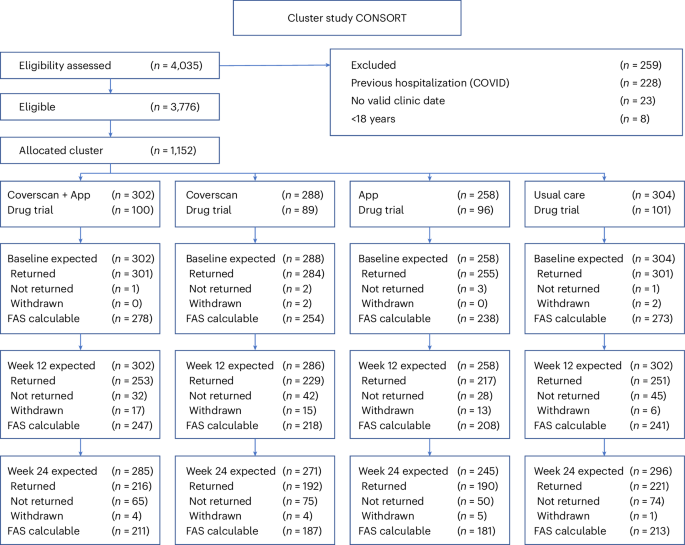
The study, published in Nature Medicine on July 28, evaluated integrated care pathways for adults with Long COVID across six National Health Service clinics in England. Researchers recruited 1,152 participants aged 18 and older and organized care at the level of primary care network clusters, allowing interventions to be delivered as a local standard of care rather than as a narrow experimental add-on for a few individuals.
That design matters because Long COVID has proven difficult not only biologically, but operationally. Health systems have been forced to manage a condition that can affect multiple organs, present with fluctuating symptoms, and require input from different specialists, rehabilitation services, and primary care teams. The study therefore tested not just a single treatment, but a scalable model for how care might be organized.
What the trial tested
The STIMULATE-ICP trial examined four intervention combinations. Patients were assigned through their primary care networks to receive multi-organ magnetic resonance imaging using Coverscan, a digital rehabilitation program called Living with COVID Recovery, both interventions together, or neither intervention, which served as usual care. All of this took place within specialist Long COVID clinics already using integrated care pathways.
The main outcome was fatigue at 12 weeks, measured with the Fatigue Assessment Scale. Secondary outcomes included fatigue at 24 weeks and health status measured through the EQ-5D-5L visual assessment scale at 12 and 24 weeks. Fatigue is a central symptom in Long COVID and one of the hardest to treat, so it served as a practical primary measure for the study.
At baseline, the groups were broadly comparable. The mean Fatigue Assessment Scale score was 35.8, with a standard deviation of 8.21, and 66.4% of participants were female. By 12 weeks, average fatigue scores had improved in all arms by 4.5 points, reaching 31.3 on average. That broad improvement suggests that structured multidisciplinary care itself may be doing useful work for patients, even when added technologies do not change the headline result.
The MRI result was notably modest
Compared with usual care, the effect of adding multi-organ MRI on 12-week fatigue was small and not statistically significant. The reported effect estimate was minus 0.18, with a 95% confidence interval from minus 0.72 to 1.09, and a P value of 0.69. In practical terms, that means the MRI arm did not outperform usual care on the primary endpoint.
The digital rehabilitation intervention also did not show a statistically significant advantage on 12-week fatigue compared with usual care. Its effect estimate was minus 0.53, with a confidence interval from minus 1.42 to 0.36, and a P value of 0.25. The interaction between MRI and digital rehabilitation was similarly small and non-significant.
Researchers reported that absolute differences from usual care for other interventions were modest. There were no serious adverse events related to the integrated care pathway interventions, which supports the safety of the approaches tested even if the efficacy differences were limited.
That combination of results is important because it pushes the field away from assumptions that more imaging or more digital tooling will automatically produce better outcomes. Long COVID has often been discussed in terms of diagnostic complexity and the search for organ-level abnormalities. The trial does not say imaging is useless. It does suggest that routine addition of multi-organ MRI, at least in this care context and against this primary outcome, did not materially shift fatigue improvement over 12 weeks.
Why the study still matters for patients and health systems
The headline could easily be misread as negative. It is better understood as clarifying. The trial showed that large, multi-site Long COVID care studies are feasible and that holistic multidisciplinary care was associated with reduced fatigue across groups. In a condition where evidence has often been fragmented, that alone is a substantial contribution.
For clinicians and policymakers, the trial also offers a more grounded view of where to invest limited resources. If specialist, coordinated care is delivering measurable patient improvement, then expanding access to those pathways may matter more than assuming that expensive imaging will transform near-term outcomes. The findings support the operational value of integrated clinics and cross-specialty care plans, even while leaving many scientific questions unresolved.
The digital rehabilitation result is also more nuanced than a simple pass-fail reading. Although it did not significantly improve the primary 12-week fatigue endpoint over usual care, the authors concluded that digital rehabilitation could still be useful in longer-term Long COVID management. That is a cautious statement rather than a declaration of success, but it leaves room for future work on how and when rehabilitation tools may help patients over longer follow-up periods or in more targeted subgroups.
What comes next
The researchers conclude that further trials are required. That is consistent with the broader state of Long COVID science, where patient populations are heterogeneous and no single intervention has emerged as a universal answer. The STIMULATE-ICP study narrows the field by showing that some system-level care structures can be implemented at scale and evaluated rigorously, while also indicating that not every add-on intervention will deliver a clear improvement on fatigue.
In that sense, the trial is less about a breakthrough therapy than about discipline in clinical care design. It argues for testing Long COVID services the way medicine tests drugs: in large, comparative, real-world studies that can separate plausible ideas from clinically meaningful gains.
For patients, the result is mixed but not empty. The study supports the value of being treated within a coordinated, multidisciplinary framework. For health systems, it suggests that building those frameworks may be more consequential than betting on high-visibility diagnostics alone. And for researchers, it provides a workable template for the next generation of Long COVID trials, which will need to be just as pragmatic and much more precise.
This article is based on reporting by Nature Medicine. Read the original article.
Originally published on nature.com

00059-7/asset/4cbe94fb-e0c0-468a-b4fb-2f4f4b6116b9/main.assets/gr3a_lrg.jpg)