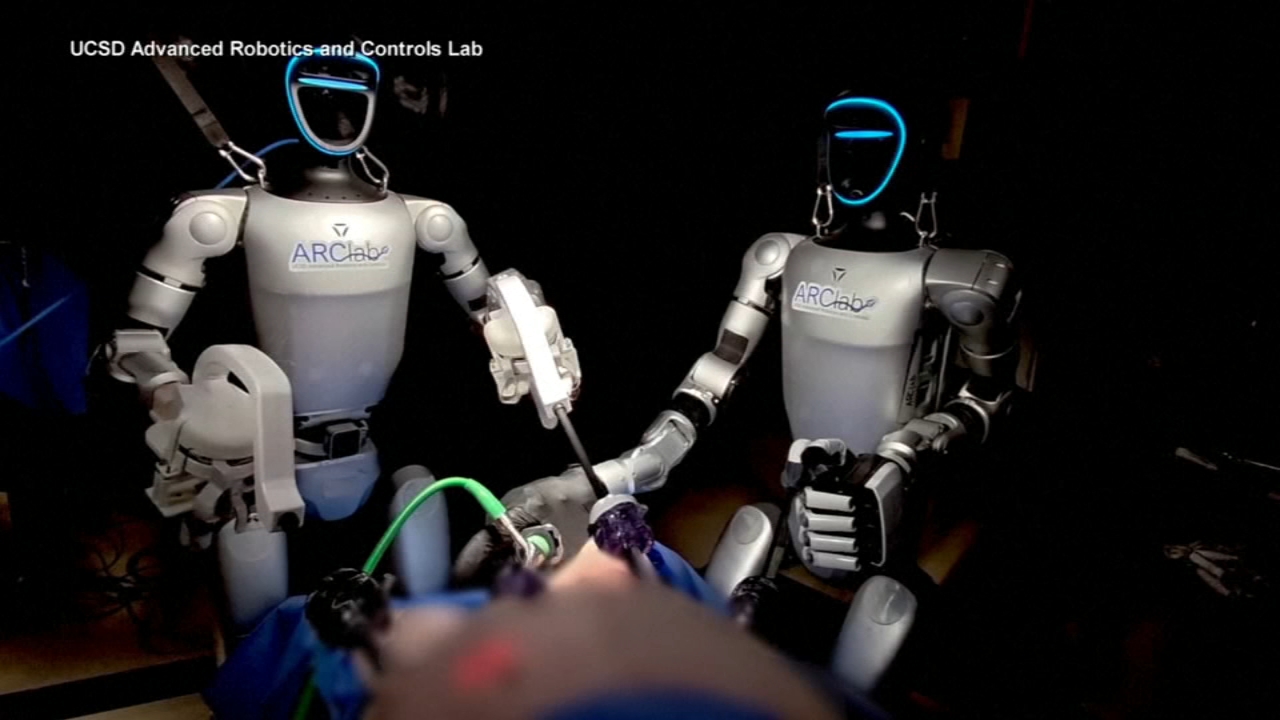
Humanoid Surgical Robots Reach a New Animal-Test Milestone
A new research highlight in Nature Medicine points to a notable step in surgical robotics: a humanoid robot, operated remotely by a human surgeon, successfully performed laparoscopic gallbladder removal in pigs. The result does not mean autonomous humanoid surgery is ready for hospitals, but it does show that a human-shaped robotic platform can handle at least some of the demands of minimally invasive procedures in a living-animal setting.
That matters because most surgical robots in use today are not humanoid machines. They are specialized systems built around proprietary platforms and robot-specific instruments. Humanoid robots represent a different proposition. Their human-like form factor is designed to work in spaces and with tools originally made for people. If that can be translated into safe and reliable surgical performance, it could widen how robotic assistance is deployed across operating rooms and other clinical environments.
Why a humanoid form could matter in medicine
The core argument behind humanoid surgical systems is practical compatibility. Hospitals are full of equipment, workflows, and physical layouts designed around human clinicians. A humanoid robot may be better able to navigate those settings without requiring the entire room to be re-engineered around a dedicated robotic platform.
That could eventually make robotic systems more flexible or accessible in a broader range of care settings. Instead of designing every task around a machine with a fixed geometry and custom tooling, developers could try to build systems that operate more like a trained assistant able to use conventional instruments and adapt to existing infrastructure.
But the same flexibility that makes humanoid robots appealing also creates a higher bar for performance. Surgery tolerates very little error. Precision, reliability, repeatability, and safety are not optional characteristics; they are the baseline. The research highlight underscores that, despite the potential advantages, it has remained unclear whether humanoid robots can meet those requirements in surgical applications.

What the pig surgeries show
According to the highlight, the robot was remotely controlled by a human surgeon and used for laparoscopic gallbladder removal in pigs. That makes the demonstration important in two ways. First, it moves beyond purely conceptual discussion and bench-top promise into an in vivo setting. Second, it focuses on a minimally invasive procedure that demands controlled tool manipulation inside the body, where limited access and fine movement are central challenges.
The source text does not frame the work as a final clinical solution. Instead, it presents the surgeries as a feasibility milestone that also revealed “key insights for future optimization and clinical translation.” That wording is important. The value of the experiment lies not only in success, but in the engineering and procedural lessons gathered from a realistic test environment.
Animal studies are often where the gap between a compelling laboratory prototype and a usable medical system becomes visible. Tasks that seem manageable in controlled demonstrations can become much harder when tissue handling, spatial constraints, and procedure flow are involved. A successful pig study therefore suggests the platform has crossed an initial threshold of practicality, even if many more thresholds remain.
Remote control, not robotic independence
Another point worth stressing is that this was not described as independent robotic surgery. The robot was controlled remotely by a human surgeon. That keeps the clinician in the loop and places the machine in the role of a dexterous interface rather than a substitute decision-maker.
That distinction has both technical and regulatory significance. Teleoperated systems can benefit from robotic reach, steadiness, and access while avoiding the much harder challenge of giving a machine the authority to interpret anatomy, adapt to unexpected changes, and decide how to proceed on its own. In the near term, teleoperation may be the more realistic route for humanoid systems entering clinical development.
It also aligns with how surgical robotics has evolved more broadly. Hospitals have shown willingness to adopt systems that extend a surgeon’s capabilities, but not systems that remove the surgeon from responsibility. A remotely controlled humanoid platform fits more naturally into that pattern.

The path from feasibility to clinical use
The research highlight also makes clear that future optimization will be necessary before clinical translation becomes plausible. In practice, that means developers will need to demonstrate consistent performance, acceptable failure modes, safe interaction with patients and staff, and strong integration with surgical workflow. A single successful application in animals is not enough to establish those points.
There is also the practical question of whether a humanoid system offers enough advantage over existing specialized robots to justify the complexity it introduces. A general-purpose, human-like machine may be more versatile, but hospitals will still ask whether it improves outcomes, efficiency, cost, or access. If it does not outperform or meaningfully complement purpose-built platforms, the novelty of the form factor will not be sufficient.
Still, the result is significant because it broadens the design space for surgical robotics. For years, the field has largely advanced through dedicated architectures optimized for specific operating-room use cases. A successful in vivo procedure by a humanoid robot suggests another route may be technically viable: adapting robots built around human morphology to carry out specialized medical work.
What this milestone does and does not mean
It would be premature to interpret the pig surgeries as evidence that humanoid robots are about to become common in operating theaters. The source material does not support that conclusion. What it does support is narrower and more meaningful: a humanoid robot has now been shown capable of performing a demanding laparoscopic procedure in animals under remote human control, and that experiment generated lessons relevant to future refinement.
For the broader health-technology sector, that is enough to merit attention. Surgical robotics is one of the most demanding proving grounds for machine precision and reliability. If humanoid platforms can make credible progress there, they may find opportunities not only in surgery but across other clinical tasks that depend on human-shaped movement in human-designed spaces.
The next phase will determine whether this remains an intriguing proof of concept or becomes the basis for a new branch of medical robotics. For now, the animal-study milestone shows that humanoid systems are moving from speculation toward evidence, even if clinical reality is still some distance away.
This article is based on reporting by Nature Medicine. Read the original article.

Originally published on nature.com