A large family genome study sharpens the picture of how new mutations arise
A major whole-genome sequencing study published in Nature Medicine adds scale and specificity to a longstanding question in reproductive and pediatric health: how parental age and assisted reproductive technologies shape the number and type of new mutations passed to children. The researchers analyzed 24,030 individuals from 7,851 parent-offspring families and identified 390,924 de novo single-nucleotide variants, or dnSNVs, giving them a large dataset for tracing how these changes emerge and what they may mean for early-life outcomes.
De novo mutations are genetic changes that are not inherited directly from either parent’s existing genome sequence but arise newly in sperm, eggs, or early embryonic development. Many are harmless, but some can contribute to congenital disease or developmental problems. Because delayed parenthood and the use of assisted reproductive technology, or ART, have both become more common, the study focused on whether those reproductive factors leave distinct mutational signatures and whether those changes are linked to measurable health effects in offspring.
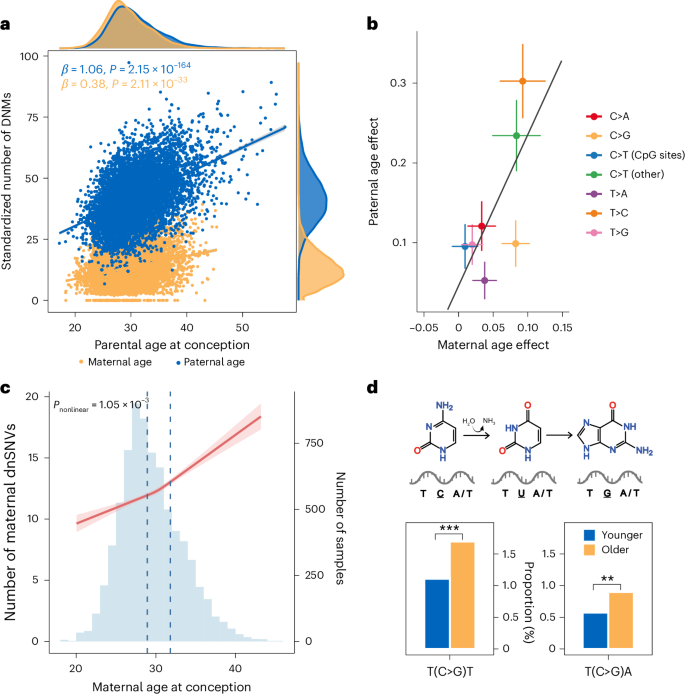
The headline result is not simply that parental age matters, but that paternal and maternal aging appear to contribute in different ways. The authors report distinct mutational patterns for fathers and mothers, and they found that maternal de novo mutation accumulation accelerates at advanced ages. That finding is notable because discussions of age-related mutation burden have often centered more heavily on fathers. This study suggests the maternal side has its own dynamic, especially later in reproductive age.
What the researchers found about parental age
The paper also links age-related mutation increases to pregnancy outcomes. According to the abstract, increased paternal dnSNVs partially accounted for the association between advanced parental age and shorter gestational duration. That does not mean the mutations fully explain why pregnancies may be shorter with older parents, but it does indicate they may be one contributing pathway. The study therefore pushes beyond counting mutations and starts connecting them to clinically relevant outcomes.
The scale of the dataset matters here. With thousands of family trios and a whole-genome approach rather than a narrower gene panel, the researchers were positioned to detect more subtle patterns than smaller studies can reliably show. The resulting picture is one of mutational burden as a layered phenomenon: influenced by the age of each parent, shaped by when and where mutations arise, and potentially connected to specific early developmental effects.
The study also examined assisted reproductive technologies in more detail than many previous reports. Rather than treating ART as a single category, the researchers separated procedures and asked whether different interventions were associated with different mutational effects. Their conclusion was that ART showed age-independent, procedure-specific effects.
Procedure-specific findings for assisted reproduction
Two findings stand out. First, intracytoplasmic sperm injection, or ICSI, was associated with increased paternal dnSNVs. Second, ovarian stimulation was associated with increased maternal dnSNVs. The authors further report that the paternal dnSNVs associated with ICSI partially accounted for the association between ICSI and shorter gestational duration. As with the age findings, that language is careful: the mutations are presented as a partial contributor, not a complete explanation.
This matters because assisted reproduction is often discussed in broad terms, even though the procedures involved can differ substantially. By identifying procedure-specific associations, the paper suggests that future risk assessment and counseling may need to be more granular. It also underscores that mutational outcomes cannot be inferred from ART use in general; the relevant question may be which step in the process is involved.
Another part of the study focused on in vitro embryo manipulation. Here the researchers found an association with increased early post-zygotic mosaic mutations. Mosaic mutations arise after fertilization, meaning not every cell necessarily carries the same change. The paper highlights a particular enrichment of C to A substitutions in this context and reports that these mutations were linked to delayed neurocognitive development at 1 year.
That is one of the study’s most consequential observations, because it connects a specific mutational pattern to a developmental outcome rather than stopping at molecular description. At the same time, the source text supports only the stated association, not a broader causal claim about all embryo manipulation or all neurodevelopmental risk. The study advances the evidence base, but it does not justify sweeping conclusions about the safety or effectiveness of reproductive medicine as a whole.
Why the study matters now
The timing of the paper is significant. In many countries, people are having children later, and fertility treatment has become more common and more technically varied. That makes it increasingly important to understand not only whether reproductive factors correlate with mutation burden, but which factors matter most, how they differ between mothers and fathers, and whether specific mutational signatures map onto specific health outcomes.
For clinicians and researchers, the paper offers several useful directions. It supports more precise investigation of paternal versus maternal age effects. It suggests that ICSI, ovarian stimulation, and embryo manipulation should not be grouped together analytically. And it raises the prospect that some reproductive interventions may have distinct genomic footprints that can be tracked in relation to pregnancy duration or early neurodevelopment.
For patients, the implications are more limited and more nuanced than a headline may suggest. The study does not say that delayed parenthood or ART necessarily lead to harmful outcomes in any individual case. It does say that, at the population level studied, these factors were associated with measurable differences in de novo mutagenesis, and that some of those differences were linked to shorter gestational duration or delayed neurocognitive development at 1 year.
That distinction is important. Large genomic studies are powerful because they can detect patterns across many families, but their findings are best used to refine counseling, monitoring, and future research rather than to make deterministic predictions for individual households. Even so, this paper meaningfully expands the field’s understanding of how reproductive timing and reproductive technology intersect with the biology of new mutations. In an era of later parenthood and increasingly sophisticated fertility care, that is likely to influence both research agendas and clinical conversations.
This article is based on reporting by Nature Medicine. Read the original article.
Originally published on nature.com