Depression’s Economic Toll Is Projected to Reach Into the Trillions
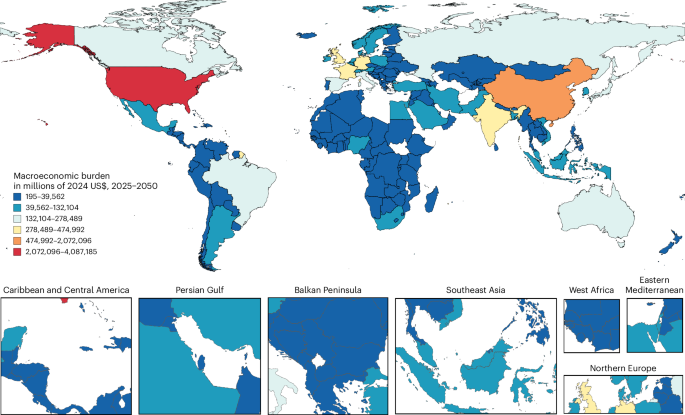
Depression is already recognized as a major driver of illness and disability worldwide. A new modeling analysis published in Nature Medicine argues that its economic consequences are similarly vast: across 154 countries, depression is projected to impose a global economic burden of about US$12 trillion between 2025 and 2050, measured in 2024 dollars.
The paper frames depression not only as a health crisis, but also as a macroeconomic one. Using a model built with World Bank data and the Global Burden of Disease Study 2021, the researchers estimated how depression affects labor force participation, educational attainment, and work experience, while adjusting for age and sex. Their conclusion is blunt: the losses are substantial, persistent, and unevenly distributed.
On an annual basis, the burden equals roughly 0.460% of global gross domestic product. That may sound modest in percentage terms, but at global scale it translates into trillions of dollars in lost economic output over a quarter century. The study also found that when suicide-related deaths attributable to depression are included using an upper-bound assumption from the literature, the total burden rises to US$14 trillion.
Why the Costs Are So Large
The analysis identifies reduced labor force participation and lower productivity as the main channels through which depression damages economies. In practical terms, that means fewer people working, more people working below their potential, and productivity losses that accumulate over time. Education and work experience also matter because depression can disrupt school completion, career progression, and the development of skills that shape lifetime earnings.
This framing matters for policy. Much of the public conversation around mental health emphasizes treatment access, stigma reduction, and quality of life. Those remain central issues, but the study suggests policymakers should also think in terms of national productivity, long-run capital accumulation, and labor-market resilience. Depression does not just impose direct clinical costs; it can reshape economic trajectories by reducing how fully people participate in work and learning.
The burden is not spread evenly. The researchers report that the United States and China face the highest absolute economic losses. Relative to regional GDP, North America bears the greatest impact. That distinction is important: some countries may see the largest total losses simply because their economies are bigger, while others may feel a more intense drag when the burden is measured against overall output.

A Global Problem With Uneven Consequences
The paper emphasizes inequity in how depression’s macroeconomic effects are distributed. Countries enter the period from very different starting points in healthcare capacity, workforce structure, and social protection. That means the same disorder can translate into different economic outcomes depending on whether a country has strong treatment systems, workplace accommodations, and educational supports.
For lower- and middle-income settings, depression can interact with fragile health systems and constrained access to care, making early intervention harder. In wealthier economies, the absolute losses can be larger because high wages and advanced sectors amplify the value of lost work and productivity. Either way, the model suggests that untreated or poorly managed depression creates cumulative drag across decades.
The study’s 154-country scope also gives weight to its broader claim: this is not a niche issue confined to a handful of health systems. It is a structural global challenge that cuts across income levels and regions. That matters at a time when governments are under pressure to raise productivity, stabilize labor markets, and control healthcare spending simultaneously.
What the Findings Do and Do Not Say
Like any long-range macroeconomic model, the study depends on assumptions. The authors used established global datasets and modeled the effects of depression through measurable channels such as employment and education, but projections out to 2050 are not predictions in a narrow sense. They estimate the scale of burden under defined assumptions rather than claim a fixed future outcome.
The suicide-adjusted estimate is a good example. The jump from US$12 trillion to US$14 trillion depends on an assumed 60% attribution rate for suicide-related deaths linked to depression, which the paper presents as the upper bound of estimates in the literature. That makes the higher figure best understood as a scenario rather than a baseline. Even without that addition, however, the core result remains large enough to command attention.
Another implication is that the burden is potentially reducible. Because the largest drivers are labor participation and productivity, better prevention, earlier diagnosis, and more effective treatment could produce economic gains alongside health benefits. The paper explicitly notes that reducing depression’s health burden could generate economic returns by supporting productivity and capital accumulation.

Why This Matters Now
The timing is notable. Many countries are confronting aging populations, workforce shortages, and slower productivity growth. In that environment, a condition that suppresses participation and output at scale becomes more than a clinical issue. It becomes part of economic strategy.
Mental health has often struggled for priority in budgets because its benefits can appear diffuse or difficult to quantify. This analysis attempts to quantify them in terms ministries of finance and economic planners recognize. Trillion-dollar estimates inevitably invite scrutiny, but they also make the opportunity cost of inaction harder to ignore.
If the modeling holds, the message is straightforward: depression is not only one of the world’s major public health burdens, but also a long-horizon economic constraint. Investment in prevention, treatment, and support systems may therefore need to be assessed not just as social spending, but as productivity policy.
Key Takeaways
- A Nature Medicine study estimates depression will cost the global economy about US$12 trillion from 2025 to 2050.
- The estimate rises to US$14 trillion in a scenario that includes suicide-related deaths attributable to depression.
- Reduced labor force participation and lower productivity are the main drivers of the projected burden.
- The United States and China face the largest absolute losses, while North America has the greatest impact relative to regional GDP.
- The findings strengthen the case for treating mental health policy as both a public health priority and an economic one.
This article is based on reporting by Nature Medicine. Read the original article.
Originally published on nature.com