Un premier essai clinique pour une stratégie plus large contre le coronavirus
Un vaccin expérimental universel contre le coronavirus conçu par intelligence artificielle a passé son premier essai chez l’humain, selon une recherche mise en avant par ScienceDaily et attribuée à l’Université de Cambridge. Le texte source fourni indique que le vaccin s’est révélé sûr et bien toléré dans une étude menée auprès de 39 volontaires sains, et qu’il a déclenché des réponses immunitaires contre plusieurs membres du groupe des sarbecovirus, dont le SARS-CoV-2, le SARS, ainsi que des coronavirus de chauve-souris apparentés présentant un potentiel pandémique.
Le résultat est donc important à double titre. D’abord, il constitue un premier signal clinique pour une stratégie de conception vaccinale plus large qui va au-delà d’une seule souche circulante. Ensuite, il est présenté comme la première fois qu’un vaccin dont l’ingrédient actif a été créé entièrement par des simulations informatiques a été testé chez l’humain.
Pourquoi un vaccin universel contre le coronavirus est important
Les vaccins conventionnels sont souvent construits autour d’un agent pathogène précis ou d’un ensemble restreint de souches. Cela fonctionne bien lorsque la cible reste suffisamment stable, mais les coronavirus ont montré à plusieurs reprises le défi posé par l’évolution virale et le risque de transmission interespèces. La logique d’un vaccin universel consiste à cibler des caractéristiques partagées par toute une famille de virus afin que la protection reste utile même lorsque certains virus évoluent.
Dans ce cas, le texte source indique que le vaccin vise la famille des sarbecovirus, qui comprend le virus à l’origine de la COVID-19, celui responsable du SARS, et des virus de chauve-souris apparentés qui n’ont pas encore infecté l’être humain mais sont considérés comme des menaces futures potentielles. Une plateforme capable de générer des réponses immunitaires à travers ce groupe représenterait un changement stratégique, passant de la réaction à la pandémie à la préparation à la pandémie.

Comment l’IA a été utilisée
L’étude indique que les chercheurs ont utilisé l’intelligence artificielle et l’apprentissage automatique pour concevoir ce qu’ils appellent un super-antigène. Plutôt que de choisir une seule séquence virale connue, le système a analysé des informations génétiques de sarbecovirus recueillies dans le cadre de programmes de surveillance à travers le monde et a identifié des caractéristiques partagées par l’ensemble du groupe. Ces caractéristiques ont ensuite été combinées en un seul antigène vaccinal.
L’intérêt de cette approche ne réside pas seulement dans sa nouveauté informatique. Elle reflète une autre manière de définir la cible vaccinale. Au lieu de courir après la variante dominante du moment, les chercheurs tentent d’assembler par calcul un signal d’apprentissage immunitaire plus large fondé sur l’architecture virale commune.
Ce que l’essai a montré
Selon le texte source fourni, l’essai a montré que le vaccin n’a provoqué aucun effet secondaire significatif chez 39 volontaires sains. Il a également stimulé des réponses immunitaires non seulement contre le SARS-CoV-2 et le SARS, mais aussi contre des virus de chauve-souris apparentés qui ne sont pas encore passés à l’humain. Pour une phase centrée sur la première utilisation chez l’humain, ce sont les deux critères les plus importants: une sécurité acceptable et la preuve que le système immunitaire répond dans la direction attendue.
Cela ne signifie pas que le vaccin est prêt à être déployé. Les premiers essais chez l’humain sont conçus pour répondre à des questions limitées, et des données de réponse immunitaire ne sont pas équivalentes à une protection démontrée dans le monde réel. Mais franchir ce premier seuil de sécurité reste une étape importante, surtout pour une méthode de conception qui n’avait jamais été testée chez l’humain.

Administration et flexibilité de la plateforme
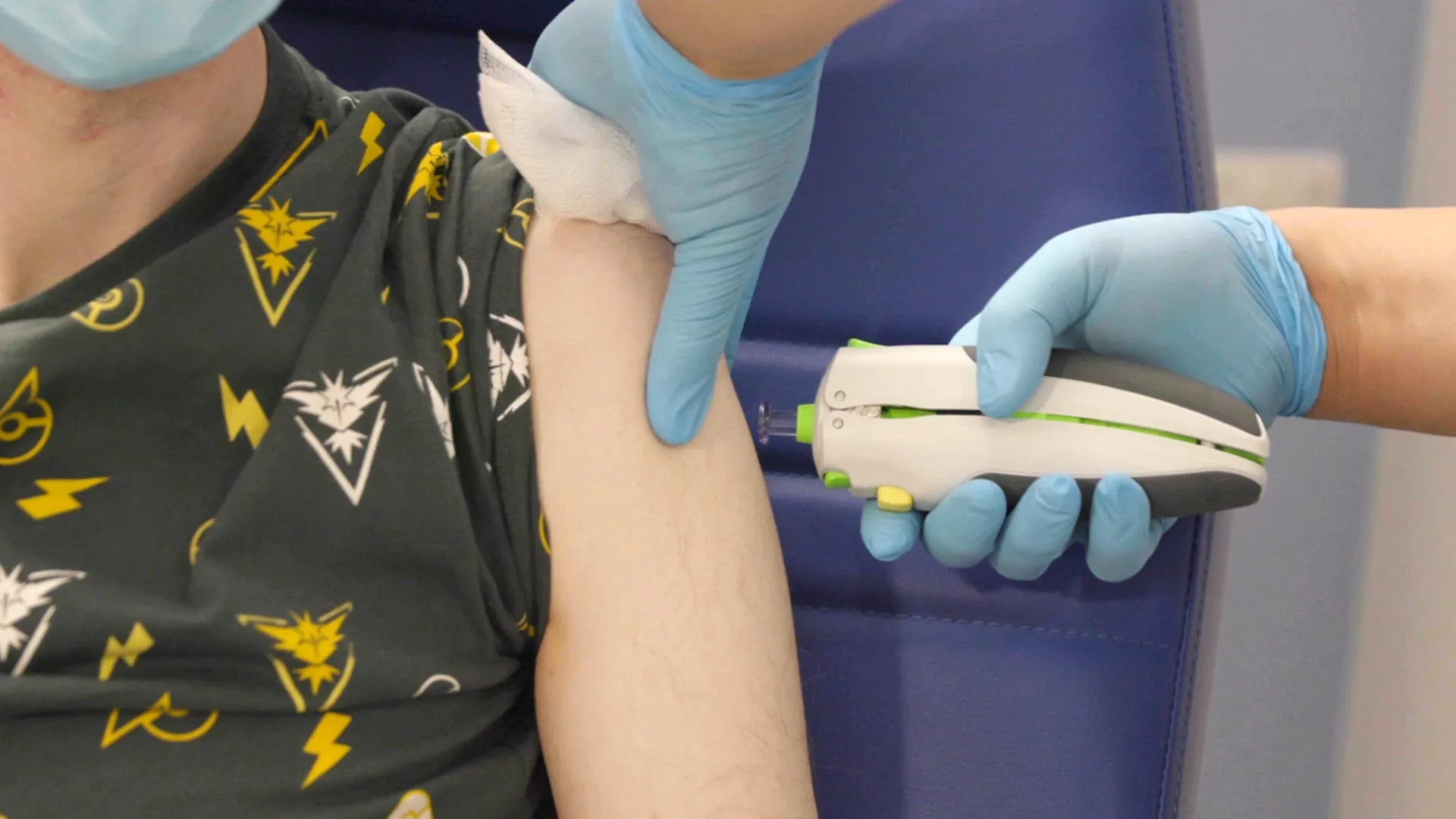
La source précise également que le super-antigène est compatible avec la plupart des systèmes d’administration vaccinale et que, dans cet essai, il a été administré sous forme de vaccin à ADN par jet microfluidique, une méthode sans aiguille. Ce détail compte, car la flexibilité de la plateforme peut influer sur la fabricabilité, les stratégies de déploiement et l’acceptation par les patients. Une conception d’antigène largement compatible offre davantage de marge pour s’adapter à différentes technologies d’administration.
L’administration sans aiguille est également notable en soi. Même si ce n’est pas le principal résultat, les méthodes d’administration alternatives peuvent réduire les obstacles pour certains patients et élargir l’usage des futurs vaccins dans les campagnes de vaccination de masse.
Ce que cela pourrait changer
Si les essais suivants confirment cette promesse initiale, ces travaux pourraient influencer à la fois le développement de vaccins et la préparation aux flambées épidémiques. Un vaccin universel contre le coronavirus réussi n’éliminerait pas le besoin de surveillance ni d’outils mis à jour, mais il pourrait offrir une base de protection plus large contre une famille de virus qui a déjà provoqué plusieurs événements graves de maladie humaine.
Plus largement, l’essai suggère que les produits biologiques conçus par IA passent de la théorie et de l’optimisation en laboratoire aux essais cliniques chez l’humain. Cette transition est importante. Beaucoup d’affirmations sur l’IA en biomédecine restent en amont, centrées sur la prédiction ou la découverte. Un résultat chez le premier humain ancre le domaine dans une réalité réglementaire et clinique plus concrète.
Une histoire encore à ses débuts
Le résultat doit encore être interprété avec prudence. Le texte source étaye des affirmations sur la sécurité chez 39 volontaires sains et sur des réponses immunitaires contre plusieurs coronavirus, et non sur une protection à long terme, une efficacité à l’échelle de la population ou une disponibilité pour autorisation. Ces questions relèvent d’études ultérieures.
Malgré tout, c’est l’un des exemples les plus clairs cette semaine d’un usage de l’IA non pas comme assistant de flux de travail, mais comme outil de conception central pour un nouveau produit médical. Si l’approche continue de tenir, elle pourrait aider à redéfinir la manière dont sont construits les vaccins pour des familles d’agents pathogènes qui n’attendent pas que les humains optimisent leur réponse.
Cet article s’appuie sur un reportage de Science Daily. Lire l’article original.
Originally published on sciencedaily.com