Mining the Sun's Century-Long Archive
A new study has reached back through more than a century of solar observations to uncover previously unrecognized connections between different manifestations of solar activity. The research, which correlated visible light, sodium, and calcium-K observations spanning over 100 years, reveals patterns that could significantly improve our ability to predict dangerous space weather events in the near term.
The Sun operates on an approximately 11-year activity cycle, swinging between quiet periods with few sunspots and active periods marked by intense flaring, coronal mass ejections, and elevated solar wind. While this broad cycle is well understood, predicting the specific timing and intensity of individual events remains extraordinarily difficult — and the consequences of getting it wrong are growing as modern civilization becomes increasingly dependent on technologies vulnerable to solar storms.
What the Research Found
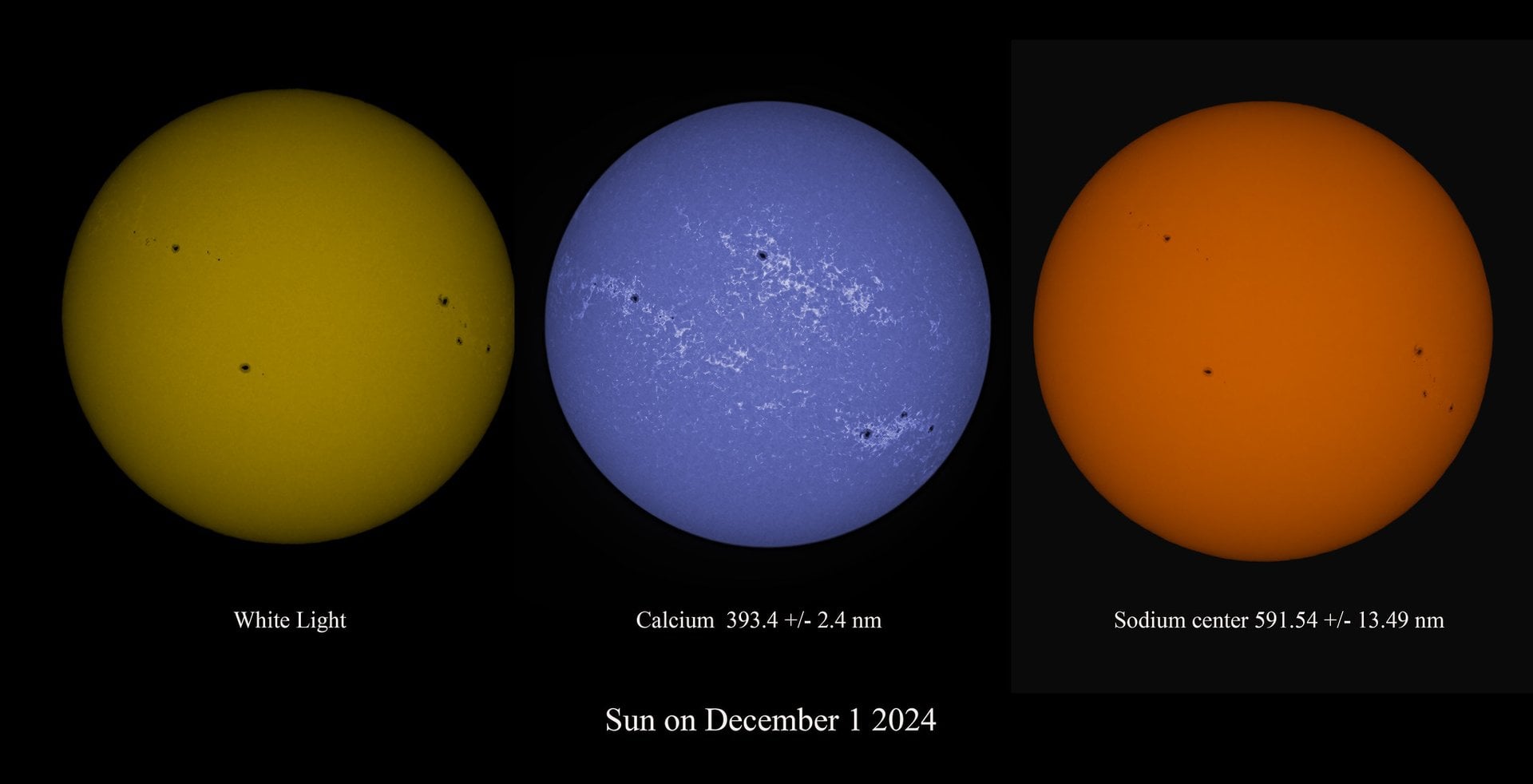
The study, conducted by solar researcher Eliot Herman, examined correlations between three different ways of observing the Sun: standard visible light imaging (which reveals sunspots), sodium wavelength observations, and calcium-K line imaging (which highlights magnetically active regions in the Sun's chromosphere). Each observing technique captures different aspects of solar magnetic activity, and by comparing them across a century of data, the research identified systematic relationships that had not been previously documented.
These correlations matter because they provide multiple independent indicators of the Sun's magnetic state. When several indicators align in a particular pattern, they can signal impending activity with greater confidence than any single measurement alone. The approach is analogous to weather forecasting on Earth, where combining data from temperature, pressure, humidity, and wind improves prediction accuracy far beyond what any individual measurement could provide.
Practical Applications for Space Weather
- Improved forecasting of solar flares that can disrupt radio communications
- Better prediction of coronal mass ejections that threaten satellite electronics
- Enhanced warning systems for geomagnetic storms affecting power grids
- More accurate predictions of radiation levels for astronaut safety
- Potential to extend the useful forecast horizon from hours to days

Why Space Weather Matters More Than Ever
The urgency of better space weather prediction has grown dramatically in recent decades. Modern civilization relies on a constellation of technologies that are directly vulnerable to solar activity. GPS navigation systems, telecommunications satellites, airline operations at high altitudes, and electrical power grids can all be disrupted by intense solar events.
The most famous example of a catastrophic solar storm — the Carrington Event of 1859 — occurred when telegraph networks were the most advanced electrical technology. A similar event today could cause trillions of dollars in damage by disabling satellites, overloading transformers, and disrupting communications. Insurance industry analyses have repeatedly identified extreme space weather as one of the highest-impact, lowest-probability risks facing modern infrastructure.
The Value of Long Data Sets
One of the study's most important contributions is demonstrating the scientific value of historical observational records. Many of the solar observations used in the analysis were made by individual astronomers at observatories that no longer exist, using instruments that have long since been superseded by space-based telescopes. Yet these painstaking ground-based records, accumulated over decades, contain information that cannot be obtained any other way — simply because modern instruments have not been operating long enough to capture multiple full solar cycles.
The research underscores a broader lesson in science: seemingly obsolete data can become extraordinarily valuable when new analytical techniques are applied to it. A century of solar observations, originally recorded on photographic plates and hand-drawn diagrams, is now being mined with computational tools that the original observers could not have imagined.
As Solar Cycle 25 continues toward its expected maximum, the correlations identified in this study will be put to the test. If the predictions hold, they could form the basis of a new generation of space weather forecasting tools that protect the infrastructure on which modern life depends.
This article is based on reporting by Universe Today. Read the original article.
Originally published on universetoday.com