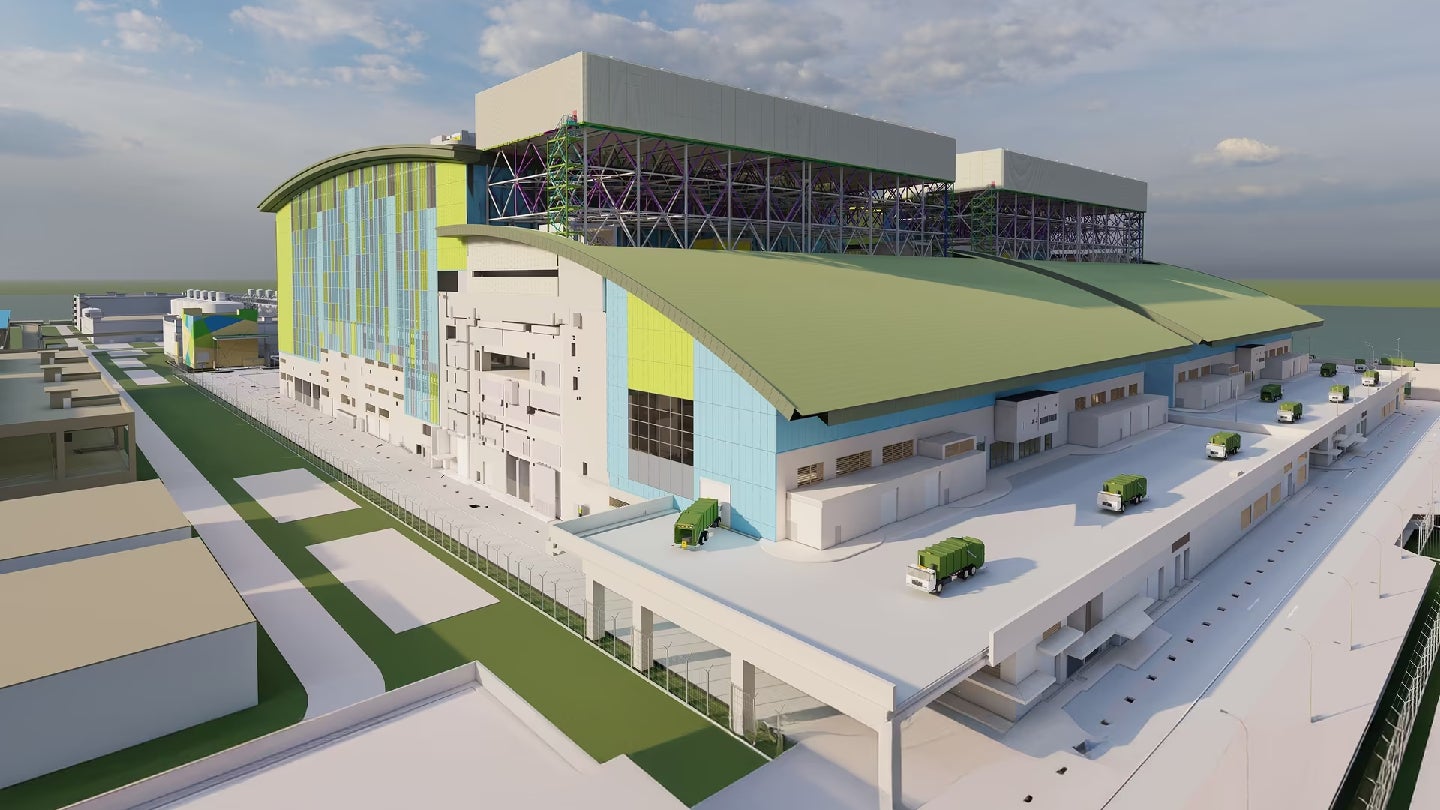
Singapore is extending one of its flagship integrated resource projects
Singapore’s National Environment Agency has appointed a joint venture of AECOM, Binnies, and Ramboll to provide consultancy services for the second phase of the Integrated Waste Management Facility at Tuas Nexus. The expansion will deepen the city-state’s effort to combine waste management, energy generation, and resource recovery within a tightly planned infrastructure complex.
Phase 2 of the facility is planned to manage up to 2,900 tonnes of waste per day. According to the project description, that capacity is intended to support both energy generation from waste and the recovery of useful resources. The facility may also incorporate future carbon capture capabilities, adding another layer to its role in Singapore’s long-term environmental infrastructure strategy.
The Integrated Waste Management Facility is co-located with the Tuas Water Reclamation Plant within the broader Tuas Nexus complex. That co-location is central to the project’s logic. Rather than treating water treatment, waste handling, and energy recovery as isolated systems, the site is designed around operational integration.
The second phase builds on an already active first phase
The newly appointed joint venture will oversee planning, design, procurement support, construction supervision, and testing and commissioning services for the expansion. The partners are not new to the site. AECOM and Binnies, with Ramboll support, have already served as owner’s engineer in Phase 1, which remains underway.
That continuity gives the team both technical familiarity and institutional memory, which can matter on complex infrastructure programs where sequencing, interfaces, and site constraints are tightly interwoven. The project will use a multi-contract delivery approach, drawing on the team’s Phase 1 experience to manage delivery across multiple scopes.
The firms also point to a wider global portfolio of waste-to-energy work. Together, the joint venture members say they bring experience from more than 200 waste-to-energy projects. For Singapore, that matters because Tuas Nexus is not simply another municipal plant. It is part of a national strategy for handling future waste volumes in a dense, land-constrained environment.

Why Tuas Nexus matters in energy and resource policy
Waste-to-energy infrastructure occupies a complicated place in the energy transition. It is not a substitute for reducing waste generation, but in dense urban systems it can be a practical tool for reducing landfill dependence while extracting energy from material that would otherwise require disposal. When paired with resource recovery and potentially carbon capture, it becomes part of a broader circular infrastructure agenda.
That appears to be the role envisioned for Tuas Nexus. The second phase is being positioned not only as added disposal capacity, but as a way to support integrated management of waste and water while generating useful outputs from waste streams. In a country like Singapore, where space constraints and infrastructure efficiency are persistent strategic issues, that integration can be more important than any single technology choice.
The mention of possible future carbon capture is also notable. It suggests that planners are leaving room for the facility to evolve as emissions management expectations change. While the current announcement does not provide implementation details, the possibility signals that waste-to-energy projects are increasingly being asked to fit within tighter carbon frameworks rather than rely only on landfill avoidance arguments.
An infrastructure story with broader regional relevance
Singapore’s approach is closely watched because it often serves as a test case for integrated urban infrastructure. Tuas Nexus reflects a model in which utilities, waste handling, and energy functions are designed as connected systems rather than separate agencies and projects. That may become more attractive elsewhere as cities confront rising waste volumes, tighter land use, and pressure to recover more value from existing streams.
The Phase 2 appointment does not change the project’s fundamentals, but it does move the next stage of the program into more concrete development. With consultancy, procurement support, and supervision responsibilities now assigned, the focus shifts from concept and policy framing toward execution.
The larger significance is that Singapore is continuing to invest in infrastructure that treats waste not just as a disposal burden, but as part of a managed energy and resource system. As urban regions search for workable combinations of resilience, efficiency, and decarbonization, that is a model likely to draw continued attention.
This article is based on reporting by Energy Monitor. Read the original article.

Originally published on energymonitor.ai




