More supply changed the price picture across much of MISO
The Midcontinent Independent System Operator’s latest Planning Resource Auction delivered a sharp reversal from the extreme pricing seen a year earlier. Outside the winter season, capacity prices fell across the system as new supply outpaced demand growth, with solar playing a central role in the increase in accredited resources clearing the market.
According to MISO’s report, summer season prices dropped from $666.50 per megawatt-day in all regions a year ago to lower levels across major areas in the new auction: $424.30 in the North and Central regions, $384.10 in Arkansas and Mississippi, and $412.10 in Louisiana and Texas. Across MISO’s 10 zones, annualized capacity prices for the 2026-27 planning year fell to a range of $116 to $126 per megawatt-day, down from a range of $212 to $217 the prior year.
That kind of decline does not mean the system’s reliability concerns are solved. But it does indicate that efforts to bring additional capacity into the market are materially affecting outcomes, at least for most seasons.
Solar was the biggest visible mover
MISO said summer auction capacity offered rose 3.4% year over year, reaching 141 gigawatts from 136.3 gigawatts. The increase was driven by 5.6 gigawatts of new accredited capacity, with more than half of that coming from solar, followed by gas and battery storage. Another 1.3 gigawatts came from increased accreditation, while additional imports contributed 1 gigawatt.
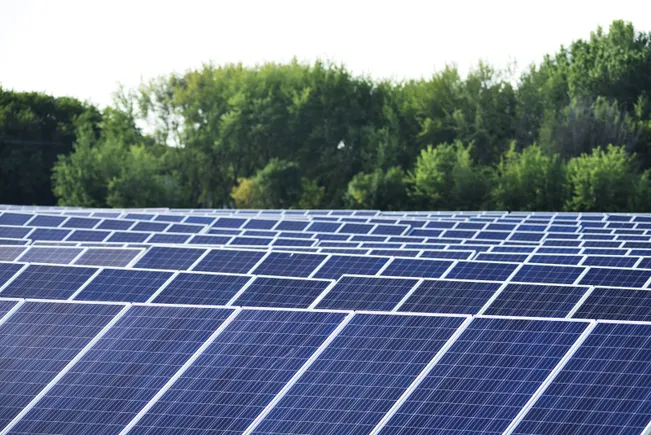
Solar’s growth is especially notable in the clearing results. About 12.2 gigawatts of accredited solar capacity cleared the auction, up 59% from 7.6 gigawatts a year earlier. That is a significant gain in a capacity construct where accreditation, rather than nameplate capacity alone, determines how much a resource can count toward reliability needs.
Not every resource type moved in the same direction. Wind cleared at about 5.5 gigawatts, down 8% from 6 gigawatts the previous year. Behind-the-meter generation and demand response were broadly steady for the summer season, with roughly 4.3 gigawatts and 9 gigawatts clearing respectively.
What the auction says about reliability
The immediate takeaway is that more supply helped cool prices. The deeper takeaway is that MISO still sees a system under pressure from growing demand and the continuing challenge of replacing retiring or less dependable resources with accredited capacity that can support reliability during stressed conditions.
The auction results included offsets that show why the story is not simply one of abundant additions. Capacity retirements removed 1.4 gigawatts. Reduced accreditation took away another 1.7 gigawatts. In other words, some of the benefit from new resources was consumed by the loss or de-rating of existing contributions.
Even so, MISO said the summer auction cleared with a reserve margin 3.5 percentage points above its 7.9% reliability reserve target. That is a useful buffer and a much healthier signal than a result scraping against the requirement. It suggests the region did more than just meet the threshold; it cleared with additional headroom.
Aubrey Johnson, MISO’s vice president of system planning and competitive transmission, said the increase in capacity reflects collaborative efforts by MISO, states, and members to bring new resources online quickly to meet growing demand. He also emphasized that more work remains as load growth accelerates.
Why the trend matters for the broader energy transition
The results offer a practical view of how the energy transition is showing up inside reliability markets. Solar additions are no longer just shaping energy prices at midday; they are increasingly large enough, and sufficiently accredited, to alter capacity auction outcomes. Batteries and gas also contributed to the supply increase, showing that the near-term buildout remains mixed rather than dominated by a single technology.
At the same time, the persistence of winter-season concern and the explicit warning about accelerating load growth make clear that falling capacity prices should not be mistaken for a fully stabilized resource adequacy picture. Data center growth, electrification, industrial demand, and extreme weather are all pushing grid planners toward a more difficult balancing act: adding enough dependable accredited capacity while navigating retirements and evolving performance expectations for each resource class.
Key numbers from the auction
- Summer offered capacity rose to 141 GW from 136.3 GW a year earlier.
- About 12.2 GW of accredited solar capacity cleared, up 59% year over year.
- Annualized capacity prices across MISO’s zones fell to a range of $116 to $126 per MW-day.
- The summer auction cleared 3.5 percentage points above MISO’s reliability reserve target.
For the market, the message is straightforward: adding supply works, and solar is now a visible part of that story. For planners, the message is more restrained. Lower prices are welcome, but they arrived alongside clear reminders that retirements, accreditation changes, and rising demand can quickly tighten conditions again. MISO’s latest auction looks like progress, not resolution.
This article is based on reporting by Utility Dive. Read the original article.

Originally published on utilitydive.com