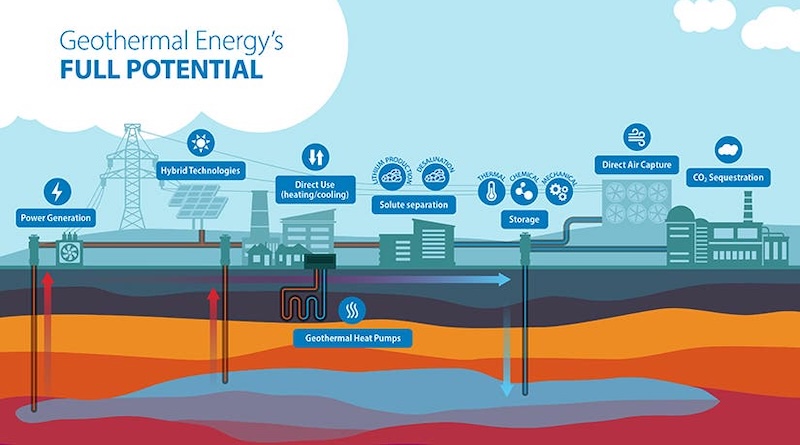
Geothermal's Moment Has Arrived
For decades, geothermal energy occupied a peculiar position in the renewable energy landscape: universally acknowledged as a nearly ideal power source — clean, baseload-capable, weather-independent, and small in footprint — yet perpetually overshadowed by the explosive growth of solar and wind. That dynamic is changing rapidly. A convergence of policy support, technological innovation, and surging demand for reliable clean electricity has pushed geothermal energy into the spotlight in a way it has never experienced before.
The past several months have brought an unprecedented string of victories for the geothermal sector. Federal and state legislators have passed measures that streamline permitting for geothermal projects, extend tax credits previously available only to solar and wind installations, and fund research into next-generation drilling technologies. The bipartisan support is notable in an energy policy landscape that is otherwise deeply divided along partisan lines.
At the same time, advances in drilling technology — many borrowed directly from the oil and gas industry — are dramatically expanding the geographic range of viable geothermal resources. Techniques like enhanced geothermal systems (EGS), which create artificial reservoirs by injecting water into hot rock formations, mean that geothermal energy is no longer limited to the volcanic regions of the western United States. In principle, EGS could be deployed almost anywhere, tapping the vast reservoir of heat stored in Earth's crust.
The Technology Revolution
The transformation in geothermal technology reads like a case study in cross-industry knowledge transfer. For decades, geothermal drilling relied on techniques and equipment that had not fundamentally changed since the industry's early days. Wells were expensive, slow to drill, and limited to naturally occurring hydrothermal reservoirs where hot water or steam could be accessed relatively close to the surface.
The oil and gas revolution that unlocked shale formations through horizontal drilling and hydraulic fracturing has now begun to reshape geothermal development. Companies like Fervo Energy have demonstrated that the same directional drilling techniques used to extract oil from tight rock can be applied to create engineered geothermal reservoirs at depths of several kilometers.
Fervo's approach involves drilling paired horizontal wells into hot granite formations, then stimulating the rock between them to create a network of fractures through which water can circulate. Cool water is pumped down one well, heated by the rock, and returned to the surface through the other well as hot water or steam that drives a turbine. The company has already demonstrated the technology at a pilot project in Nevada and is scaling toward commercial operations.
Other companies are pursuing even more ambitious approaches. Quaise Energy is developing millimeter-wave drilling technology that uses directed energy to vaporize rock, potentially enabling wells to reach depths of 20 kilometers or more — far beyond the reach of conventional drilling. At those depths, temperatures exceed 500 degrees Celsius, offering energy densities that would make geothermal competitive with fossil fuels on a cost-per-megawatt basis.

Big Tech Comes Calling
Perhaps the clearest signal that geothermal has crossed a threshold is the interest from major technology companies. Google, Microsoft, and Meta have all signed or are negotiating power purchase agreements for geothermal electricity to supply their data centers. For these companies, geothermal offers something that solar and wind cannot: round-the-clock clean electricity that does not require massive battery storage systems to smooth out intermittency.
The appeal is especially strong for AI data centers, which run at very high utilization rates and require extremely reliable power. A data center training large AI models cannot afford to lose power for even brief periods, making baseload clean energy sources like geothermal particularly attractive.
Google has been the most visible tech company in the geothermal space, partnering with Fervo Energy on a project in Nevada that has been operational since 2023. The company has described geothermal as a key component of its strategy to match all electricity consumption with carbon-free energy on a 24/7 basis by 2030.
Policy Tailwinds
The policy environment for geothermal has never been more favorable. The Inflation Reduction Act of 2022 extended production tax credits and investment tax credits to geothermal projects, putting them on roughly equal footing with solar and wind for the first time. Subsequent legislation has gone further, funding geothermal research and development at the Department of Energy and directing the Bureau of Land Management to expedite permitting on federal lands.
State-level action has been equally important. Several western states have passed laws that specifically encourage geothermal development, recognizing it as a complement to the intermittent solar and wind capacity that already dominates their grids. Texas, which has no significant geothermal generation today, has emerged as a surprising supporter, with legislators seeing potential in the state's deep sedimentary basins and existing oil and gas workforce.
The bipartisan nature of this support reflects geothermal's unique political position. It is clean enough to satisfy climate advocates, industrial enough to appeal to energy hawks, and domestic enough to fit into energy independence narratives. It also promises to create high-paying jobs for workers with drilling and oilfield experience — a powerful argument in states where the fossil fuel industry is a major employer.

Scale and Challenges
Despite the momentum, geothermal still faces significant scaling challenges. The United States currently has about 3.7 gigawatts of installed geothermal capacity, compared to over 200 gigawatts of solar and nearly 180 gigawatts of wind. Closing that gap will require massive investment in drilling rigs, workforce development, and supply chain capacity.
Drilling costs remain the single largest barrier. Geothermal wells are expensive — often $5 million to $10 million each — and not all wells produce commercially viable heat. Reducing these costs through technology improvements and learning-by-doing is essential for the industry to achieve the scale its advocates envision.
Water usage is another consideration. EGS systems require water for the circulation loop, raising questions about resource competition in arid regions where geothermal resources are most accessible. Closed-loop designs that minimize water consumption are being developed but add complexity and cost.
Nevertheless, the trajectory is unmistakable. Geothermal energy is transitioning from a niche contributor to a potentially transformative component of the clean energy mix. Whether it can scale fast enough to meet the moment remains to be seen, but the combination of technology, policy, and market demand suggests that the long-overlooked renewable is finally getting its day.
This article is based on reporting by CleanTechnica. Read the original article.
Originally published on cleantechnica.com




