Utility load growth is back, but on different terms
Evergy now expects retail sales to grow 7% to 8% a year through 2030, up from its previous 6% forecast, with data centers driving much of the increase. According to Utility Dive’s reporting on the company’s first-quarter earnings call, the Kansas City-based utility has signed large-load electric service agreements totaling 2.5 GW, up from 1.9 GW disclosed just three months earlier.
That acceleration is significant because it captures one of the clearest shifts in the US power market: electricity demand from hyperscale digital infrastructure is no longer a distant planning scenario. It is beginning to reshape utility forecasts, generation plans, and capital allocation decisions in real time.
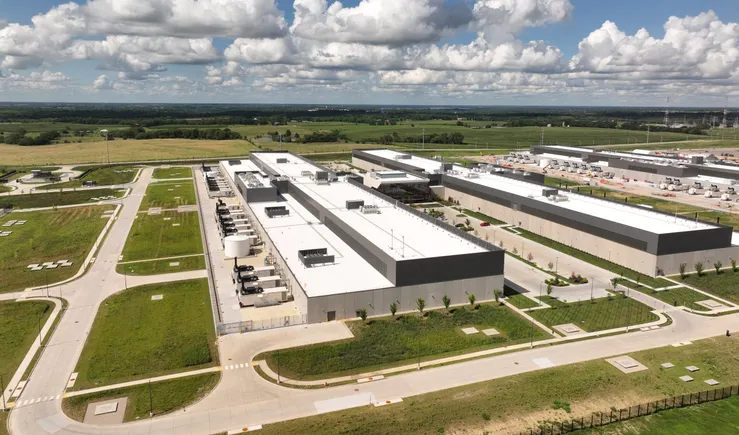
Evergy’s management said customers including Meta and Google are contributing to the growth outlook, while an additional unnamed customer has expanded the utility’s contracted large-load pipeline. The company also said it expects to sign at least one more large-load agreement this year and is in discussions that could further increase demand after 2030.
The growth story comes with a fossil-heavy response
The most consequential part of Evergy’s update may not be the higher sales forecast itself, but how the company plans to serve that demand. Utility Dive reported that Evergy has increased its planned gas-fired generation in Missouri to 4.7 GW. At the same time, it has reduced long-term planned wind and solar additions to 465 MW, down from 4,815 MW expected a year earlier.
That is a striking rebalancing. In simple terms, a utility facing fast data-center growth is leaning harder into gas and dramatically trimming future renewable additions. The shift does not necessarily mean renewables are disappearing from the mix, but it does show how load timing, system reliability concerns, and contracting realities can push utilities toward generation choices that look more conventional than many decarbonization road maps had anticipated.
This matters well beyond Evergy’s service territory. Utilities across the United States are now confronting the same question: if large-load customers want firm power on aggressive schedules, what resources can actually be built in time and integrated with confidence? Evergy’s answer, at least for now, points strongly toward natural gas.

Why the data-center effect is so powerful
The company’s latest figures show how quickly these customers can change utility planning assumptions. Evergy said it has 2.5 GW in total large-load contracts, plus another 450 MW under contract with customers including Panasonic’s electric-vehicle battery manufacturing plant. It is also exploring expansion of existing electric service agreements by up to 1.5 GW and is in advanced discussions for another 1.5 GW to 3 GW of large-load customers after 2030.
Those volumes are large enough to alter not only sales growth, but transmission planning, reserve margins, and investment priorities. In its first quarter, Evergy said weather-normalized retail sales rose 4.7% from a year earlier. Residential, commercial, and industrial segments all contributed, but data centers were identified as a main factor in commercial demand growth and a broader driver of the company’s long-term outlook.
That pattern reinforces a national trend: data centers are becoming one of the most powerful demand-side forces in electricity markets, alongside manufacturing and electrification. For utilities, they promise new revenue and stronger load growth after years of relative stagnation. For policymakers and customers, however, they also raise questions about costs, fuel choices, and whether the new demand will crowd out cleaner resource plans.
What this says about the energy transition
Evergy’s update illustrates a widening tension in the power sector. On one side is the push to decarbonize through more wind, solar, storage, and grid modernization. On the other is the practical pressure to serve very large new customers on timelines that may favor dispatchable thermal generation. The company’s decision to raise gas plans while cutting long-range renewable additions by more than 90% is one of the clearer signs yet that these pressures are no longer theoretical.
It does not prove that data-center growth and clean energy expansion are inherently incompatible. But it does show that the transition can move in uneven directions when demand growth returns faster than planning frameworks can adapt. If utilities perceive that reliability, timing, or interconnection constraints make renewable-heavy buildouts harder to execute quickly, gas can regain strategic importance even in systems that remain publicly committed to lower-carbon futures.
That dynamic is likely to shape debates over transmission, generation permitting, and the contractual obligations of large-load customers. Should data centers be required to bring their own clean energy or storage solutions? Should utilities recover new infrastructure costs from those customers specifically, rather than spreading them broadly? Those questions become more urgent as gigawatt-scale loads move from announcements to signed agreements.

Evergy’s forecast is a warning and an opportunity
Evergy reported first-quarter income of $151.5 million, up 21% from a year earlier, giving the company financial momentum as it adjusts its plans. But the strategic implications matter more than the quarterly numbers. The company is effectively signaling that a new era of load growth has arrived in its region, and that the supply response may look more carbon-intensive than many expected.
For investors, that may look like a straightforward infrastructure story. For regulators, communities, and industrial customers, it is more complicated. Rapid demand growth can support utility earnings and regional development while also reshaping generation choices for years. Evergy’s revised plan is one of the clearest early examples of that tradeoff.
If the company’s forecast holds, the utility will sit near the front edge of a national change: data-center expansion not as a marginal planning factor, but as a force strong enough to rewrite sales trajectories and resource mixes. That is why this earnings update matters. It is not just about Evergy. It is about what kind of power system the next wave of digital infrastructure may produce.
This article is based on reporting by Utility Dive. Read the original article.
Originally published on utilitydive.com