China’s electric truck shift is becoming visible in daily traffic
One of the clearest signs that a transport transition is real is when it stops living only in launch events and starts showing up on ordinary roads. That is the frame behind CleanTechnica’s report on LANDKING at Auto China: electric trucks are no longer a speculative category in China’s commercial vehicle market, but an increasingly visible part of freight movement.
The article begins with a simple observation from Guangzhou. Compared with just a few months earlier, more electric trucks were already appearing in traffic, sometimes with older cargo boxes mounted on new chassis. That visible increase set up the larger point: companies such as LANDKING, a division of Weichai, are now offering products whose specifications and economics make practical urban electrification easier to justify.
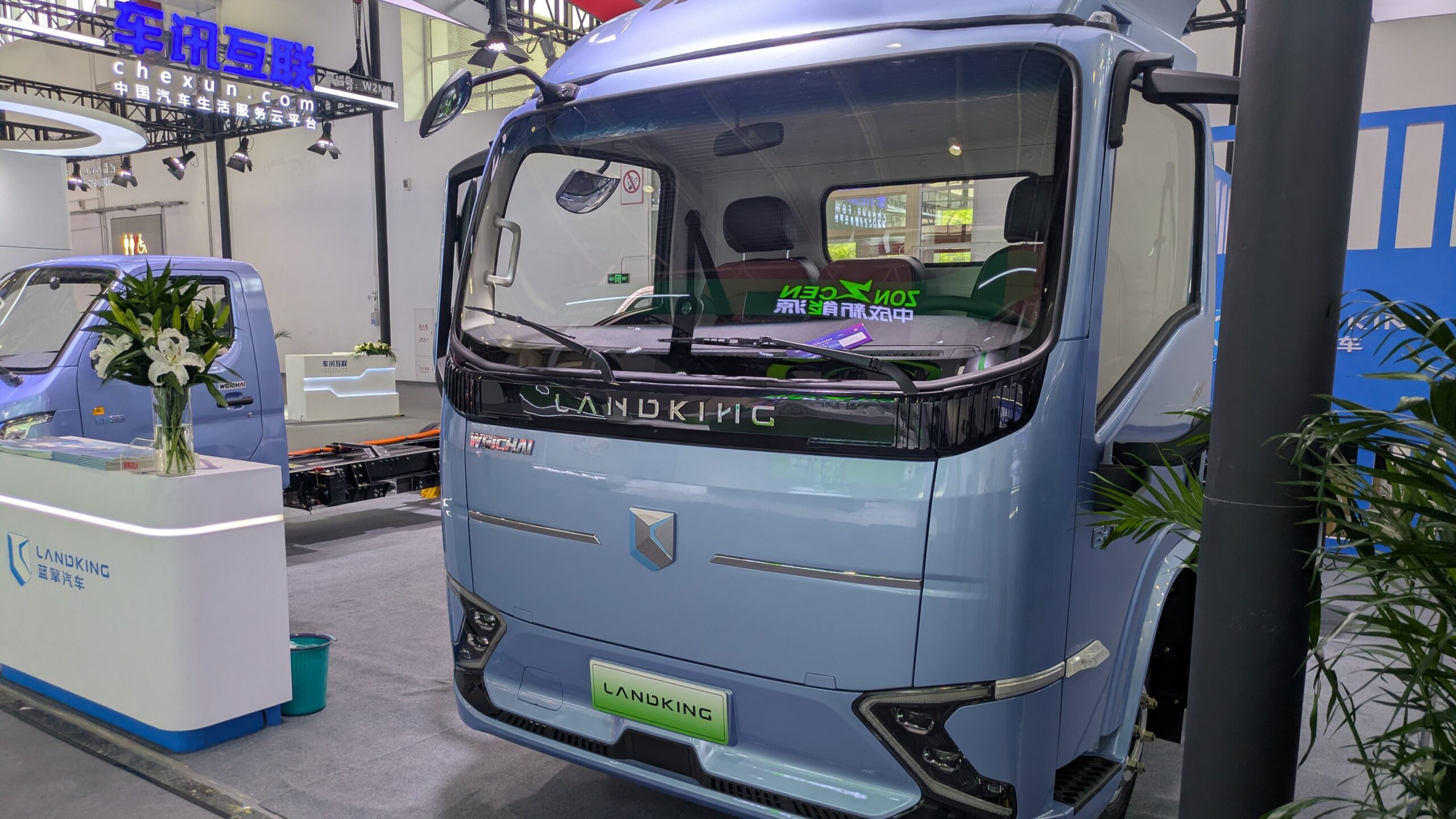
LANDKING’s truck lineup targets the right use case
At the show, LANDKING displayed both its larger EH Pro series and smaller ES series. The EH Pro 90, the most detailed vehicle in the report, is a medium-duty electric truck with a 9,000-kilogram gross vehicle weight rating and payload of up to 5,650 kilograms. It uses a 132-kilowatt-hour fast-charging LFP battery from FinDreams, BYD’s battery arm, and a single rear-axle motor delivering up to 200 kilowatts and 450 newton-meters of torque.
Those figures are not aimed at long-haul trucking, and the report does not pretend otherwise. The vehicle’s speed is electronically limited to 90 kilometers per hour, consistent with truck speed rules in China, and its range is rated at up to 330 kilometers, with actual distance depending on load and configuration.
That makes the EH Pro a tool for urban and short-distance transport rather than a universal replacement for diesel. But that is precisely why the product matters. Electrification rarely arrives by solving every transport problem at once. It starts where the duty cycle is favorable, charging can be planned, and the total cost equation is strong.

Urban freight may be the strongest early market
The report suggests that China offers particularly favorable conditions for this shift. Rail already carries a substantial share of long-distance freight, reducing the pressure on trucks to cover every leg of a logistics chain. That leaves a large and important market for regional and urban movement, where electric trucks are better matched to the work.
In that context, a 330-kilometer rated range can be more than adequate. Many commercial fleets value predictability over theoretical maximum flexibility. If a truck returns to base, operates on repeatable routes, and benefits from lower fueling and maintenance burdens, electrification can become a business decision rather than a branding exercise.
CleanTechnica also points to lightweighting efforts in the chassis, which remove hundreds of kilograms and support efficiency. In commercial transport, those engineering choices matter because they affect both usable payload and energy consumption. The truck is being designed around operating economics, not merely around an electric powertrain.
The product is also selling modernization
Commercial vehicles are purchased on performance, uptime, and cost, but modern fleet buyers still notice usability. The EH Pro’s cab is described as contemporary, with a central touchscreen, multifunction steering wheel, electronic parking brake, and an air-suspension seat with heating and ventilation. The report also notes maintenance-oriented features and repositioning of the cooling fan to reduce cab noise.
None of those details alone guarantees adoption. Together, they show how battery-electric trucks are being marketed not just as compliant or clean, but as better workplace tools. That matters in a sector where driver experience, maintenance simplicity, and urban operating comfort can influence fleet choices.
Why this matters beyond one brand
LANDKING’s products are the immediate subject, but the broader story is about momentum. The more truck makers bring purpose-built electric models to market, the easier it becomes for buyers to view electrification as standard procurement rather than experimental procurement.
The report’s tone suggests that this threshold may be approaching in parts of China. When electric trucks begin appearing frequently enough to stand out in street-level observation, that usually means multiple forces are aligning at once: product availability, charging support, regulatory pressure, manufacturing scale, and customer economics.
It also means expectations shift. Fleet managers stop asking whether electric trucks are possible and start asking which routes, payload classes, and charging models fit best. That is a much more mature stage of adoption.
What the China market is signaling
The key takeaway from the LANDKING display is not that one truck solves freight decarbonization. It is that commercial vehicle electrification becomes compelling when it is matched to the right geography and workflow. China appears to be creating those conditions faster than many other markets.
The EH Pro 90’s specs point toward a practical strategy: medium-duty trucks, short-haul use, rapid charging, reasonable payload, and product refinements aimed at daily fleet operation. That is not the flashiest transport story, but it may be one of the more consequential. Energy transitions often look inevitable only in retrospect. On the roads described here, electric trucking is starting to look inevitable in real time.
This article is based on reporting by CleanTechnica. Read the original article.

Originally published on cleantechnica.com