Virginia’s electricity growth is outpacing nearly every state
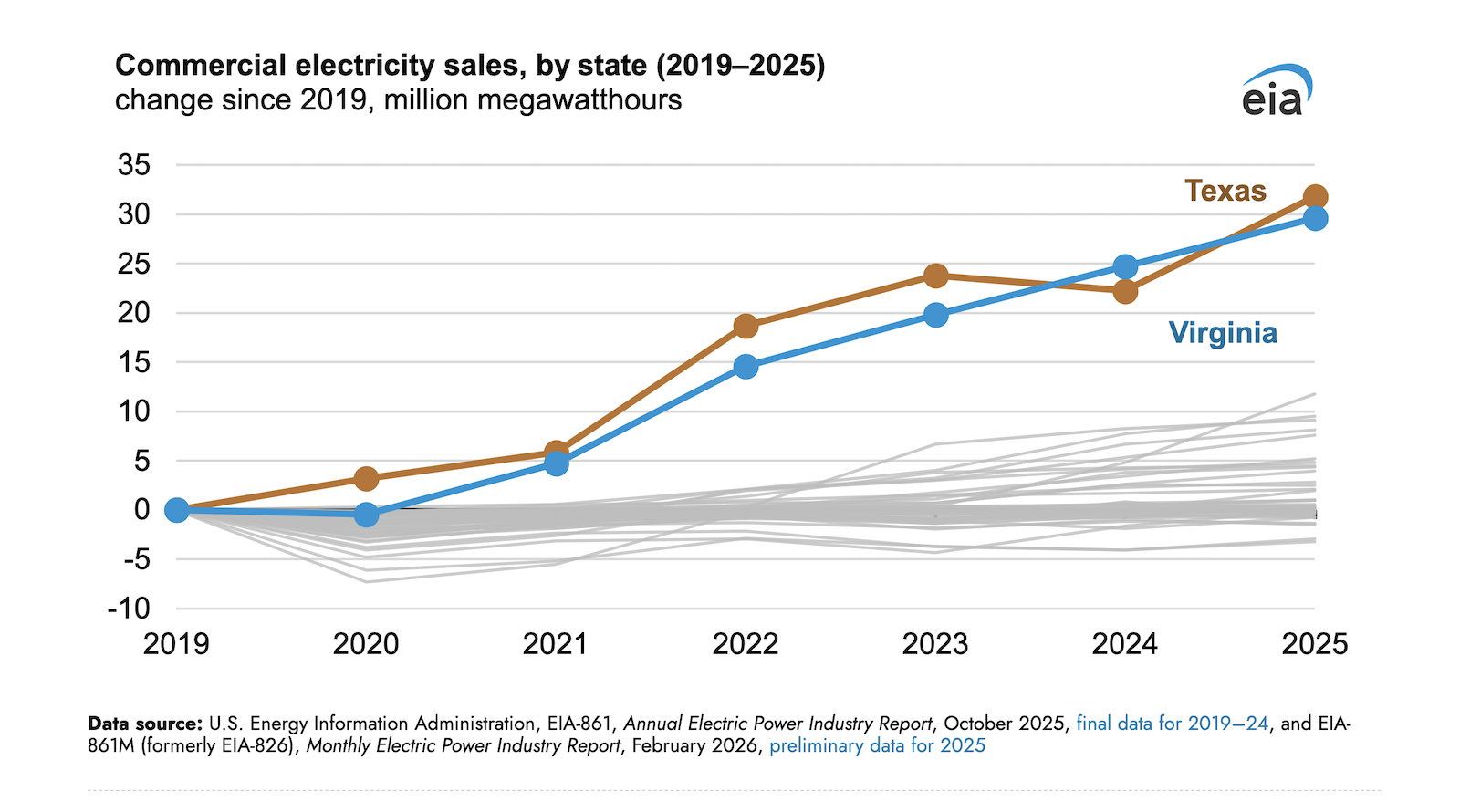
Virginia’s commercial electricity market has expanded at an unusually rapid pace, and the latest federal data points to a clear driver: data centers. According to the U.S. Energy Information Administration material cited in the source report, commercial electricity sales in the state increased by nearly 30.0 million megawatthours between 2019 and 2025. That is faster growth than in every other state except Texas, which is a much larger electricity market.
The increase matters because it is not simply a story about more power being sold over time. It is a sign that one of the country’s most important digital infrastructure corridors is putting real pressure on the grid that serves it. Virginia, and especially the Northern Virginia region tied to the PJM Interconnection footprint, has become synonymous with hyperscale and colocation data center growth. The federal data in this case links that commercial load growth largely to the concentration of data centers in the state, while also noting contributions from electric vehicle adoption and building electrification.
Why the load increase matters beyond a sales figure
Electricity sales describe how much energy load-serving entities deliver to end customers. But utilities and grid operators do not just have to meet annual energy demand totals. They also have to manage short bursts of demand that arrive during the hottest summer afternoons, the coldest winter mornings, or during severe weather. Those peaks can determine how much generation, transmission capacity, and reserve margin the system needs in order to remain reliable.
That is why the Virginia story is not only about a bigger bill for commercial users. It is about what happens when a region with the world’s largest concentration of data centers keeps layering new demand onto a system that must remain ready for hourly, daily, and seasonal spikes. A data center buildout can raise underlying energy use, but it can also reshape planning assumptions for substations, transmission upgrades, backup arrangements, and procurement strategies.

PJM expects Virginia to lead in peak demand growth
The source report says PJM Interconnection’s 2026 long-term load forecast expects the Dominion transmission zone, which covers Virginia, to post the largest absolute increase in summer peak demand from 2026 through 2030. PJM attributes that outlook largely to data center load. That forecast reinforces the idea that Virginia’s recent growth is not a short-lived anomaly. Grid planners are preparing for more of it.
The recent peak figures already show the direction of travel. Summer peak load in PJM’s Dominion zone reached 23,905 megawatts in 2025, up 23 percent from 2019, according to the cited data. Winter peak load rose even faster, reaching 25,413 megawatts in the 2025 to 2026 winter season, a 45 percent increase from the comparable 2019 to 2020 winter season.
Those numbers are notable for two reasons. First, they show that winter reliability is becoming more important alongside the traditional summer peak problem. Second, they suggest that the conversation around AI and digital infrastructure is increasingly inseparable from utility and transmission planning. Data centers are often discussed as a cloud or software story. In Virginia, they are also a hard infrastructure story measured in megawatts.
Why Virginia became the center of the buildout
The source identifies three factors behind Virginia’s data center concentration: fiber optic connectivity, land availability, and power infrastructure. Those advantages have helped make the state, and particularly the Dominion service area, a global hotspot for server farms that support cloud computing, internet traffic, and AI workloads.
That clustering creates a flywheel. Existing infrastructure attracts more tenants, more tenants justify more buildout, and more buildout raises the value of the surrounding network. But the same concentration also means the state’s electricity system feels the effect sooner and more intensely than markets where digital infrastructure is more dispersed.
Even the supporting drivers in the report, including building electrification and EV adoption, fit the same broader pattern. More end uses are shifting onto the grid at the same time that the digital economy is demanding more always-on capacity. The result is not just incremental growth. It is a structural increase in how important load growth has become in utility planning.

What this signals for the broader U.S. grid debate
The Virginia case is likely to be watched closely because it offers an early look at a problem other regions may soon face. When large data center clusters arrive in a market, annual electricity growth can accelerate quickly, and planners have to think in terms of both energy delivered and the highest-demand intervals that stress the system.
The source material does not present a policy prescription, but it makes one thing clear: demand growth in Virginia is now large enough to stand out at the national level. A nearly 30 million megawatthour gain in commercial sales in six years, plus steep increases in seasonal peaks, is no longer a niche utility statistic. It is evidence that digital infrastructure is becoming a leading force in state-level electricity demand.
For energy markets, the practical implication is straightforward. The next phase of the data center boom will not be defined only by new campuses, chips, or software models. It will also be defined by how quickly grids can expand capacity, maintain reliability, and absorb highly concentrated commercial load. Virginia is already living that transition.
This article is based on reporting by CleanTechnica. Read the original article.
Originally published on cleantechnica.com