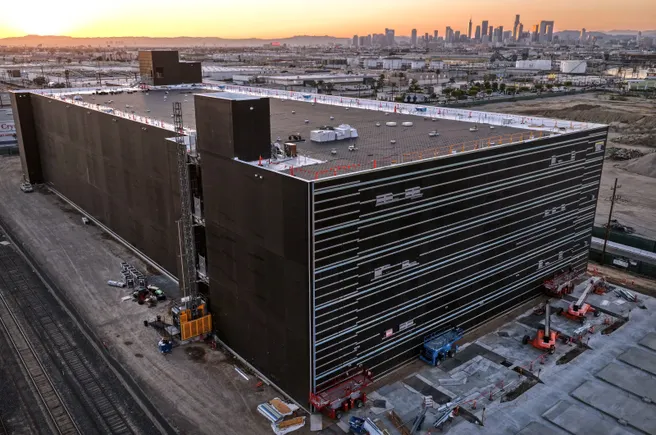
Data center expansion is no longer limited by developer appetite
For much of the past year, data centers stood out as one of the strongest areas in an otherwise weak construction market. That momentum is now running into a harder reality. Developers pursuing the next wave of large facilities are finding that many projects are slowing down or collapsing before construction starts, held back by grid limits, permitting friction and organized public opposition.
The shift reflects how quickly the market has changed. According to the reporting, what counted as a very large project only a few years ago has been overtaken by a new benchmark. A 100-megawatt lease once looked massive. Now projects larger than 1,000 megawatts are increasingly part of the conversation.
That jump in scale has consequences well beyond real estate. It changes the burden placed on transmission systems, generation planning, local permitting and community tolerance.
Power access is the first major bottleneck
The most immediate problem is electricity. These facilities require huge amounts of power, and that demand is reaching the grid faster than many regions can serve it. When a single project asks for hundreds of megawatts or more, the question is no longer simply whether a parcel is available or financing is in place. It is whether the surrounding energy infrastructure can support the load in a reliable and timely way.
That uncertainty is increasingly enough to derail a project. Industry participants quoted in the report said proposals that seem workable on paper often fail once power, permitting or labor constraints are examined in detail. In practice, that means the sector’s growth is becoming less a pure story of demand and more a story of infrastructure readiness.
Public opposition is becoming organized and effective
The second major constraint is political and social rather than technical. Local communities and political groups are pushing back against large data center construction, and the resistance is no longer isolated. The report says at least 188 local opposition groups are operating across 40 states.
That scale matters because it changes the developer playbook. Public sentiment is now described as the top concern in the market. In response, conference participants cited in the report said community benefits plans are rapidly becoming essential if projects are to survive local scrutiny.
This is a sign of how the industry is being forced to adjust. Data centers may be promoted as drivers of tax base, jobs and digital infrastructure, but neighbors and local officials are weighing those claims against land use, noise, visual impact, water and power consumption, and perceived strain on local systems. Where those tradeoffs feel one-sided, projects slow down.
Cancellations are rising as the politics harden
The numbers already show the trend. Baird analyst Justin Hauke found that data center project cancellations rose to 25 in 2025, up from six in 2024 and two in 2023. That is a sharp shift for a sector that had appeared to be moving almost entirely in one direction.
State-level politics are also entering the picture. Some legislatures are considering measures that would slow or limit development. Even where outright moratoriums do not pass, the threat of them adds uncertainty for developers, utilities and investors trying to line up land, power and approvals for projects with long lead times.
The broader significance is that the data center buildout is now colliding with the physical and political limits of regional infrastructure. The market still wants more capacity, especially as AI systems drive expectations for new compute demand. But the assumption that demand alone guarantees construction is proving false.
The next phase of the data center boom will be shaped not just by capital and cloud demand, but by whether developers can secure power, win community trust and fit projects into electricity systems already under strain. That is a much more complex expansion model than the industry has grown used to.
This article is based on reporting by Utility Dive. Read the original article.
Originally published on utilitydive.com