The US added thousands of fast-charging ports in one quarter
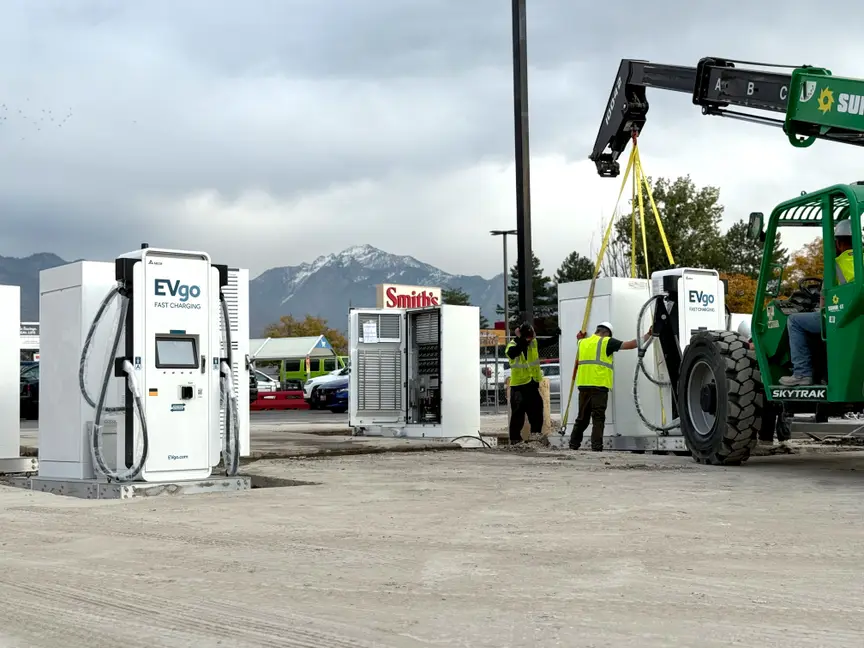
The US fast-charging network kept expanding at a substantial pace in the first quarter of 2026, adding roughly 3,300 new ports according to a new report from Paren. That level of deployment, the firm said, remained in line with seasonal patterns while keeping utilization near the levels seen at the end of 2025. In practical terms, that means the network is growing without yet showing signs that new stations are being built far ahead of demand.
Paren put first-quarter utilization at about 15.6 percent, only slightly below the previous quarter. That figure matters because charging infrastructure faces a difficult balancing act. If usage is too low, operators struggle to justify investment and maintenance. If usage is too high, drivers face queues, congestion, and a degraded experience. Steady utilization alongside rapid expansion suggests that new capacity is being absorbed as the electric-vehicle fleet grows and as more drivers rely on public charging for regional and long-distance travel.
The buildout is also becoming more concentrated around a particular model of deployment. Rather than simply opening a larger number of small sites, operators are increasingly prioritizing throughput. Paren said the trend is toward fewer stations with more ports per location, especially at higher power levels. New installations are increasingly dominated by chargers rated at 250 kilowatts or higher, reflecting a market that is optimizing for shorter sessions, better equipment turnover, and more standardized site layouts.
High-power charging is becoming the default strategy
This move toward larger, higher-output sites marks an important stage in the evolution of the charging market. Early public charging networks often emphasized geographic presence first, even if that meant modest site sizes or hardware that would quickly look underpowered as newer EVs entered the market. In 2026, the emphasis appears to be shifting toward economics and usability. More ports at each site can improve reliability through redundancy. Higher power ratings can reduce dwell times for compatible vehicles. Standardized designs can simplify construction, operations, and maintenance.
That does not mean every EV will charge at the same top speed, since vehicle architecture and battery management still determine how much power a car can accept. But widespread deployment of higher-capacity chargers improves the network’s overall ceiling. It also helps future-proof sites as more vehicles arrive with charging systems designed to take advantage of faster equipment.
Another notable part of the current wave is where many chargers are being installed. The report highlights mainstream retail and travel locations such as Walmart, Wawa, ShopRite, Kroger, and Love’s Travel Centers. That placement strategy matters because it turns charging into a more routine stop rather than a specialized one. Drivers can combine a fast charge with shopping, food, or rest breaks, making the infrastructure feel less like a workaround and more like a normal part of travel.

Why the charging network matters beyond the hardware itself
Charging stations are rarely the most glamorous part of the EV industry, but they remain one of the most consequential. Consumer interest in electric vehicles is shaped not only by the cars themselves but by confidence that those cars can be used flexibly. For many potential buyers, public charging availability still plays an outsized psychological role, even though a large share of charging happens at home. A denser and faster public network reduces range anxiety, supports apartment dwellers and drivers without home charging, and makes intercity travel more practical.
The first-quarter data also suggests that the US network is maturing operationally. When utilization stays stable despite thousands of additional ports, it implies that operators are not merely scattering underused hardware. Instead, the market appears to be finding a workable supply-demand balance. That is important for investors, network operators, automakers, and policymakers because charging reliability is not just a technical issue. It is a commercial one. A network that can add capacity without losing asset productivity is more likely to keep attracting capital.
There is also a behavioral dimension. Fast charging changes what long-distance EV travel feels like. If a driver can reliably charge during a short break for food or a restroom stop, then electric road trips begin to fit familiar travel rhythms rather than forcing major detours or lengthy waits. As charger density improves along highways and at destination-adjacent sites, the difference between planning an EV trip and planning a conventional one narrows.
A buildout that is becoming harder to dismiss
The quarter’s expansion arrives in a broader environment where EV adoption is shaped by price pressure, political conflict, and uneven narratives about consumer demand. Yet the charging network continues to grow in a way that is measurable and geographically visible. Each additional high-power site reduces a practical barrier to EV ownership, especially in places where public infrastructure has lagged behind vehicle sales.
The data does not mean the US has solved charging. Reliability remains uneven across networks. Rural coverage still lags urban and suburban corridors. Payment systems, maintenance practices, and station uptime continue to influence whether drivers trust a route or avoid it. But the first quarter of 2026 adds to a longer pattern: the network is not standing still, and it is not only getting larger. It is becoming more powerful, more standardized, and more integrated into everyday commercial locations.
If that trajectory continues, the significance goes beyond charger counts. A fast-charging system that expands while maintaining healthy usage can make EV adoption easier without waiting for a single breakthrough vehicle or policy intervention. The infrastructure itself begins to do more of the work, not by changing public opinion directly, but by making electric driving feel increasingly normal.
This article is based on reporting by CleanTechnica. Read the original article.
Originally published on cleantechnica.com