Advanced biofuels face a cost test in Europe’s car debate
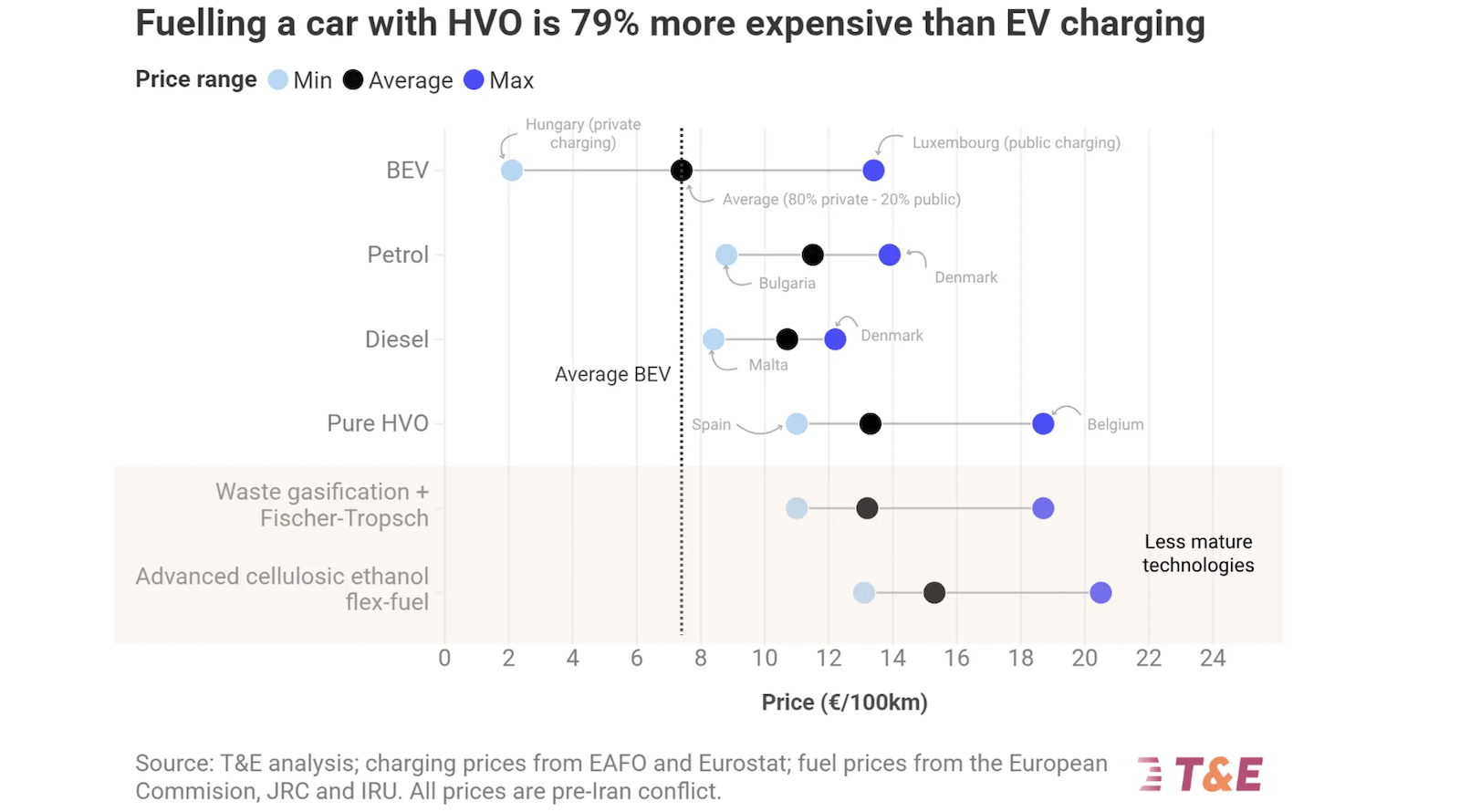
A new analysis from Transport & Environment adds sharper numbers to one of the European auto sector’s most contested policy arguments: whether advanced biofuels should help combustion vehicles count as a lower-emissions pathway, or whether the bloc should stay focused on battery-electric cars. According to the group’s figures, the economics are lopsided. Charging an electric vehicle costs about €7 per 100 kilometers on average in the European Union, while running a car on pure hydrotreated vegetable oil, or HVO, would cost about €13 over the same distance.
That gap matters because HVO has been promoted as a practical “drop-in” replacement for fossil fuel, one that could preserve much of the existing vehicle fleet and fueling infrastructure. The new analysis argues that the convenience story masks a more difficult reality for drivers. On average, T&E says, pure HVO is 79% more expensive than charging an EV. Less mature advanced biofuels made from sources such as the biomass portion of municipal solid waste or cellulosic residues could be even more costly, ranging from 80% to 110% above the cost of driving a battery-electric vehicle.
The policy dispute is bigger than one fuel
The cost comparison lands in the middle of a broader push by some governments and industry players to reshape how the EU treats vehicle emissions. The German and Italian governments, along with parts of the European car industry, want to weaken EU car CO2 targets by allowing combustion cars that can run on advanced biofuels to be counted as zero emission. T&E argues that such a change would undercut one of the main policy levers pushing automakers to bring more affordable EVs to market.
In that framing, the question is not just technical. It is about who pays for slower electrification. If lawmakers dilute the targets, the analysis suggests, consumers could be nudged toward vehicle and fuel combinations that are more expensive to use while also relying on limited biofuel supply. T&E’s position is blunt: keeping the current targets would do more to expand the supply of affordable EVs than creating new incentives for combustion vehicles dependent on scarce advanced biofuels.
Émilie Casteignau Bernardini, vehicles policy manager at T&E, summarized the argument clearly in the source article: charging an EV is cheaper than filling a tank with advanced biofuel, and promoting biofuels for cars risks delaying electrification while leaving motorists with the bill.

Scarcity may be as important as price
The analysis does not rest only on today’s pump-versus-charger math. It also points to a supply problem that could intensify over time. Advanced biofuels are limited, and demand for them is not confined to road transport. Aviation is becoming a major competitor. Under the EU’s ReFuelEU framework, jet fuel suppliers face penalties tied to sustainable aviation fuel targets, creating a strong incentive to buy advanced biofuels even when they are costly. That competition could push prices higher still.
From a policy standpoint, that scarcity creates an awkward mismatch. Road cars are a sector where battery-electric technology is already commercially available and increasingly mainstream. Aviation has fewer near-term alternatives for cutting fuel emissions at scale. If both sectors compete for the same finite pool of advanced biofuels, lawmakers will have to decide where those fuels deliver the most system-wide value.
T&E’s analysis implies that using scarce advanced biofuels in passenger cars would be an expensive diversion, particularly if it slows the shift toward electrification in a segment where battery vehicles are already a proven option.
What the Commission is proposing
The source also notes that the European Commission has proposed awarding biofuels credits to carmakers, even if it has not gone as far as counting biofuel-capable combustion cars as fully zero emission in the way some member states want. T&E calculates that the Commission’s proposal would still raise fuel spending significantly over the long term. The group says that by 2050, fuel spending would be 60% higher than under the current regulation, adding roughly €500 billion in extra costs.
Those figures are part of the reason this fight is becoming central to Europe’s transport and industrial policy. The debate is no longer simply about whether biofuels can cut emissions in principle. It is about whether they are the right answer for mass-market cars when the alternatives now differ so sharply on operating cost and scalability.

Why this matters now
The pressure to preserve flexibility for combustion technology remains strong across parts of Europe’s industrial base. Carmakers are balancing capital needs, uneven consumer demand, and regional politics. Biofuels can sound attractive because they promise continuity. Drivers keep familiar vehicles. Fueling stations remain relevant. Manufacturers protect legacy product lines for longer.
But continuity is not the same as competitiveness. The analysis highlighted in the source makes the opposite case: if policymakers treat expensive, supply-constrained fuels as a substitute for electrification in passenger cars, they may lock in higher costs for households while weakening the market signals that push cheaper EVs into showrooms.
- T&E says EV charging averages €7 per 100 kilometers in the EU, versus €13 for pure HVO.
- The group estimates pure HVO driving is 79% more expensive than driving an EV.
- More experimental advanced biofuels could be 80% to 110% more costly than battery-electric driving.
- The analysis argues that weakening EU car CO2 targets would shift costs to drivers and slow electrification.
The result is a clearer dividing line in Europe’s transport transition. Advanced biofuels may still have a role, especially where electrification is harder, but the case presented here is that passenger cars are not where limited, expensive supply should be spent. For drivers, the cost gap described in the source suggests the real issue is not whether biofuels are possible. It is whether they make economic sense at all compared with plugging in.
This article is based on reporting by CleanTechnica. Read the original article.
Originally published on cleantechnica.com