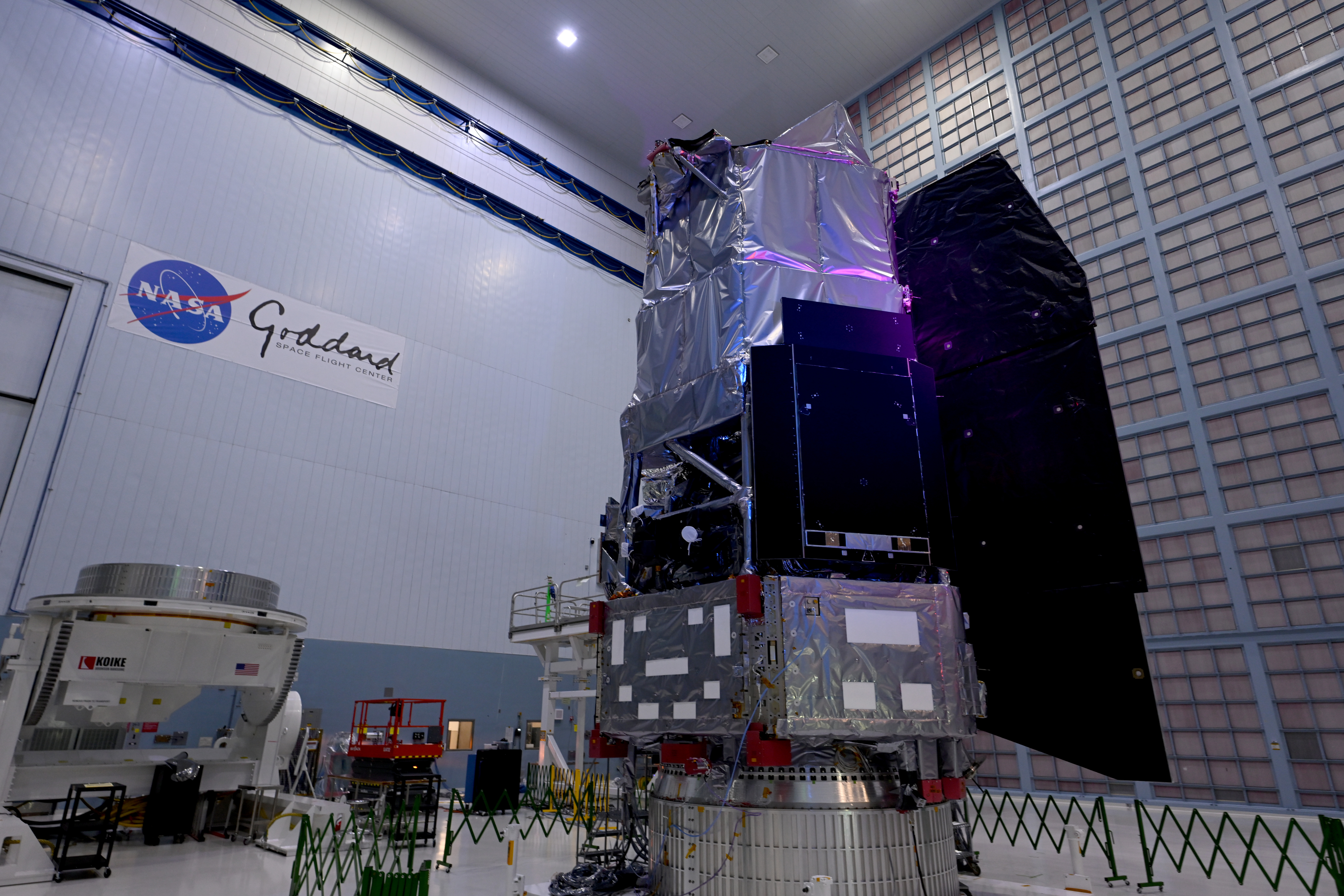
Roman leaves the clean room and enters its launch phase
NASA’s Nancy Grace Roman Space Telescope is about to cross an important threshold. The observatory, completed after construction, assembly, and testing at NASA’s Goddard Space Flight Center, is set to arrive at Kennedy Space Center in Florida for launch processing.
The agency’s announcement is technically a media advisory, but the underlying milestone is significant. Major space observatories spend years in design, integration, and test. Arrival at the launch site is one of the clearest signs that a mission is moving from development toward execution. For Roman, that means the telescope is transitioning from clean-room completion work in Maryland to the practical demands of launch-site handling and final preparations in Florida.
According to the supplied source text, Roman will travel aboard NASA’s Pegasus barge from Goddard to Kennedy. After unloading at Kennedy’s turn basin, technicians will move the telescope to the Payload Hazardous Servicing Facility for launch processing. Those logistics are routine for flagship-class missions, but they also reflect just how carefully space hardware must be handled once it has completed its core test campaign.
Roman’s scientific ambitions explain why the handoff matters. NASA says the observatory will use deep, sweeping views of the universe to observe billions of cosmic objects and explore fundamental questions about dark energy and planets outside our solar system. The telescope is expected to conduct broad cosmic surveys, generating large panoramic datasets rather than focusing only on narrowly selected targets.
That survey strength is part of what makes Roman distinct. The mission is designed to uncover vast numbers of celestial objects and provide a wider view of cosmic structure and evolution. NASA also says the observatory will carry a technology demonstration for direct imaging of planets around nearby stars, described as the most advanced technology of its kind ever flown in space. That makes Roman both a science mission and a testbed for capabilities relevant to future exoplanet searches.
The mission’s arrival at Kennedy therefore marks more than a shipping event. It is the beginning of the last major prelaunch stretch, when transport, storage, fueling-related procedures, integration planning, and final readiness activities all become central. By the time a telescope reaches this stage, the focus shifts from proving that it works to ensuring it survives the trip to orbit exactly as designed.
Roman also sits within a broader NASA strategy that blends astrophysics research with technology maturation. Its science case targets some of the biggest open questions in cosmology, especially the forces shaping the expansion of the universe, while its planet-imaging work points toward longer-term ambitions in the search for habitable worlds and possible signs of life beyond the solar system.
For space watchers, the immediate headline is simple: Roman is on the move. But the deeper significance is that one of NASA’s major next-generation observatories is leaving its development home and entering the launch pipeline. For a mission built to reveal unseen aspects of the cosmos, that is the point where promise starts becoming schedule.
Why this milestone matters
- Roman has completed construction, assembly, and testing at Goddard.
- Arrival at Kennedy shifts the mission into launch-site processing.
- The telescope is designed for wide-field surveys tied to dark energy and exoplanet science.
This article is based on reporting by NASA. Read the original article.
Originally published on nasa.gov