Cosmic Alchemy at the Edge of the Observable Universe
NASA telescopes have detected what may be the most distant gamma-ray burst ever observed, produced by two neutron stars spiraling into each other and detonating in a cataclysmic explosion known as a kilonova. The event, which occurred roughly 8.5 billion light-years from Earth, forged heavy elements including gold and platinum in a blinding flash that briefly outshone entire galaxies.
The detection, made possible by coordinated observations from the Chandra X-ray Observatory, the James Webb Space Telescope, and ground-based observatories, pushes back the frontier of multi-messenger astronomy and provides new evidence about how the universe manufactures its heaviest elements.
Where Gold Comes From
For most of the 20th century, scientists believed that all elements heavier than iron were produced inside massive stars and scattered into space when those stars exploded as supernovae. This picture was upended in 2017 when the LIGO gravitational wave detectors and dozens of telescopes observed a neutron star merger in the galaxy NGC 4993, just 130 million light-years away. That event, designated GW170817, confirmed that neutron star mergers are prolific factories for the heaviest elements in the periodic table.
The physics is extraordinary. When two neutron stars collide, the impact releases an enormous burst of neutrons — far more than are available in any other astrophysical environment. These neutrons are captured by atomic nuclei in a process called rapid neutron capture, or the r-process, building up heavier and heavier elements in fractions of a second. Gold, platinum, uranium, and many other heavy elements are assembled in this neutron-rich crucible and ejected into space at significant fractions of the speed of light.
The newly detected kilonova at 8.5 billion light-years represents the same process observed at far greater distance and far earlier in cosmic history. When the light from this explosion was emitted, the universe was only about 5 billion years old — less than half its current age. Detecting r-process elements at this epoch tells astronomers that neutron star mergers were already enriching the cosmos with heavy elements when the universe was relatively young.

An Unusual Cosmic Address
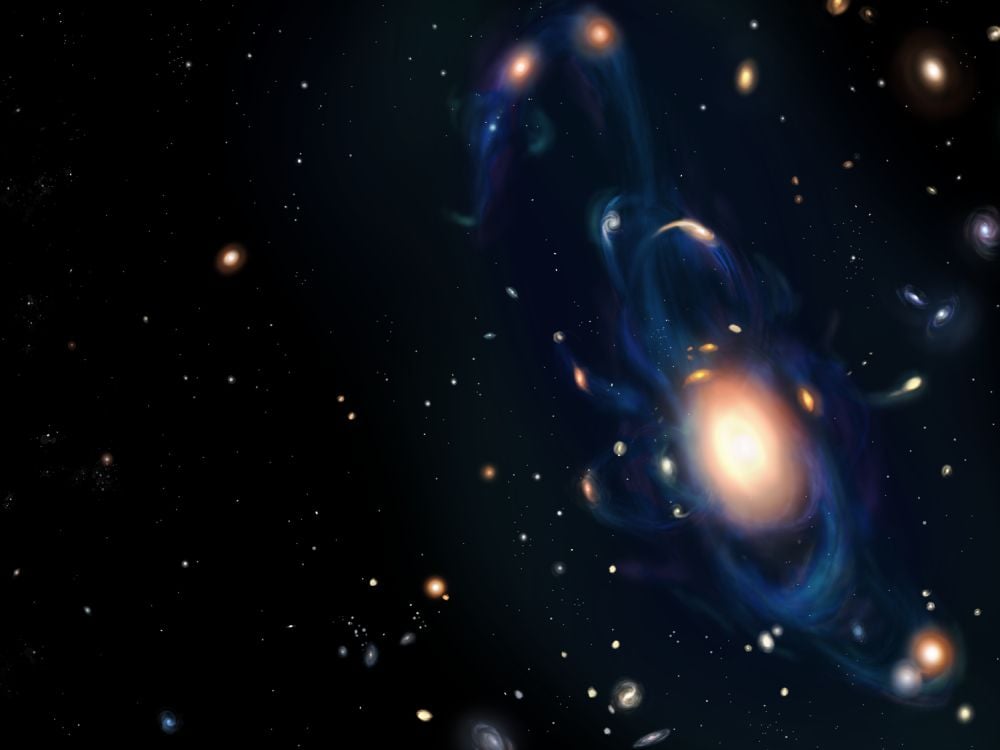
What makes this detection particularly intriguing is the kilonova's location. Rather than occurring within a single galaxy, the merger happened in a tidal stream — a ribbon of stars and gas torn from galaxies by gravitational interactions during a group merger. Multiple galaxies in the cluster are in the process of colliding and merging, creating complex streams of debris that stretch across hundreds of thousands of light-years.
Neutron star binaries — pairs of neutron stars orbiting each other — can take billions of years to spiral close enough to merge. During this time, gravitational interactions can kick the binary out of its parent galaxy entirely. Finding a kilonova in a tidal stream suggests that the neutron star pair may have been ejected from one of the merging galaxies and spent billions of years drifting through intergalactic space before finally colliding.
This has implications for understanding how heavy elements are distributed throughout the cosmos. If a significant fraction of neutron star mergers occur outside galaxies — in tidal streams, galactic halos, or intergalactic space — then the heavy elements they produce may enrich the diffuse gas between galaxies rather than being recycled into new stars and planets within galaxies.
Detecting the Faintest Signals
Observing a kilonova at 8.5 billion light-years required extraordinary sensitivity. The initial gamma-ray burst was detected by NASA's Swift observatory, which identified the high-energy flash and alerted other telescopes to the event's location. Chandra then detected the X-ray afterglow, which provided precise positional information. The James Webb Space Telescope observed the infrared emission characteristic of r-process elements, whose radioactive decay produces a distinctive red glow that persists for days to weeks after the merger.
The infrared signature is the smoking gun for heavy element production. Different elements produce different spectral features as their radioactive isotopes decay, and JWST's sensitive infrared spectrograph was able to identify the fingerprints of several heavy elements in the kilonova's fading glow. This spectroscopic confirmation is what distinguishes a kilonova from other types of transient events.

Implications for Cosmic Chemistry
Each kilonova detection helps astronomers build a statistical picture of how much heavy element material neutron star mergers produce and how frequently these events occur across cosmic time. Current estimates suggest that neutron star mergers can account for most of the gold, platinum, and other r-process elements observed in the universe, though some contribution from supernovae and other sources remains possible.
The record-breaking distance of this detection extends the observational baseline back to an era when galaxies were still actively assembling. Understanding the rate of neutron star mergers at this epoch constrains models of binary star evolution, neutron star formation, and the chemical evolution of the early universe.
Every gold atom on Earth — in jewelry, electronics, central bank vaults — was likely forged in an event like this one, billions of years ago, in the violent final moments of two dead stars colliding at a third the speed of light. This latest detection reminds us that even the most familiar materials have origins that are anything but ordinary.
This article is based on reporting by Universe Today. Read the original article.
Originally published on universetoday.com