Governments are doing more than regulating platforms
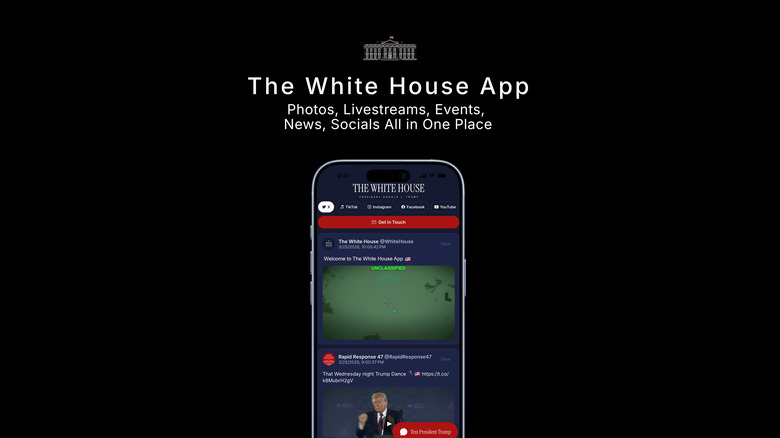
One of the quieter shifts in digital politics is that states and political institutions are no longer only trying to police platform power from the outside. They are also building new channels of their own, experimenting with direct distribution, and shaping how official narratives reach the public. An Engadget report on the new White House app captures that shift in unusually blunt form.
The app is presented as a direct line to the White House, offering press releases, livestreams, official communications, and notifications. In practical terms, the report says it acts as a central point for Trump administration messaging, with some features feeling less like civic infrastructure and more like campaign-style engagement. Among the examples Engadget highlighted were a news tab filled with apparently favorable stories, a “Text President Trump” prompt that pre-populates praise, and a pathway for submitting tips to Immigration and Customs Enforcement.
A new stage in platform politics
The larger significance of this kind of app is cultural as much as technical. For years, the relationship between governments and major platforms was defined by dependency. Officials needed social networks, video sites, and app ecosystems to reach citizens at scale. That dependence remains, but it is increasingly paired with something else: efforts to create branded state channels that bypass or at least complement third-party feeds.
The White House app, as described in the source material, does not replace social media or the web. Much of it reportedly opens external sites. But that is beside the point. The point is symbolic and strategic. A standalone app frames official communication as a destination rather than an interruption inside someone else’s platform. It creates a controlled wrapper around messaging, notifications, imagery, and prompts for action.
That matters because control over distribution increasingly means control over attention. When governments build their own channels, they are not just publishing information. They are trying to structure how citizens encounter it.

Official communication and political branding
The Engadget account emphasizes how quickly the app’s civic framing gives way to political branding. The publication questions the app’s value as a utility and portrays it as a cherry-picked portal for favorable narratives. That tension is revealing. Official digital tools are often presented as public-service infrastructure, but their design can blur into persuasion, loyalty-building, and image management.
The “Text President Trump” feature is a good example because it collapses the distance between formal office and personalized political identity. A user does not just contact an institution. The app reportedly encourages an expression of personal praise before funneling the interaction into a marketing signup. That is not a neutral design choice. It reflects a broader pattern in which digital interfaces can turn institutional access into political mobilization.
The reported inclusion of an ICE tip-submission function pushes the point further. It suggests that apps of this kind can operate not merely as communication tools but as behavioral funnels, encouraging citizens to participate in enforcement systems or ideological communities through a single interface.
The wider trend
The significance of the White House app becomes clearer when placed next to other developments in digital governance. Austria is pursuing stricter social media rules for minors. Other governments are pressing platforms over safety, moderation, and accountability. At the same time, public institutions are learning from the design logic of platforms themselves: notifications, engagement loops, branded feeds, and direct channels.
In other words, governments are responding to the platform era in two ways at once. They are seeking greater control over private digital systems, and they are becoming more platform-like in their own communications.
This does not mean every state app is propagandistic or novel. Many are routine service tools. But when the communication layer of government starts to adopt the idioms of social media and direct-response marketing, the cultural distinction between governance and attention management becomes less stable.

Why this matters culturally
Culture is shaped not only by what institutions say but by the interfaces through which they say it. A government website organized around documents and formal announcements communicates one kind of relationship with the public. An app built around push alerts, curated story carousels, and personalized prompts communicates another. The medium changes the tone of authority.
The White House app described by Engadget appears to push that evolution into a more openly partisan register. That makes it easy to dismiss as odd or excessive. But it may also be a sign of where public communication is headed more broadly. In a fragmented media environment, institutions want channels they can control, audiences they can notify instantly, and interfaces that keep attention inside their own branded spaces.
That logic does not belong only to political campaigns or media companies anymore. It increasingly belongs to states.
The open question
The unresolved question is what happens when official communication adopts the habits of platform culture too completely. Does it create better access to information, or does it encourage citizens to treat governance as another personalized content stream? Does it strengthen democratic visibility, or does it narrow the public sphere into curated feeds and branded interactions?
The source material does not answer those questions, but it makes them harder to ignore. An app that presents itself as a direct civic line while steering users through selective narratives and personalized political cues reveals how unstable the boundary has become between public information and political product.
That is why the White House app matters as a cultural story. It is not just a weird government app. It is evidence that the platformization of politics is entering a new phase, one in which institutions do not merely inhabit digital ecosystems created by others. They increasingly try to build their own.
This article is based on reporting by Engadget. Read the original article.

Originally published on engadget.com