San Diego Flock debate spills into satire and surveillance
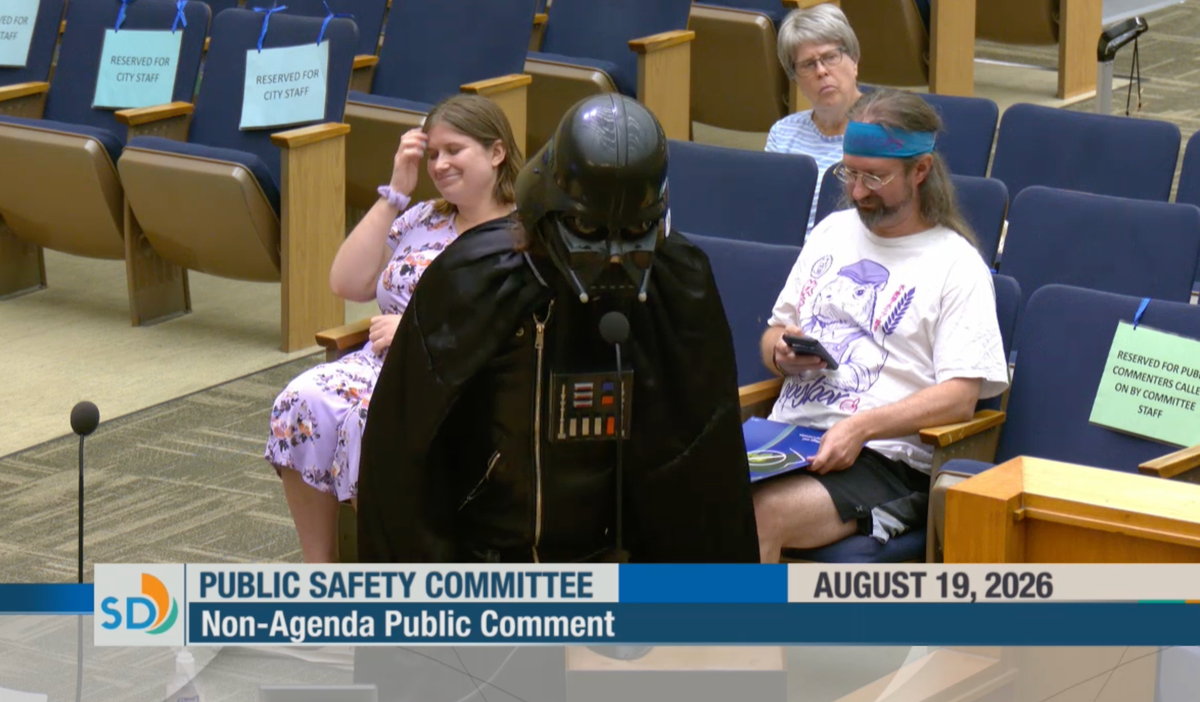
A San Diego city council meeting took an unusual turn this week when a public commenter dressed as Darth Vader used a brief, theatrical monologue to make a pointed argument about surveillance. The speaker, appearing during the public comment portion of the city’s Public Safety and Livable Neighborhoods Committee meeting on August 19, urged officials to continue using Flock technologies in language that was clearly satirical and sharply critical.
The performance was memorable, but the underlying issue is not comic. San Diego’s use of Flock systems sits inside a broader and increasingly consequential debate over how cities combine camera networks, license plate readers, open-source intelligence, and person-linking tools into larger surveillance infrastructures. The episode became newsworthy not because of the costume alone, but because it distilled a serious policy dispute into a form impossible to ignore.
What happened at the meeting
According to 404 Media’s account, the commenter approached the microphone in black helmet and cape as the council called for “Darth Vader” to speak. The remarks mocked official justifications for surveillance and framed Flock as a tool that extends well beyond vehicle tracking. In the speech, the commenter sarcastically praised the technology for following people, including children in parks and gymnasiums, and for enabling stalking and social control. The language was exaggerated by design, but the criticism was direct: surveillance systems sold as public safety tools can expand into much broader monitoring.
The commenter also invoked San Diego’s June 2023 vote in favor of the city’s Unsafe Camping Ordinance, tying the current surveillance debate to longer-running concerns about criminalization, enforcement, and the unequal burdens of public-order policy. That connection matters. Surveillance controversies rarely remain confined to the hardware itself. They quickly widen into questions about how data is used, who is targeted, and what institutional safeguards actually exist once a city has purchased the capability.
The scale of the local system
San Diego is not debating a hypothetical deployment. The city already has a substantial Flock footprint. 404 Media reports that publicly available data aggregated by the tracking map DeFlock shows more than 550 Flock cameras installed around San Diego. That kind of density changes the character of the discussion. At smaller scales, license plate readers can be presented as narrowly tailored investigative tools. At larger scales, they begin to resemble persistent urban sensing networks.
The number of cameras does not by itself reveal how the system is used day to day, but it does establish why residents and advocates are scrutinizing the program more intensely. Once hundreds of nodes are installed, the questions shift from whether a city has adopted a technology to what kind of data environment it has created.
Why Nova changes the conversation
The stakes increased further with the city’s move into Flock’s Nova service. Axios reported in April, as cited by 404 Media, that San Diego signed a year-long deal giving the San Diego Police Department access to Nova, which combines open-source intelligence with data from other law enforcement agencies.
That expansion is important because it suggests a shift from a primarily camera-centered system to a more integrative intelligence platform. A license plate reader on its own captures a relatively bounded form of information. A platform that links plate data with wider personal and relational data can create a far richer profile. Even if each individual data source is legal or commercially available, the combined result can feel qualitatively different from the sum of its parts.
404 Media underscored that point by citing an audio recording from an internal Flock company meeting. In that recording, a Flock employee said users would be able to jump from license plate reader data to a person and then understand the context around that person, including links to other people through relationships such as marriage or gang affiliation. The quoted remark is striking not just for what it says about product capability, but for what it implies about investigative ambition: the goal is no longer simply to locate a vehicle, but to map social context around individuals.
From public safety tool to relational surveillance
This is where the San Diego debate becomes emblematic of a larger national shift. Camera networks have often been introduced with narrow promises, usually focused on stolen vehicles, wanted suspects, or rapid identification after specific crimes. But once those systems are connected to broader databases and analysis layers, the practical function can expand from observation to inference.
The criticism voiced at the council meeting, however theatrical, was built around exactly that fear. The speaker’s references to following children, surveilling movement between community spaces, and using official language to sell broader monitoring all aimed at the same concern: that public consent is often sought for one use case while the system’s architecture allows many more.
Supporters of such tools generally argue that data integration makes investigations faster and more effective. Critics counter that the same integration lowers the threshold for intrusive monitoring and makes misuse harder to detect. The supplied source text does not resolve that dispute, but it does show that San Diego is already living inside it.
Why the style of protest matters
There is a tendency to dismiss performative protest as spectacle. In this case, that would miss the function of the tactic. The Darth Vader appearance worked because surveillance policy can be abstract, procedural, and difficult for the public to parse. A satirical speech translated a technical governance issue into plain political language. It accused officials of using public-safety rhetoric to normalize more expansive monitoring, and it did so in a format likely to travel beyond the hearing room.
That alone does not prove the critique correct. But it does reveal something important about the politics of surveillance in 2026: the fight is no longer only about whether a city buys cameras. It is about whether residents understand how those cameras connect to software, data brokers, intelligence feeds, and relationship-mapping tools.
What comes next
The San Diego confrontation is unlikely to be the last of its kind. As cities adopt systems that merge physical monitoring with digital data enrichment, public oversight will have to grapple with more than procurement contracts. It will need to address linkage, retention, access, and the practical boundaries of investigative use.
The Vader speech put that challenge into a sharp, if unconventional, frame. San Diego’s surveillance debate now includes not only the visibility of hundreds of cameras but also the less visible question of what happens when those cameras feed into tools designed to connect people, places, and relationships. That is a policy question with consequences far beyond one city council microphone.
- A San Diego public commenter used satire in costume to criticize the city’s use of Flock surveillance technology.
- More than 550 Flock cameras are installed in San Diego, according to data cited by 404 Media.
- The city also signed a year-long deal for Flock’s Nova service, which adds open-source intelligence and other agency data.
- The debate is shifting from cameras alone to broader person-linking and relational surveillance capabilities.
This article is based on reporting by 404 Media. Read the original article.
Originally published on 404media.co


