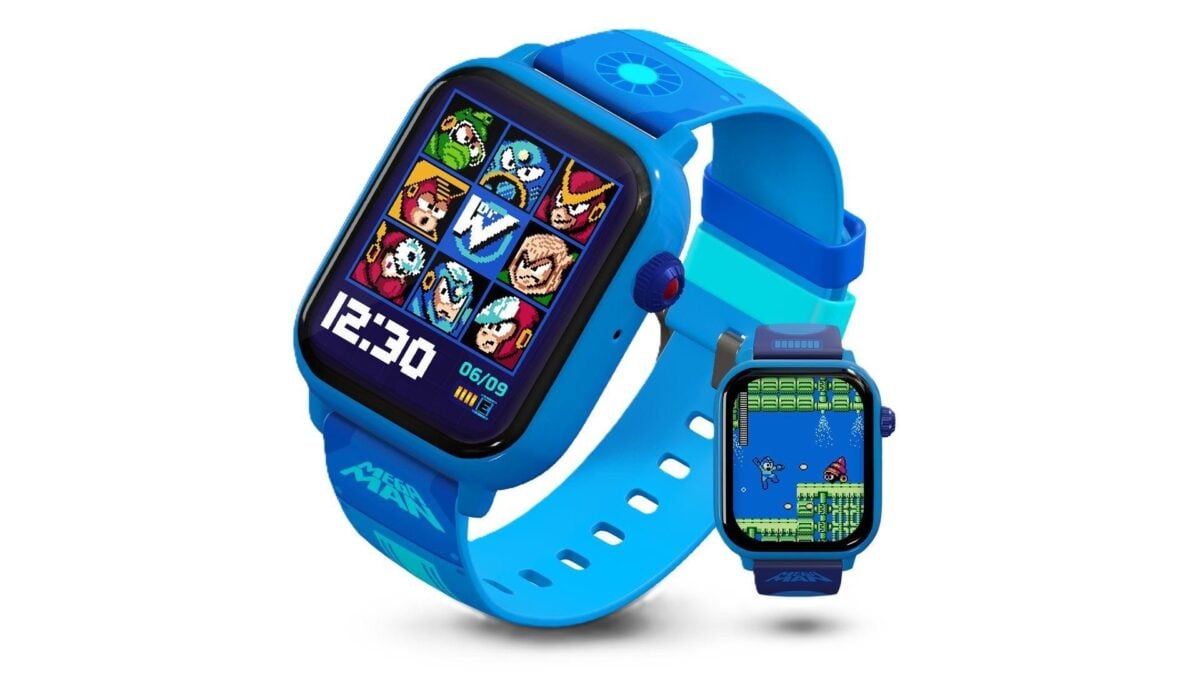
A smartwatch aimed squarely at the nostalgia economy
The latest sign that retro gaming has become a full consumer-tech lane is not a console or a handheld, but a smartwatch. MyPlay Watch has opened preorders for the Mega Man: MyPlay Watch, an $79.99 device that packages a custom version of Mega Man 2 with the functions expected from an entry-level wearable, including activity tracking, calorie counting, heart-rate monitoring, and changeable watch faces.
The device is less an attempt to compete with premium smartwatches than a deliberate collision of fandom, novelty hardware, and casual utility. Its hook is not app ecosystems or productivity. It is the promise that a wrist-worn gadget can deliver a recognizable slice of an 8-bit classic while still behaving like a modern smartwatch.
According to Gizmodo, the Mega Man watch uses original sprites, stages, bosses, and music from the NES-era game, but reworks the controls for one-touch input. That adjustment is crucial because it reveals the product’s real ambition. This is not about perfect emulation on a tiny screen. It is about adapting a shared cultural memory into a wearable format that feels playful enough to justify the purchase.
How the game has been reshaped for the wrist
The watch includes two play modes. A “Classic” mode follows stage-by-stage progression, while an “Arcade” mode drops players into selected stages with increasing speed and difficulty. Those modes suggest MyPlay is trying to preserve the identity of Mega Man 2 while acknowledging that a smartwatch is a radically different environment from a controller and television.
The one-touch control scheme is the clearest compromise and the clearest design choice. A direct port would likely be awkward or unusable. Rebuilding the input model makes the game accessible on the device, even if that means the experience is necessarily different from the original. In other words, the watch is not selling authenticity in the strict archival sense. It is selling recognition.
That distinction matters in nostalgia hardware. Consumers in this category often want just enough fidelity to trigger memory and just enough novelty to make the object feel new. The Mega Man watch appears designed around that balance.
Why nostalgia tech keeps expanding
Gizmodo places the launch inside a broader trend: retro-themed technology has become a durable market rather than a passing gimmick. Across categories, companies are turning classic gaming and pre-internet aesthetics into products that function as both devices and identity signals. Mini arcade cabinets, handhelds, and other throwback hardware are no longer fringe curiosities. They are part of an established commercial language.
The Mega Man watch fits neatly into that pattern. It targets people who grew up with console gaming and now have enough disposable income to buy novelty objects that compress entertainment, style, and memory into a single product. It also benefits from the way wearable tech has normalized charging yet another screen-bearing object. Once people are willing to wear a small digital device all day, the leap from health tracker to fandom accessory becomes much smaller.
There is also a practical reason the category persists: nostalgia reduces discovery costs. Consumers know what Mega Man means. They know the color palette, the music, the character design, and the emotional register. A themed watch does not need to educate the market from scratch. It can instead focus on whether the object feels desirable enough to wear and amusing enough to show off.
More accessory than platform
The watch’s specifications, as described in the source text, place it closer to a themed lifestyle gadget than to a serious smartwatch platform. It offers familiar health and fitness features, but the defining value proposition is the built-in game and the Mega Man-themed presentation. That includes watch faces tailored to the franchise, reinforcing the idea that the product is meant to live halfway between wearable and collectible.
This positioning may actually be an advantage. Competing on general smartwatch capability would force the device into a crowded market shaped by Apple, Samsung, Garmin, and other entrenched players. Competing as a niche object with a clear cultural reference is a different strategy. It lowers expectations around software breadth and raises the importance of charm, design, and franchise loyalty.
The challenge for products like this is durability of interest. Novelty tech can attract attention quickly and then disappear just as fast if the experience is shallow or the hardware feels flimsy. Gizmodo notes that at its price, the watch could be a strong value if it performs well. That “if” is important. Nostalgia can drive the preorder, but the device still has to function capably enough that buyers do not feel they paid mainly for a licensed skin.
What this says about pop culture hardware
The Mega Man: MyPlay Watch is a reminder that consumer electronics increasingly compete on emotional design as much as on technical specification. For a certain buyer, the ability to play a customized version of Mega Man 2 on a watch is not a gimmick to be dismissed. It is the point. The device offers a form of ownership that feels more personal than streaming a catalog title or downloading a retro app.
It also reflects how cultural franchises are spreading into hardware categories that once seemed unrelated to entertainment IP. Watches, controllers, keyboards, earbuds, and other everyday devices are now vehicles for media identity. That trend blurs the line between practical gadget and fan object, creating room for products that would have looked improbable a decade ago.
In that sense, the Mega Man watch is not just a quirky launch. It is part of a broader consumer-tech strategy in which devices gain value by becoming portable symbols of taste and memory. Function still matters, but so does recognizability.
A small screen for a familiar world
MyPlay Watch’s latest release will not redefine wearable computing. That is not what it is trying to do. What it does show is how far nostalgia-native hardware has matured as a market. A smartwatch with heart-rate tracking is ordinary. A smartwatch that lets you play a one-touch version of Mega Man 2 turns that ordinary object into something more collectible, more conversational, and more culturally legible.
For buyers who want a wearable that does not look like a miniature office terminal, that may be enough. The appeal of the Mega Man watch is not that it replaces a flagship smartwatch. It is that it makes wearable tech feel a little less generic and a lot more specific.
This article is based on reporting by Gizmodo. Read the original article.
Originally published on gizmodo.com


