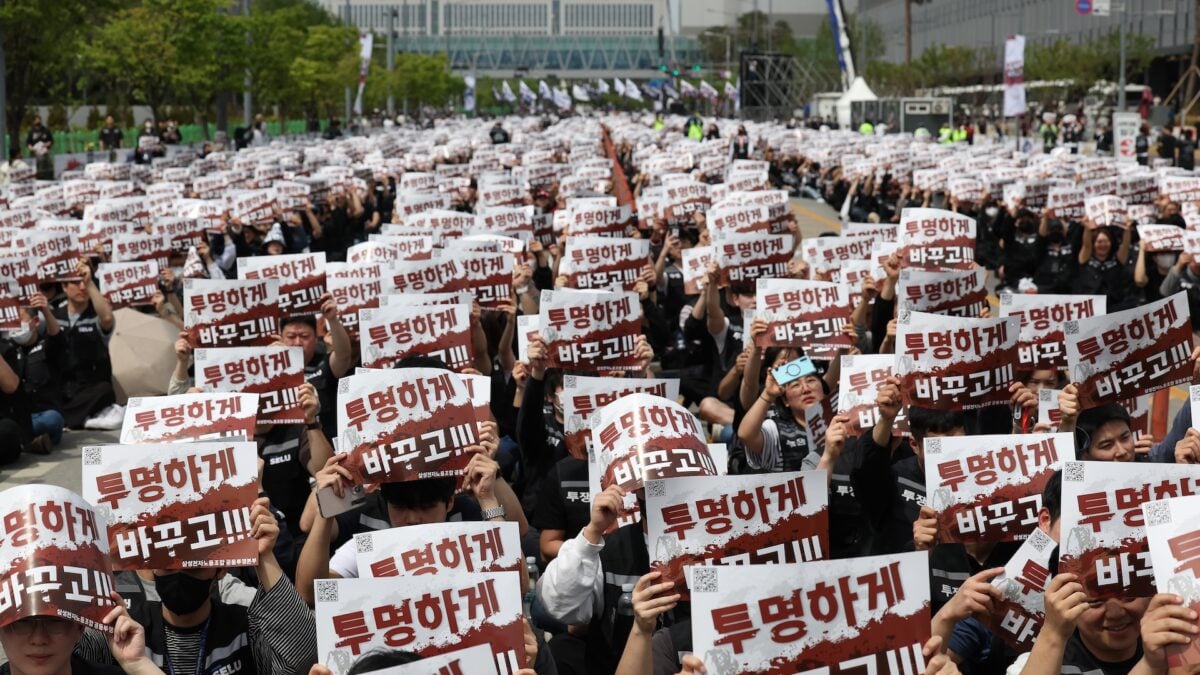
A labor dispute with global consequences
A planned strike at Samsung in South Korea is shaping up as more than a local industrial relations story. Because Samsung sits inside one of the most constrained parts of the AI supply chain, the dispute now carries implications for cloud infrastructure, high-performance computing, and the pace of hardware deployment across the industry.
According to the supplied report, Samsung and a South Korean labor union ended talks on Tuesday without reaching a deal. Those negotiations were described as a last-ditch attempt to avoid a strike scheduled to begin on May 21 and last for two weeks. If that walkout happens, the effects may be felt far beyond Samsung’s own balance sheet.
The reason is straightforward. Samsung’s manufacturing sites at Giheung, Hwaseong, and Pyeongtaek make components used in cloud and high-performance computing, including AI memory. The report specifically points to high-bandwidth memory, or HBM, as a critical flashpoint. Samsung and SK Hynix are described as two of only three companies in the world making it.
Why the memory issue matters
HBM is one of the most strategically important components in the current AI stack. Even without going beyond the supplied text, the implications are clear: when only a handful of suppliers can manufacture a part that sits at the heart of AI systems, any labor disruption becomes a system-level risk.
The article makes that pressure explicit by noting that even Samsung and SK Hynix combined cannot manufacture HBM fast enough to satisfy present demand. That means the market is already tight before any strike begins. In a balanced market, customers might absorb a short disruption by switching orders or drawing from excess inventory. In a constrained one, the margin for error is much smaller.
This is why the dispute matters to companies far removed from Korean labor negotiations. AI model developers, hyperscalers, chip buyers, and systems integrators all depend on predictable access to components that are already scarce. When a bottleneck supplier stumbles, the shock can travel quickly.

Signs from an earlier work stoppage
The strongest evidence in the supplied text comes from a previous one-day strike in April. During that action, production reportedly fell sharply. The chip foundry’s output plunged 58.1%, while memory fabrication plants dropped 18% during the relevant shift.
A one-day strike does not automatically predict a two-week outcome. Production can be buffered, rescheduled, or partially recovered. But those figures are still revealing because they show that Samsung’s operations are not insulated from labor action. The facilities appear vulnerable to immediate disruption, not just long-run inconvenience.
That matters for market psychology as much as for physical output. If customers believe supply reliability is deteriorating, they may accelerate orders elsewhere, raise inventory targets, or revise deployment timelines. In a high-demand market, expectations can tighten conditions even before a full shortage becomes visible.
The dispute inside Samsung’s broader AI race
The labor standoff is arriving at a sensitive moment for Samsung. The report says the company’s income from chips in the first quarter of 2026 rose almost 50-fold year over year, underscoring how heavily the current AI cycle is reshaping semiconductor economics.
It also notes that Samsung crossed the $1 trillion valuation mark this month and is now the world’s 11th largest company by market capitalization. Those numbers help explain why a labor dispute over bonus structures has attracted such outsized attention. The stakes are not confined to wages. They sit inside a business suddenly being revalued by investors as a major AI infrastructure player.
At the same time, the article says SK Hynix moved earlier and more aggressively into AI-friendly HBM in 2024, giving it an advantage in the supply chain. Samsung therefore faces two pressures at once: it wants to defend or regain leadership in a strategically valuable segment, and it now faces a labor dispute that could weaken execution at exactly the wrong time.
The report quotes Samsung board chairman Shin Je-yoon as saying he was worried about losing market leadership amid fleeing customers and falling competitiveness in the event of a strike. Even stripped of rhetoric, that is a meaningful statement. It suggests Samsung sees labor stability not as a side issue but as part of the competitive contest itself.

What the union is fighting over
The dispute centers on compensation, specifically a union demand to abolish a cap on bonus pay. The supplied article says SK Hynix removed a similar cap in 2025 and that employee bonuses there surged to three times what Samsung workers can receive. The report presents that difference as a factor behind broader union activity at Samsung.
This detail matters because it frames the strike not as an abstract labor protest, but as a dispute tied directly to the economics of the AI boom. Workers appear to be asking why a company benefiting so dramatically from AI demand should maintain tighter limits than a close rival operating in the same market.
Whether Samsung concedes is still unresolved. A union representative quoted by Reuters said none of the agenda items requested by the union had been addressed. That leaves the confrontation in a brittle state, with little evidence in the supplied text that a compromise is imminent.
A reminder about AI’s physical foundations
The current AI narrative often centers on models, software, and capital spending plans. This episode is a reminder that the industry still depends on people operating specialized facilities in a tightly concentrated manufacturing base. A two-week strike at the wrong node can become as consequential as a product launch or a model upgrade.
The report includes a union estimate that a full strike could cost Samsung 30 trillion won, roughly $20 billion. Because that figure comes from a party to the dispute, it should be treated cautiously. But even if the exact number proves high, the broader point remains credible: disruption in advanced memory production would be expensive and strategically damaging.
For the wider AI sector, the lesson is less about one labor action than about structural fragility. When demand is intense, substitution is limited, and supply is concentrated among a few producers, resilience becomes hard to buy at short notice.
If the May 21 strike proceeds, the industry will get a live test of how much slack remains in one of AI’s most critical supply chains. If it is averted, the warning still stands. The AI boom may look digital from the outside, but some of its most important vulnerabilities are industrial, local, and very physical.
This article is based on reporting by Gizmodo. Read the original article.

Originally published on gizmodo.com