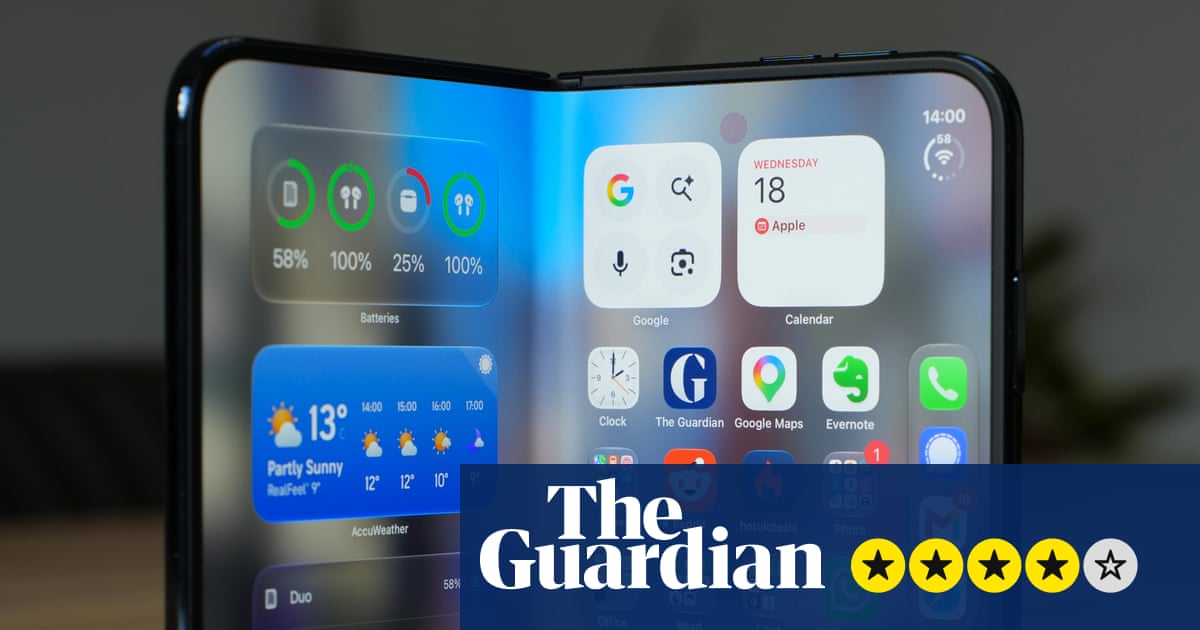
Apple’s foldable is not simply an iPhone that opens wider
Apple’s first folding phone, the iPhone Duo, arrives as an attempt to turn a familiar category into something more specific: a device intended to replace both a phone and a small tablet without behaving exactly like either. According to a review by The Guardian, that ambition shapes the Duo’s hardware and software choices from the moment it is closed in a hand to the moment its 7.6-inch interior OLED display is unfolded.
The device is Apple’s most expensive smartphone, priced at £1,999 in the UK, €2,299 in Europe and $1,999 in the United States. That places it alongside, or above, premium foldable Android devices and makes its proposition necessarily selective. The Duo is aimed at early adopters willing to accept a high price and some physical compromises in exchange for a new form factor and a reworked iOS experience.
Its core idea is straightforward. Closed, it has a 5.4-inch external display. Opened like a book, it becomes a larger-screen device for apps, reading and other tablet-like tasks. Yet the review argues that Apple has not tried to make it a pocket iPad. Instead, it has created a distinct interface and set of trade-offs.
A short, wide departure from foldable convention
Most established foldable phones have used tall, narrow outer displays. Apple has taken another route. The Duo uses the same 1.4:1 aspect ratio for the outer and inner screens, only at different sizes. The choice is visually tidy, but it gives the closed device an unusually broad shape.
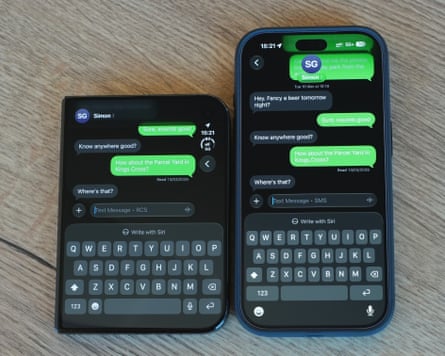
At 84.1 millimeters wide, the closed Duo is 6.1 millimeters wider than the iPhone 18 Pro Max cited in the review. That width makes it largely a two-handed phone for typing and for reaching across the display, even with a grip accessory attached. Its short external screen also leaves less vertical room for messages and content when the keyboard is visible.
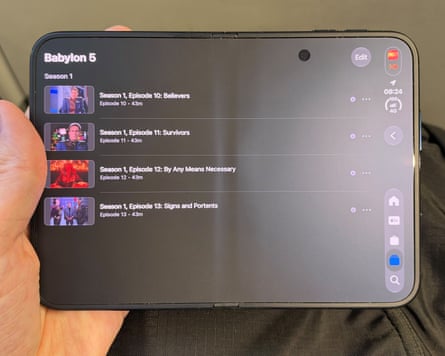
Those constraints explain why the Duo should not be understood as a conventional flagship phone with a bonus screen. A standard phone is optimized for quick, one-handed interactions. The Duo instead asks users to decide when to work within its squat outer display and when to open it for greater space.

The inner display is the product’s strongest argument
When unfolded, the 7.6-inch OLED display is the clearest case for the device. The Guardian described it as bright, crisp and smooth, with a matte finish comparable to Apple’s higher-end iPads, MacBooks and displays. The matte surface reduces glare and makes the central fold less visually distracting.
The crease remains physically perceptible, and it can be seen when the display is dark. But the review found that it quickly fades from attention during normal use. That is an important threshold for foldables: the hinge line does not disappear, but it becomes a manageable part of a larger screen rather than the defining experience.
The material also brings the usual foldable-screen caution. Unlike conventional hardened smartphone glass, the inner display can be permanently marked by sufficient pressure from a fingernail. The review also notes reports of faulty devices with broken screens. For a phone at this price, durability concerns are not a side issue; they are central to the decision to buy one.
iOS changes matter as much as the hinge
Apple’s more consequential move may be software. The review says the company has altered iOS for the first time in a decade to accommodate the Duo’s different modes of use. That means the product is not being sold merely on flexible hardware. It is a test of whether iOS can make transitions between a small external screen and a tablet-sized interior feel purposeful.
This approach gives the Duo a clearer identity than a device that simply stretches existing phone apps across a larger panel. It also makes the outcome harder to judge by specifications alone. The value lies in whether the operating system makes more room genuinely useful, and whether the narrow compromises of the closed device feel justified in daily use.

A compelling niche rather than a universal upgrade
The iPhone Duo demonstrates that Apple sees foldables as a mature-enough category to reinterpret, not merely imitate. Its display treatment, unusual proportions and iOS changes distinguish it from the tall-and-thin foldable pattern that has developed over years of Android competition.
But the same decisions limit its universal appeal. It is heavy, wide when closed, costly and dependent on a screen that demands more care than the glass on an ordinary iPhone. The product may successfully consolidate phone and small-tablet roles for some people, but it does not erase the compromises involved in doing so.
For Apple, the Duo is less a replacement for every iPhone than a statement that the company is prepared to make the iPhone category stranger again. For buyers, the question is simpler: whether a compact tablet that folds into a very wide phone is the device they have been waiting for—or an intriguing specialty tool best left to the first wave of adopters.
This article is based on reporting by The Guardian. Read the original article.
Originally published on theguardian.com