
Aerial predators may be more formidable than assumed
Evidence from Chad suggests that Verreaux’s eagles may hunt adult olive baboons weighing up to 57 pounds, a finding that could alter how scientists think about the threat birds of prey posed to early human relatives.
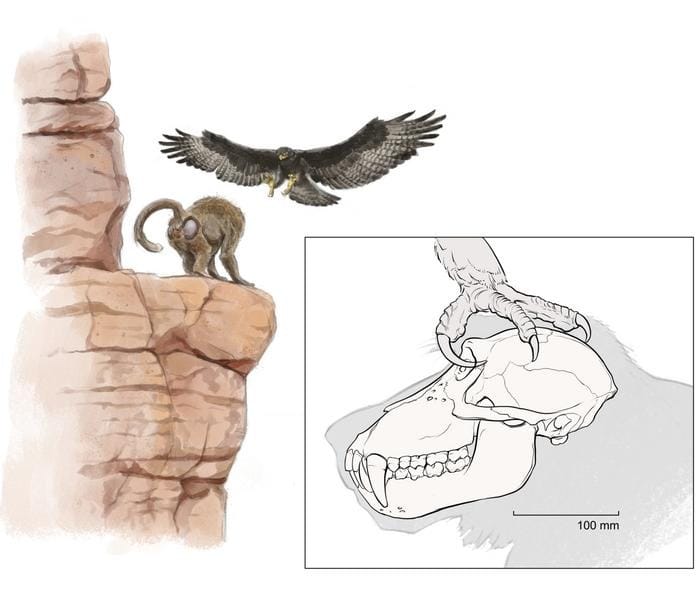
The observations, described in a study in the American Journal of Biological Anthropology, concern baboon remains found among sandstone cliffs on the Ennedi Plateau. The remains showed marks consistent with eagle predation, including talon punctures on the skull and scrapes on shoulder bones.
If the interpretation is confirmed, the study would document raptors attacking primates substantially larger than the animals typically associated with such encounters. It would also weaken a long-standing assumption that hominins soon became too large for birds of prey to threaten them.
The evidence at Ennedi Plateau
Researchers studying the site identified baboon remains with injuries that fit a predatory attack by an eagle. The team said it could not definitively rule out scavenging, but described the severity of the punctures as suggestive of lethal interactions involving a killing grip.
Behavioral observations added another piece of evidence. Baboons were seen retreating rapidly when eagles approached, behavior the researchers interpreted as consistent with fear of aerial attacks.
Verreaux’s eagles are among the largest eagle species in the world. The new account does not say that every carcass was certainly killed by an eagle, nor does it establish a population-wide estimate of predation. Its importance lies in showing that a large raptor may be capable of confronting adult primates far heavier than the usual mental picture of avian prey.


Why the weight question matters
Raptors have hunted primates for at least 20 million years, including hominins, the group that includes early human relatives. One of the best-known examples is the Taung child, a young hominin from roughly 2.5 million years ago whose remains have been interpreted as bearing signs of raptor attack.
That interpretation has faced objections. Some researchers have argued that the young hominin would have been too heavy for a bird to carry or kill. The Chad evidence challenges the premise behind that objection by pointing to possible attacks on adult baboons weighing up to 57 pounds.
The distinction between carrying prey away and killing it is crucial. The study’s account describes a “low flight with sustained grip attack” used by eagles against ungulates, including antelopes and cattle. Such attacks indicate that a raptor may be able to kill an animal much larger than itself without needing to lift it into the air.
Reconsidering risk to hominins
The researchers’ interpretation does not mean eagles were necessarily frequent predators of ancient hominins. Nor does it turn a single present-day observation into a complete reconstruction of prehistoric ecosystems. It does, however, expand the range of plausible danger faced by primates living in exposed landscapes.
Early human relatives have often been discussed in terms of threats from terrestrial carnivores. Large cats, hyenas and other ground-based predators dominate many accounts of ancient risk. The findings from Chad point toward the sky as another potential source of selective pressure, especially for smaller individuals or groups using terrain where eagles could launch low attacks.
The Taung child remains central to that debate. If large eagles can attack adult baboons today, the idea that a raptor could have preyed on a smaller hominin child becomes harder to dismiss solely on the basis of body size.

What the study does and does not show
The study is careful about uncertainty. Scavenging cannot be completely excluded, and the evidence does not directly show an eagle killing a baboon in real time. The authors instead draw their conclusion from the pattern of damage, the context in which remains were found and observed baboon responses to approaching eagles.
That caution is especially important in paleoanthropology, where interpretations of bones and injuries can carry implications far beyond a single site. A puncture or scrape may have several possible causes. The strength of the new work is not that it eliminates every alternative explanation, but that it supplies a modern analogue for interactions that were previously considered unlikely.
The result also places limits on overly simple weight-based arguments. An animal’s mass alone does not determine whether it is vulnerable to a predator. Attack method, terrain, surprise, group behavior and the predator’s ability to hold rather than carry prey can all matter.
A modern observation with deep-time relevance
Present-day animal behavior cannot be treated as a perfect window into the distant past. Environments, species and ecological relationships change. But living predation events can test assumptions used to interpret fossil evidence.
In this case, the evidence from Verreaux’s eagles and olive baboons offers a tangible comparison for a long-running question: could a bird of prey have been dangerous to hominins beyond early childhood? The study suggests the answer may be yes, at least under some circumstances.
That does not resolve the history of the Taung child or establish how commonly ancient raptors hunted hominins. It does shift the discussion. Rather than assuming that larger primates had passed beyond the reach of aerial predators, researchers now have reason to consider that eagles may have remained a serious threat well later than previously believed.
This article is based on reporting by 404 Media. Read the original article.

Originally published on 404media.co