Solar hardware is shedding weight while boosting output
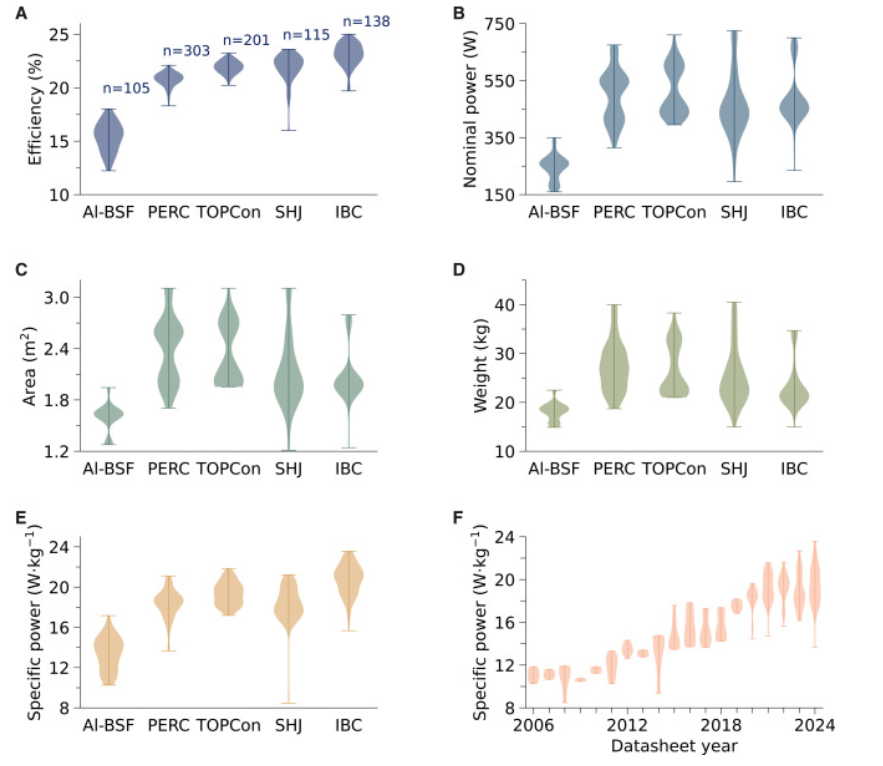
Commercial silicon solar modules are delivering much more power for every kilogram of weight than they did in the early 2000s, according to an international research effort highlighted by PV Magazine. The study reports that specific power, a measure of electrical output per unit of weight, has climbed from about 8.5 watts per kilogram in the early 2000s to 23.6 watts per kilogram today.
That change matters because solar deployment is no longer judged only by headline efficiency or cost per watt. Weight affects shipping, rooftop loading, handling during installation, and the feasibility of solar use in places where every kilogram counts. Specific power has long been important in spacecraft and portable power systems, but it is increasingly relevant across mainstream solar as developers push into more constrained sites and new application types.
The finding points to a broad design evolution in commercial photovoltaics. Modules are not simply becoming more efficient cells wrapped in familiar packaging. They are being reworked as integrated products whose glass, frames, thermal characteristics, and rear-side performance all influence what they can deliver in practice.
Why specific power is becoming a more useful metric
Specific power offers a way to compare panels beyond nameplate output alone. Two modules may provide similar peak power, but if one weighs much less, it can offer advantages in transport, mounting, and structural requirements. For installers and system designers, those differences can change project economics even before electricity production is considered.
PV Magazine notes that the research team found strong gains in this metric over the last two decades. That suggests the industry’s progress has not been limited to incremental cell improvements. Module-level engineering has also become more effective at converting a given mass of material into usable generation capacity.
The article says this trend has been driven by advances in module design, bifaciality, and temperature management. Each of those factors reflects a different layer of solar engineering. Module design improvements can reduce unnecessary material or distribute it more efficiently. Bifaciality allows panels to capture light from both sides under the right conditions. Better thermal behavior can help preserve power output under real operating temperatures rather than only under laboratory-style conditions.
Together, those shifts help explain why modern modules are doing more with less. They also show why comparing products based only on front-side peak power misses part of the story.
Weight is still dominated by the non-cell components
One of the more practical conclusions highlighted in the report is that glass and framing still dominate module weight. That is an important reminder that solar manufacturing is not just a semiconductor problem. Even if cells continue to improve, overall module performance per kilogram can remain constrained by packaging choices needed for durability, weather resistance, and installation.
This matters for manufacturers trying to balance several competing goals at once. Heavier glass and stronger frames can improve ruggedness and survivability, but they add mass. Lighter designs can improve handling and expand where modules can be deployed, but they must still withstand wind, moisture, thermal cycling, and long service lives.
The fact that glass and frame materials remain central to module weight suggests there is still room for innovation outside the cell itself. Future gains may come not only from higher-efficiency silicon architectures, but from changes in encapsulation, structural materials, or form factors that reduce mass without sacrificing reliability.
For commercial rooftops, warehouses, and older buildings with tighter structural margins, those tradeoffs can be especially consequential. A module that provides more output per kilogram can make previously marginal sites more viable or reduce balance-of-system constraints.
Operating conditions matter more than a datasheet snapshot
The researchers also emphasized that accurate photovoltaic system design requires attention to operating conditions, including nominal operating cell temperature and rear-side illumination. That point is easy to overlook in a market that often relies on simplified product comparisons.
Nominal operating cell temperature affects how a panel behaves in the field, where sunlight, airflow, mounting configuration, and ambient heat can pull performance away from standard test conditions. Rear-side illumination is equally important for bifacial modules, whose actual energy yield depends on how much reflected or scattered light reaches the back of the panel.
In other words, a module’s real-world value cannot be captured by one label alone. A panel that appears comparable on paper may perform differently depending on mounting height, surface reflectivity, climate, and thermal environment. As bifacial products become more common, those contextual variables become a larger part of sound engineering.
This also has implications for buyers and policymakers. Procurement frameworks that focus too narrowly on headline module ratings may miss differences that influence delivered energy, logistics costs, or system suitability. Better design decisions may require broader use of metrics that connect hardware characteristics to real deployment conditions.

A sign of a more mature solar industry
The rise in specific power reflects a sector that is maturing across multiple dimensions at once. Solar is no longer advancing through one dominant lever. Cell efficiency, product architecture, temperature behavior, and system-aware design are all contributing to progress.
That is particularly significant as solar moves deeper into infrastructure, mobility-adjacent applications, and constrained built environments. Lighter, more power-dense modules can expand the range of viable installations while reducing some of the friction that still surrounds deployment. Even modest reductions in weight can matter at scale when multiplied across shipping containers, rooftop arrays, and field crews.
The new analysis does not suggest weight has ceased to matter. If anything, it argues the opposite: mass is becoming a more strategic variable as the industry optimizes beyond basic cost declines. With glass and framing still accounting for much of module weight, the next stage of competition may increasingly involve materials and package engineering as much as cell performance.
For now, the headline result is clear. Commercial silicon modules are generating far more power per kilogram than they did two decades ago. That improvement is a useful marker of how comprehensively solar products have evolved and of how much practical design detail now shapes the performance of modern clean-energy hardware.
This article is based on reporting by PV Magazine. Read the original article.
Originally published on pv-magazine.com