The Accuracy Gap Hiding in Plain Sight
Ask any robotics engineer about their system's precision and they will likely quote an impressive repeatability figure — typically 0.1 millimeters or better for modern industrial robots. This number describes how consistently the robot can return to the same position after performing a series of movements, and it is indeed remarkable. But there is another metric that receives far less attention and causes far more problems: absolute accuracy.
Absolute accuracy measures how closely a robot's actual position matches its commanded position in absolute coordinates, referenced to the robot's base coordinate system regardless of previous movements. While repeatability figures hover around 0.1 mm, absolute accuracy for the same robots typically ranges from 0.5 to 1.5 mm — a gap of five to fifteen times. For applications that depend on offline programming, where robot paths are defined in software and executed without manual teaching, this gap can be the difference between a successful operation and a scrapped part.
Why the Distinction Matters
Consider a robotic welding application where the wire tip must be positioned precisely in the center of a seam. If the robot was manually taught this position, repeatability ensures it will return to that exact spot thousands of times. But if the welding path was defined using offline programming software — an increasingly common approach as manufacturers seek to reduce setup time and improve flexibility — the robot must navigate to absolute coordinates it has never physically visited before.
This is where absolute accuracy becomes critical. A robot with 1.0 mm of absolute error might consistently miss the seam center by that amount, producing defective welds across every part. The same problem affects precision pick-and-place operations, overspray-free painting, and drilling and deburring tasks where positional accuracy directly determines product quality.
The ability to execute planned paths without manual interaction on the real robot represents a significant competitive advantage in modern manufacturing. It eliminates the time-consuming process of teaching every point by hand, enables rapid changeovers between different products, and allows programming to happen in parallel with production rather than requiring machine downtime.

Fraunhofer Institute's Systematic Approach
Researchers at the Fraunhofer Institute for Manufacturing Engineering and Automation (Fraunhofer IPA) have developed a systematic methodology for diagnosing and improving absolute accuracy in industrial robots. Rather than applying generic calibration procedures, their approach begins with root-cause analysis to identify the specific factors degrading accuracy in each individual system.
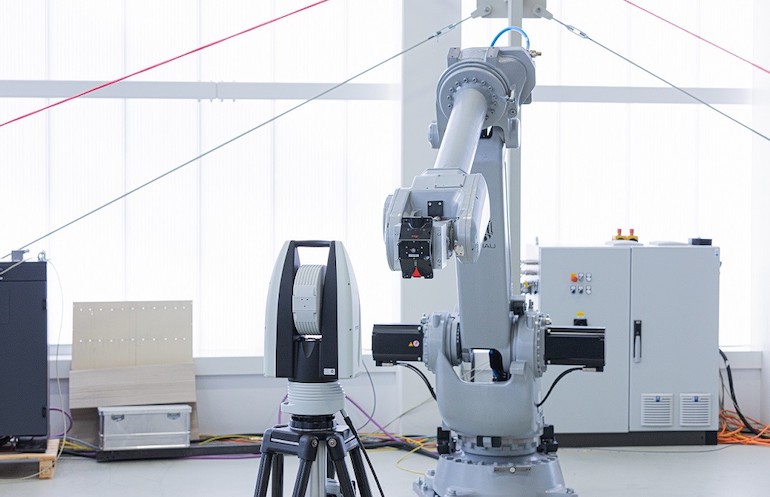
The diagnostic process uses laser tracking technology, specifically the Leica Absolute Tracker AT960, which achieves measurement accuracy of plus or minus 40 micrometers anywhere in the working space. This instrument can measure the robot's actual TCP (tool center point) position with sufficient precision to identify even subtle accuracy errors that would be invisible to conventional measurement tools.
The Fraunhofer team examines three categories of accuracy degradation simultaneously: hardware, software, and external factors. This holistic approach prevents the common mistake of optimizing one area while ignoring root causes in another.
Hardware: The Mechanical Reality
On the hardware side, the most common sources of absolute accuracy error include inferior encoders that do not provide sufficient resolution for precise positioning, poor gearing that introduces backlash or compliance, and insufficient structural rigidity in the robot's links and joints. These issues affect all robot types — articulated arms, SCARA robots, and gantry systems alike — though the specific failure modes differ between architectures.
Encoder quality is particularly important because it determines how accurately the robot knows its own joint positions. A robot can only be as accurate as its self-knowledge, and if the encoders provide joint position data with limited resolution or significant noise, the resulting TCP position will inherit those errors, amplified by the kinematic chain of the arm.
Structural rigidity presents another challenge. Under load, robot links deflect, joints compress, and the overall geometry of the arm changes from its nominal model. These deformations are load-dependent and often temperature-dependent, meaning they shift throughout the workday as the robot handles different parts and as the ambient temperature in the facility changes.
Software: Calibration and Control
Software-related accuracy issues typically stem from inadequate robot calibration and underperforming motion controllers. Factory calibration establishes the baseline kinematic model of the robot — the mathematical description of link lengths, joint offsets, and other geometric parameters that the controller uses to calculate joint angles for a desired TCP position.
When factory calibration is imprecise or when the robot's actual geometry drifts from its calibrated model over time, absolute accuracy suffers. Advanced calibration techniques use measurement data from many positions throughout the workspace to build a more accurate kinematic model. Some approaches go further, incorporating non-geometric error sources like gear compliance and thermal expansion into the model.
Controller performance matters too. The algorithms that convert desired Cartesian positions into joint commands must account for dynamic effects, including inertial forces, centripetal forces, and gravitational loading. Controllers that model these effects accurately can maintain better absolute accuracy during complex multi-axis movements than simpler controllers that treat each joint independently.
External Factors: The Environment Fights Back
Even a perfectly calibrated robot with excellent hardware will suffer accuracy degradation from external environmental factors. Temperature is the most significant, causing thermal expansion of both the robot structure and the workpiece. Air pressure variations can affect pneumatic systems and, in extreme cases, the density of air itself can influence certain measurement techniques.
Process forces — the reaction forces generated by the robot's interaction with its work — also degrade accuracy. A drilling operation generates forces that deflect the robot away from its commanded position, and these forces vary with drill bit sharpness, material hardness, and cutting speed. Compensating for these effects requires either force sensing and real-time path correction or detailed process models that predict and precompensate for expected deflections.
Beyond ISO 9283: A New Benchmark
The Fraunhofer team has developed a proprietary closed-loop benchmark for sensor-integrated robotic systems that expands beyond the ISO 9283 standard for robot performance evaluation. This benchmark evaluates not just the robot's open-loop accuracy but also its ability to use sensor feedback to correct positional errors in real time, reflecting the growing importance of sensor-guided applications in precision manufacturing.
For manufacturers struggling with absolute accuracy, the message from Fraunhofer's research is clear: the problem is solvable, but only through a systematic approach that addresses hardware, software, and environmental factors together. Generic solutions rarely work because every robot installation has its own unique combination of error sources. The investment in proper diagnosis pays for itself many times over through reduced scrap rates, faster setup times, and the ability to fully leverage offline programming capabilities.
This article is based on reporting by The Robot Report. Read the original article.
Originally published on therobotreport.com