From Pilot Program to Scaled Deployment
Toyota Motor Manufacturing Canada (TMMC) is tripling its deployment of Agility Robotics' Digit humanoid robots, expanding from an initial trial of three units to a fleet of ten. The move represents one of the most significant expansions of humanoid robot deployment in an active automotive manufacturing environment and suggests that Toyota is seeing meaningful returns from its initial investment in the technology.
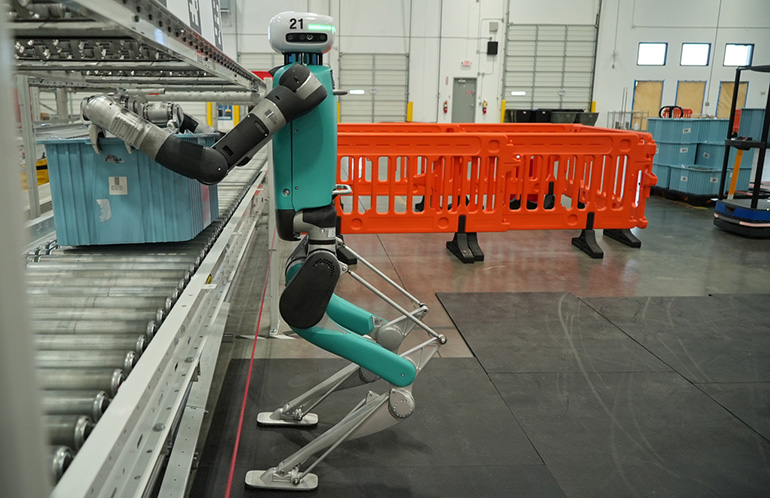
Digit is a bipedal humanoid robot designed by Agility Robotics, a company that has been developing legged robots for nearly a decade. Standing roughly 5 feet 9 inches tall and weighing about 140 pounds, Digit is built to operate in environments designed for humans, moving through doorways, navigating warehouse aisles, and manipulating objects using its two arms and hands. Unlike wheeled or tracked robots that require modified environments, Digit can theoretically work alongside human employees in existing facilities without major infrastructure changes.
What Digit Does at Toyota's Canadian Facilities
The initial three-unit trial at TMMC focused on material handling tasks within the manufacturing plant. Digit robots were tasked with moving totes and bins between production stations, a repetitive and physically demanding job that human workers perform thousands of times per shift. The work involves picking up containers weighing up to 35 pounds, carrying them across factory floor distances, and placing them at designated locations with sufficient precision to maintain production flow.
Toyota has not disclosed detailed performance metrics from the trial, but the decision to more than triple the deployment speaks for itself. Automotive manufacturers operate on thin margins and tight production schedules, and they do not expand technology trials unless the technology is demonstrating clear value. The fact that TMMC is moving from three Digits to ten suggests that the robots performed reliably enough during the pilot phase to justify a larger commitment.
The expanded deployment will likely involve the robots taking on additional material handling routes within the facility, potentially covering more production zones and working longer shifts. One of Digit's advantages over human workers in these roles is its ability to operate continuously without the fatigue, injury risk, and shift change overhead that come with human labor in physically repetitive jobs.

The Broader Humanoid Robot Movement in Manufacturing
Toyota's expansion is part of a broader trend that has seen several major manufacturers begin experimenting with humanoid robots on their production floors. The automotive industry, with its high labor costs, repetitive tasks, and precisely controlled environments, is widely seen as one of the most promising early markets for humanoid deployment.
Several factors are driving this interest:
- Labor shortages: Automotive manufacturing faces persistent difficulty recruiting and retaining workers for physically demanding, repetitive jobs. Humanoid robots offer a potential solution that does not require the complete redesign of production facilities.
- Ergonomic concerns: Repetitive lifting and carrying tasks are a leading cause of workplace injuries in manufacturing. Deploying robots for these tasks reduces injury rates and the associated costs of workers' compensation and lost productivity.
- Flexibility: Unlike single-purpose automation systems, humanoid robots can theoretically be reassigned to different tasks as production needs change, offering a degree of flexibility that traditional industrial robots cannot match.
- Human-compatible environments: Factories are built for human bodies. Bipedal robots that can navigate stairs, doorways, and narrow aisles can integrate into existing facilities without the expensive modifications required by other types of automation.
Toyota is not alone in exploring humanoid robots. BMW has conducted trials with Figure AI's humanoid platform, and several other automakers are known to be evaluating competing systems. The race to deploy humanoids in manufacturing is accelerating, and each successful expansion, like TMMC's move from three to ten Digits, increases confidence across the industry.
Agility Robotics' Growing Commercial Footprint
For Agility Robotics, the Toyota expansion is a significant commercial milestone. The company has been working toward large-scale commercial deployment of Digit for several years, and each new customer commitment strengthens its position in the emerging humanoid robotics market. Agility opened a dedicated manufacturing facility called RoboFab in Salem, Oregon, in 2023, with the capacity to produce thousands of Digit units per year. Securing expanding orders from major manufacturers like Toyota helps justify that manufacturing investment and moves the company closer to the production volumes needed to drive down per-unit costs.
Agility has also been investing heavily in Digit's software capabilities, including improved navigation, more reliable object manipulation, and better integration with warehouse management systems. These software improvements are essential for scaling deployments, because a robot that requires frequent human intervention or manual programming for each new task is not economically viable at scale.

Challenges and Open Questions
Despite the encouraging expansion, significant questions remain about the long-term viability of humanoid robots in manufacturing. The technology is still in its early commercial stages, and per-unit costs remain high compared to the annual salary of a human worker performing the same tasks. Reliability data over extended operating periods is limited, and the long-term maintenance costs of complex bipedal systems are not yet fully understood.
There are also questions about how quickly humanoid robots can be retrained for new tasks. One of the key selling points of the humanoid form factor is its flexibility, but that flexibility only matters if the software can be reconfigured quickly and reliably when production needs change. The industry is still in the early stages of answering these questions.
For now, Toyota's decision to expand its Digit deployment is a strong vote of confidence in the technology, and one that the rest of the manufacturing industry will be watching closely. If ten Digits at TMMC deliver results as promising as three, the next expansion could be considerably larger.
This article is based on reporting by The Robot Report. Read the original article.
Originally published on therobotreport.com