A Strategic Acquisition With a Familiar Customer in Common
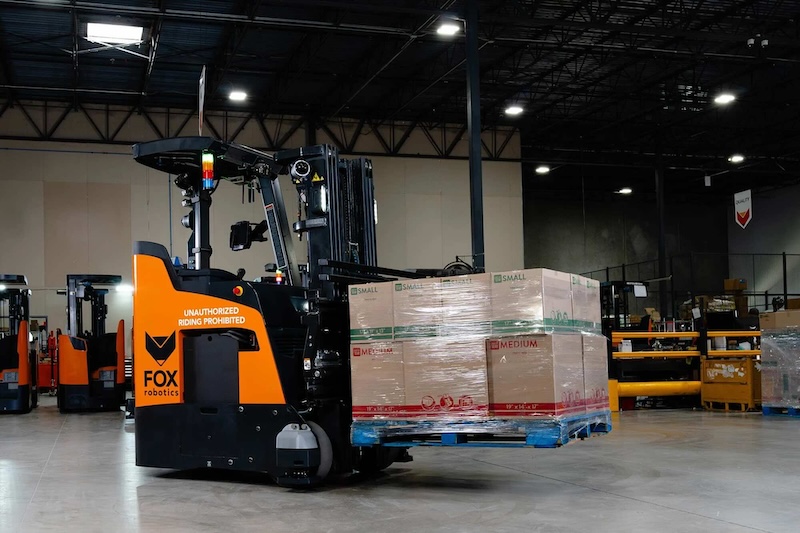
Symbotic, the warehouse automation company whose robotic systems process goods for some of the world's largest retailers, has acquired Fox Robotics, an Austin-based developer of autonomous forklifts. The deal, announced during Symbotic's first-quarter 2026 earnings call, did not include disclosed financial terms. But the strategic logic is clear: Fox Robotics gives Symbotic a lower-cost, more broadly deployable product that can serve as an entry point with customers who may not be ready for a full-scale Symbotic installation.
The two companies already share a significant connection. Symbotic founder and CEO Rick Cohen acknowledged during the earnings call that Fox Robotics is selling to Symbotic's largest customer, which is Walmart. The retail giant, which by some estimates accounts for close to 90 percent of Symbotic's revenue as of early 2026, deployed 19 Fox Robotics autonomous forklifts across four distribution centers following a 16-month pilot announced in 2024. Walmart operates thousands of conventional forklifts, representing a substantial addressable market for autonomous alternatives.
Expanding the Customer Funnel
Cohen was candid about the acquisition's purpose: broadening Symbotic's customer base. A full Symbotic warehouse automation system represents a major capital commitment that limits the addressable market to large-scale retailers and distributors. An autonomous forklift, by contrast, can be sold in quantities as small as two units to midsize warehouses and consumer packaged goods manufacturers. Cohen framed Fox Robotics' existing customer relationships, most of which do not overlap with Symbotic's, as a pipeline of potential future buyers for the company's more comprehensive automation solutions.
Fox Robotics, founded in 2017, claims more than 100 FoxBot autonomous forklifts installed across 54 customer sites in the United States and Canada, though Cohen characterized most current engagements as pilot programs across roughly 25 customers. That gap between the company's self-reported install base and Cohen's description of the deployment maturity suggests that many of these installations are still in evaluation phases rather than full-scale production use, a common pattern in industrial robotics adoption.
Symbotic's Revenue Diversification Challenge
The acquisition arrives at a moment when Symbotic is posting strong financial results but faces persistent questions about customer concentration. The company reported first-quarter fiscal 2026 revenue of $630 million, a 29 percent increase year over year, and swung to a net income of $13 million from a $17 million loss in the prior-year period. Adjusted EBITDA reached $67 million, nearly quadrupling from $18 million a year earlier. Cash on hand stood at $1.8 billion following a follow-on stock offering that raised $424 million.
Yet those headline numbers mask a fundamental vulnerability. Symbotic's relationship with Walmart deepened further in 2025 when it acquired Walmart Advanced Systems and Robotics, a unit originally built around Alert Innovation's grocery fulfillment technology that Walmart had purchased in 2022 before selling it to Symbotic. Every strategic move the company makes is evaluated, at least in part, through the lens of whether it reduces or reinforces the Walmart dependency. Fox Robotics, with its broader customer base and lower entry price, is clearly intended to address that concern.
Why It Matters for the Warehouse Automation Market
The deal reflects a broader consolidation trend in logistics robotics, where platform companies are acquiring specialized capabilities to offer end-to-end warehouse automation. Autonomous forklifts occupy a particularly attractive segment because they address one of the most common and physically demanding tasks in distribution centers, moving loaded pallets between storage locations and truck docks, without requiring the facility redesign that more ambitious automation systems demand.
For Fox Robotics' existing customers and pilot partners, including DHL and several large CPG manufacturers, the Symbotic acquisition could accelerate product development and provide access to a larger service organization. For Symbotic, the bet is that autonomous forklifts will serve as a wedge product, building trust with operations managers who may eventually consider the company's full automation suite. Whether that cross-selling thesis proves out will depend on how well Symbotic integrates a startup culture built around a single product into an organization managing complex, multi-system deployments at enterprise scale.
This article is based on reporting by The Robot Report. Read the original article.
Originally published on therobotreport.com