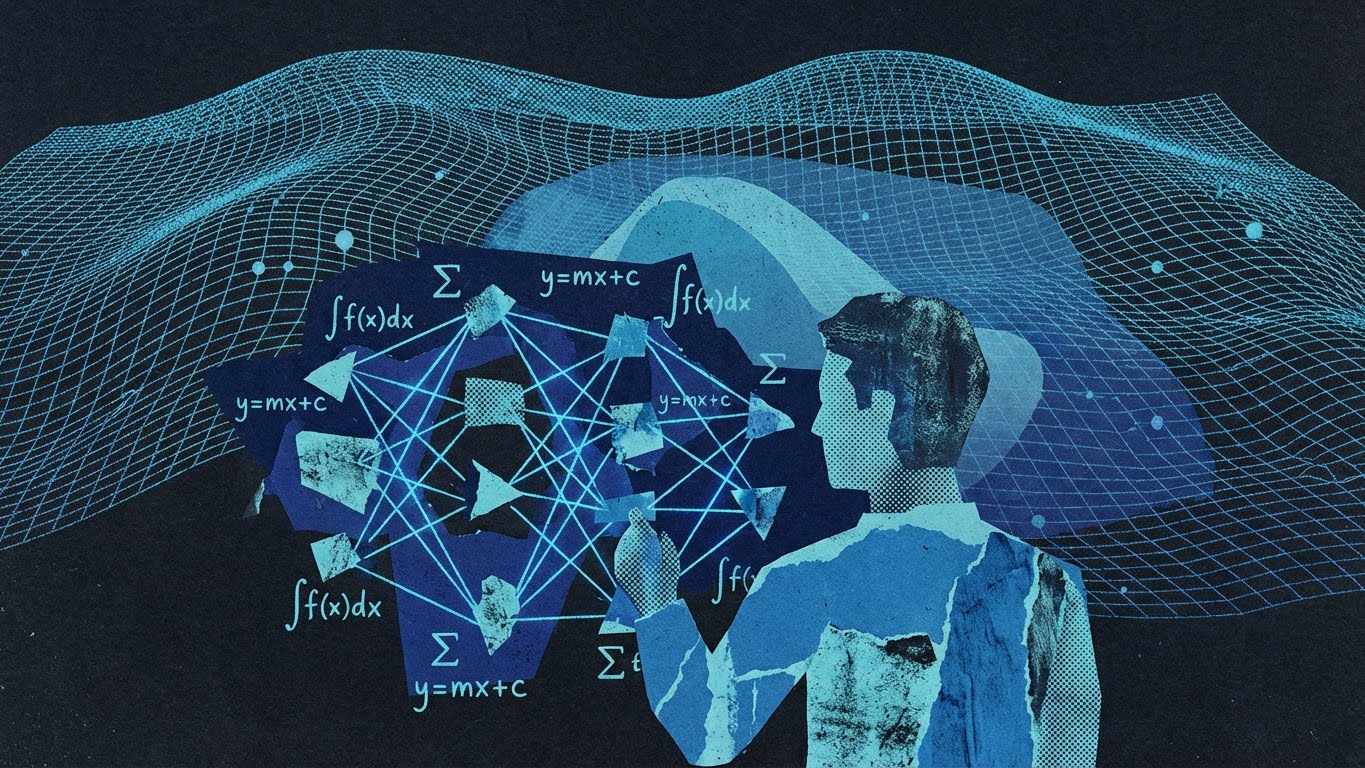
Math is becoming the proving ground for advanced AI
OpenAI researchers Sebastian Bubeck and Ernest Ryu are making a clear case for why mathematics now sits near the center of the artificial general intelligence debate. In a recent OpenAI Podcast discussion reported by The Decoder, the two researchers described math as more than a difficult domain for language models. They framed it as a compact stress test for the broader capabilities that a generally intelligent system would need.
The argument rests on the nature of mathematical work itself. Proofs require long, internally consistent reasoning, often sustained over extended periods. A single mistake can invalidate an entire line of thought. In that sense, mathematics is not just another benchmark. It is a domain where success depends on reliability, self-correction, and persistence rather than fluency alone.
A rapid shift in model capability
Bubeck said the pace of change has been striking. He recalled that just four years ago he was impressed by Google’s Minerva model being able to draw a line through points on a coordinate system. Two years ago, reasoning-focused models did not exist in the form now driving much of the field’s progress. Today, he said, these systems are assisting mathematicians at the highest levels, including Fields Medal winners, in their daily work.
That progression matters because mathematics has often been treated as one of the hardest areas for AI to crack in a meaningful way. According to Bubeck, 18 months ago most mathematicians at one conference still believed scaled-up large language models would not be able to help open research problems. The shift from skepticism to practical use has therefore happened on a compressed timeline.
From assistant to research partner
Ryu offered a concrete example of that transition. A former UCLA mathematics professor, he said he solved a 42-year-old open problem concerning Nesterov’s method in optimization theory with the help of ChatGPT over the course of three evenings totaling around 12 hours. Before using the model, he had already spent more than 40 hours on the problem without reaching a solution.
His account is notable for what it says about the division of labor. Ryu did not describe the model as an infallible oracle. He acted as a verifier, catching mistakes and steering the exchange toward more promising directions. That framing is important. The system’s value, in this telling, lies in accelerating exploration and proposing productive paths, while the human remains responsible for validation.
Why mathematics fits the AGI debate
Bubeck’s broader claim is that math works as an AGI benchmark because it demands the same ingredients required in other hard scientific and technical domains. A system capable of holding together a long proof must be able to sustain focus, maintain internal consistency, detect errors, and revise its own reasoning. Those are transferable capabilities, not math-specific tricks.
He also compared mathematical training to human education. Students are taught math not simply because they will all become professional mathematicians, but because the discipline forces a form of structured thinking. In the same way, training models on mathematics may produce habits of reasoning that carry into fields such as biology and materials science.
Math has another advantage: evaluation is unusually clear. Problems are typically well specified, and answers can be checked. In a field crowded with fuzzy benchmarks and disputed claims, that gives researchers a relatively clean environment for measuring progress.
The idea of “AGI time”
One of the more interesting concepts Bubeck introduced is what he called “AGI time.” He used the phrase to describe how long a model can effectively sustain the equivalent of a coherent line of thinking. Two years ago, he said, systems could simulate that kind of thinking for minutes. Now they can do so for days or even a week. The next goal is to push that horizon to weeks and months.
That is a useful framing because it shifts the discussion away from one-shot benchmark scores and toward endurance. If future systems are expected to function as automated researchers, they will need to remain productive over long stretches rather than merely solve isolated tasks. Extending “AGI time” is therefore not just a slogan. It points to a concrete development target.
The automated researcher ambition
The researchers said OpenAI is building an “automated researcher” able to work on problems over long periods with a degree of independence. They also said the underlying training methods are general rather than specialized for mathematics alone. If that is correct, then gains demonstrated first in math could eventually propagate into other scientific domains.
That does not mean the path is settled. The debate over what mathematical progress really proves will continue, especially around famous open problems and how much human scaffolding current systems still require. But the discussion has clearly moved beyond arithmetic or contest-style novelty. The emerging question is whether AI can become dependable in the kind of extended reasoning work that serious research demands.
If mathematics is the testing ground for that transition, then Bubeck and Ryu’s argument is straightforward: the route to broader machine intelligence may run through the hardest form of disciplined thinking humans have devised.
This article is based on reporting by The Decoder. Read the original article.
Originally published on the-decoder.com