A Push Toward Continually Improving AI Agents
Most AI agents today are trained, deployed, and then largely frozen. They may get prompt updates or model upgrades, but they do not usually adapt themselves in a continuous way while serving users. MetaClaw is an attempt to change that model.
Researchers from the University of North Carolina at Chapel Hill, Carnegie Mellon University, the University of California, Santa Cruz, and the University of California, Berkeley have built a framework that lets AI agents improve during operation. The system watches for failures, derives new behavioral rules from those failures, and schedules model training during periods when the user is inactive.
The result, according to the supplied source text, is a framework that can nearly lift a weaker language model to the performance level of a significantly stronger one in testing. If that kind of gain holds outside controlled evaluations, it could shift attention from simply buying larger models toward building agents that learn better after deployment.
How MetaClaw Works
MetaClaw has two main mechanisms. The first activates when an agent fails a task. A separate language model reviews the failed interaction and produces a compact behavioral rule. That rule is then injected into the agent’s system prompt so the change takes effect immediately on future tasks.
This matters because it avoids waiting for a full retraining cycle. The service can keep running while the agent absorbs lessons from specific mistakes. According to the paper summary in the source text, common rule types included properly normalizing time formats, creating backups before destructive file operations, and following naming conventions.
Those examples are modest, but they point to a practical idea: small operational failures often repeat across many workflows. If an agent can extract a reusable rule from one mistake, it may improve performance across other tasks without needing a major architecture change.

Training During Idle Time
The second mechanism is more ambitious. MetaClaw updates model weights through reinforcement learning using cloud-based LoRA fine-tuning. Because that process briefly interrupts the agent, the researchers built a scheduler to find low-impact training windows.
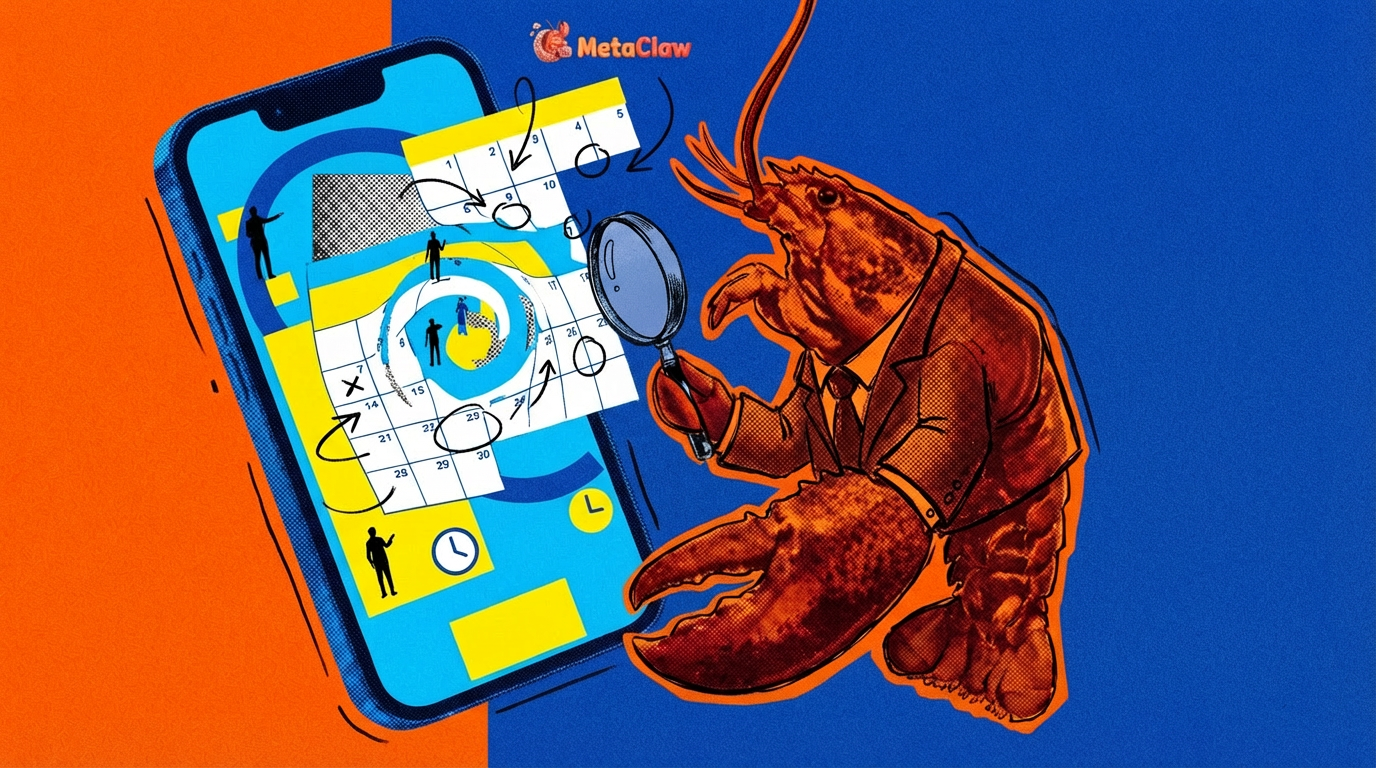
That background process is called OMLS, or Opportunistic Meta-Learning Scheduler. It watches configurable sleep times, keyboard and mouse activity, and the user’s Google Calendar to infer when the person is unlikely to be actively using the system. The framework then uses those windows for model updates.
The scheduling idea is one of the project’s most striking features because it treats personalization as an operational problem, not just a modeling one. The challenge is not only how to improve an agent, but when to do so without getting in the user’s way.
In that sense, MetaClaw reflects a broader shift in AI engineering. As models become commodities, product performance may depend more on the surrounding system: error analysis, memory, scheduling, recovery behavior, and safe adaptation.
Why This Matters for Agent Design
Many current AI agents fail in predictable ways. They mishandle file operations, lose track of formatting requirements, or repeat the same task-specific mistakes. The standard answer has been to use a stronger base model, add more context, or write better prompts. MetaClaw suggests another path: treat deployed agents as systems that should learn from their own work history.
If successful, that could make smaller or cheaper models more competitive. The source text says MetaClaw nearly raised a weaker model to the level of a significantly stronger one in testing. Even without exact benchmark details here, that claim is strategically important. It implies that post-deployment learning infrastructure could become a substitute for some raw model capability.
That would be attractive for businesses trying to control inference costs. Rather than paying continuously for a frontier model, a company might accept a weaker base model if it can adapt effectively over time.

The Friction Points
MetaClaw also raises clear questions. Watching Google Calendar events, keyboard activity, mouse activity, and sleep schedules gives the system useful signals, but it also touches sensitive parts of a user’s digital life. The supplied source text presents these as scheduling inputs, not surveillance features, but the line between the two will matter in any real deployment.
There is also the risk of self-reinforcement. If an agent turns a mistaken interpretation into a behavioral rule, it could harden a bad habit rather than fix one. The source text describes a separate model distilling rules from failures, but it does not detail how those rules are audited, ranked, or reversed.
Operational learning systems therefore need strong controls around rule quality, rollback, and safety. That is especially true if they handle destructive actions such as file modification or account changes.
A Different Vision of AI Progress
MetaClaw stands out because it frames intelligence as something that can keep improving in use, not just in the lab. That idea has been common in traditional software and in recommendation systems, but it is still not standard for consumer-facing language-model agents.
The framework also hints at a future in which agents become more individualized. A system that learns from one user’s workflows, naming preferences, time formatting rules, and risk tolerance may gradually become more useful than a generic assistant with a stronger base model but no memory of operational mistakes.
Whether this specific framework becomes widely adopted is less important than the direction it represents. AI agents are moving from static interfaces toward maintained systems that require scheduling, learning loops, and behavioral governance. MetaClaw offers one early blueprint for that transition.

Why It Matters
- It reframes agent improvement as an ongoing operational process rather than a one-time model release.
- It suggests cheaper models may become more competitive if they can learn effectively after deployment.
- It surfaces new privacy and governance questions as agents begin using personal activity signals to decide when and how to retrain.
This article is based on reporting by The Decoder. Read the original article.
Originally published on the-decoder.com