MISUMI is trying to become more than a parts supplier
MISUMI Group has launched MISUMI Americas, a move the company says is meant to combine its long-established precision components business with the digital manufacturing capabilities it gained through Fictiv. The launch sits inside a much larger plan: a ¥150 billion, roughly $1 billion, global investment vision aimed at expanding the company’s footprint in the Americas and accelerating its shift toward AI-enabled manufacturing and supply chain services.
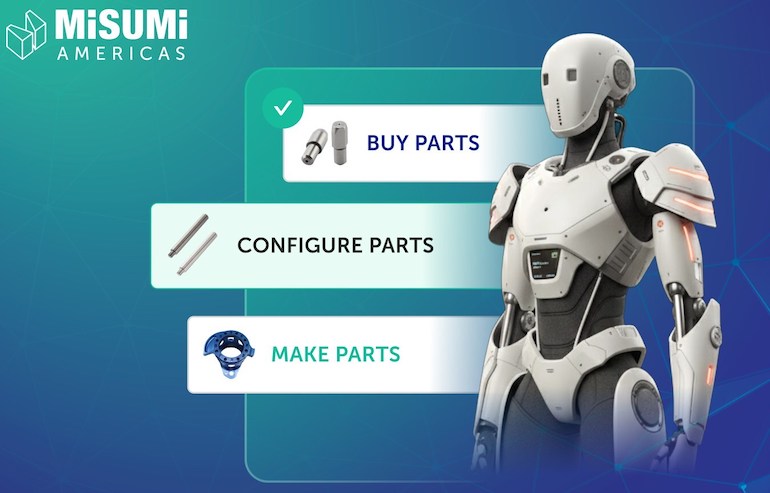
The announcement marks a notable change in how MISUMI wants to be perceived. Rather than operating primarily as a catalog supplier of industrial components, the company is positioning itself as a broader production and supply chain partner for engineering teams. In practical terms, that means tying together standard parts, configurable components, custom-fabricated parts, assemblies, and production services under one commercial and digital umbrella.
The strategy is closely linked to MISUMI’s acquisition of Fictiv last year for $350 million. Fictiv built its business around digital workflows for sourcing and manufacturing, and MISUMI now appears to be using that platform as a core part of its growth plan in North America. The company says the combined offering will use AI-powered sourcing tools, digital workflows, engineering support, and access to a global supplier base to help customers move from design into production with less friction.
Why the Americas launch matters
Manufacturing companies have spent years dealing with fragile supply chains, long qualification cycles, and the complexity of sourcing both off-the-shelf and custom mechanical parts. MISUMI Americas is aimed directly at that problem. The company says engineering, procurement, and supply chain teams will now be able to launch an entire mechanical bill of materials through a single partner, rather than splitting work across multiple vendors and disconnected procurement systems.
That claim is important because it pushes MISUMI beyond component sales and into a higher-value operational role. Mechanical bills of materials often contain a mix of commodity parts, configurable items, and highly customized components. Coordinating those categories is one of the more painful parts of industrial product development, particularly for companies scaling new hardware in robotics, aerospace, factory automation, medical devices, and related sectors.
MISUMI says its new Americas operation is built to support exactly those markets. The company specifically highlighted robotics, eVTOL, satellites, medical devices, machine building, maintenance, repair, and factory automation as target areas. Those are sectors where delays in sourcing and production can slow development, deployment, and fundraising timelines.
A manufacturing platform shaped by AI
The AI element of the announcement is not about humanoid robots or generative assistants for consumers. It is much more operational. MISUMI says it is using AI-powered sourcing and digital tools to reduce complexity in how customers buy, manage, and scale mechanical components and manufacturing services. The pitch is that supply chains should behave less like static procurement networks and more like adaptive systems that can respond to changing production needs.
Dave Evans, the company’s first American CEO, framed the effort as a way to give engineers at smaller and faster-moving companies access to supply chain capabilities typically associated with much larger enterprises. That message matters because many growth-stage industrial companies face the same procurement headaches as incumbents but do not have the staff or systems to manage them efficiently.
The role of Fictiv is central here. Its digital platform gives MISUMI a way to connect quoting, sourcing, and production workflows in a more software-driven manner. MISUMI’s legacy strength, by contrast, has been reliability, precision, and a deep catalog of industrial components. The combined thesis is that hardware builders want both: predictable physical parts and faster digital coordination.
What the investment suggests about industrial competition
MISUMI’s $1 billion investment vision signals confidence that the next phase of industrial competition will depend as much on digital execution as on manufacturing capacity. Suppliers are no longer just judged on whether they can deliver parts. Increasingly, customers want fewer handoffs, more visibility, faster iteration, and procurement systems that can keep pace with hardware development.
That makes MISUMI’s expansion more than a regional branding exercise. It is part of a broader race to modernize industrial supply chains through software, automation, and data. Companies serving hardware teams are under pressure to prove they can reduce lead times, simplify sourcing, and support scaling from prototype to volume production.
The company also pointed to recent relationships beyond the Fictiv deal, including a March 2026 partnership with Oishii Farm. That detail suggests MISUMI sees the opportunity not only in traditional factories but also in newer technology verticals where robotics, automation, and supply chain resilience are increasingly inseparable.
Whether MISUMI can fully deliver on its ambitions will depend on execution. Turning a respected components brand into a comprehensive digital manufacturing partner is a large organizational shift. It requires integrating software, supplier networks, sales, and customer support around a more complex promise. But the launch of MISUMI Americas makes one thing clear: the company believes the industrial buyer of the next decade will expect AI-assisted sourcing and end-to-end manufacturing coordination as standard, not optional.
Key takeaways
- MISUMI has launched MISUMI Americas as part of a broader $1 billion investment plan.
- The effort combines MISUMI’s precision components business with Fictiv’s digital manufacturing platform.
- The company is targeting sectors including robotics, aerospace, factory automation, satellites, eVTOL, and medical devices.
- The main commercial pitch is a single partner for an entire mechanical bill of materials, backed by AI-powered sourcing and global supply chain support.
For industrial technology companies, the bigger message is straightforward: supply chain services are becoming software products as much as logistics functions. MISUMI wants to be one of the companies defining that shift.
This article is based on reporting by The Robot Report. Read the original article.
Originally published on therobotreport.com