Meta and academic collaborators push self-improving AI a step further
Researchers from Meta, the University of British Columbia, and other institutions say they have developed a new class of systems called “hyperagents” that can improve not only at solving tasks but also at refining the process they use to improve themselves. If the approach holds up, it would mark a meaningful expansion of self-improving AI beyond domains where previous methods worked well, especially programming.
The work, reported by The Decoder, builds on the Darwin Gödel Machine, or DGM, a framework in which an agent generates variants of its own code, tests them, and stores successful versions in an archive that can support further rounds of refinement. The key limitation of that earlier setup, according to the source text, was that the mechanism directing improvement remained fixed by humans. The agent could optimize within that framework, but it could not change the framework itself.
What makes a hyperagent different
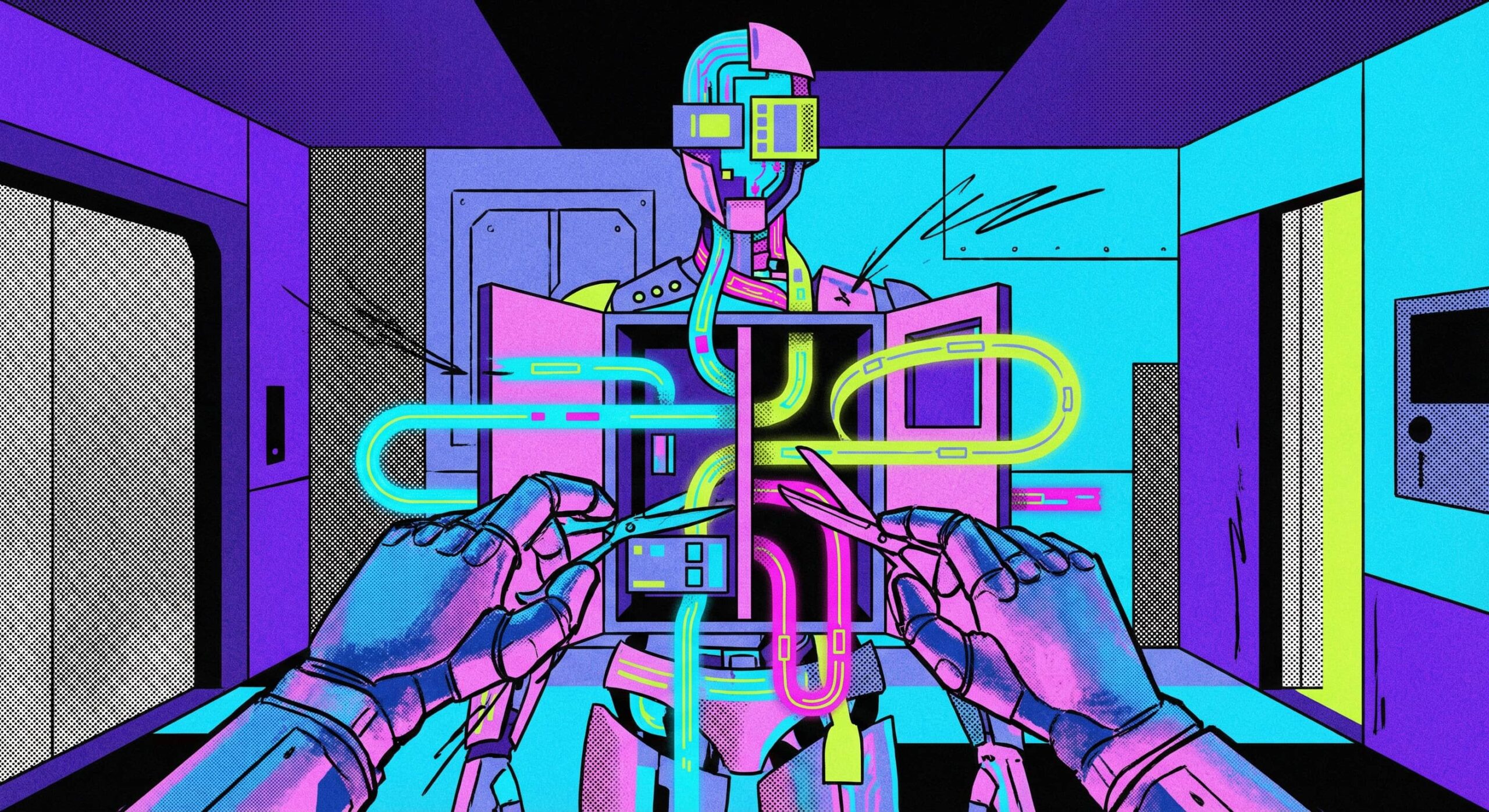
The proposed solution is to combine two functions inside one editable program. One component handles the task at hand, such as evaluating a scientific paper or designing a reward function for a robot. The other component modifies the agent and creates new variants. Because both components exist inside the same codebase, the system can in principle rewrite not just its task-solving behavior but also its improvement logic.
That is the central claim behind the hyperagent idea. Rather than improving only inside a fixed human-authored shell, the agent can also optimize the shell. In the language of the source report, it gets better both at tasks and at “figuring out how to improve in the first place.”
This matters because self-improvement has long faced a ceiling. A system may be highly capable in one domain, yet still depend on hand-built mechanisms that do not themselves evolve. Hyperagents are an attempt to remove that bottleneck by making the meta-level editable too.
Why earlier self-improvement did not generalize well
According to the supplied source text, the original Darwin Gödel Machine showed promise for coding tasks because there is a natural relationship between being a better programmer and writing better self-modifications. In coding, the agent’s skill at the task and its skill at changing its own implementation are tightly connected.
Outside of coding, that link weakens. An agent that becomes better at evaluating scientific papers does not automatically become better at rewriting its own code. The researchers argue that this is why the original DGM performed poorly beyond programming without manual adjustment. The report says the system achieved nearly zero performance on non-programming tasks unless humans intervened to tune it.
Hyperagents are meant to address that failure mode. By allowing the improvement mechanism itself to be optimized, the researchers aim to preserve the archive-based evolutionary structure of DGM while freeing the meta-agent from being permanently fixed.
The new system: DGM-H
The team calls the new approach DGM-Hyperagents, or DGM-H. The archive remains a key part of the method. The system generates variants, evaluates them, and uses successful versions as stepping stones for future changes. What changes is that the “meta” component is no longer locked. The architecture is designed so the agent’s process for generating better versions can itself be modified as part of the same cycle.
That is a substantial conceptual shift. In many AI systems, self-improvement is constrained by a hard separation between the object-level task solver and the meta-level controller or training logic. DGM-H reduces that separation by putting both into editable code. The result, at least in theory, is a system with a better chance of adapting to unfamiliar domains where the path to improvement is not already aligned with task competence.

Reported results across four task areas
The candidate text says the researchers tested DGM-H across four task areas and reported major gains. The excerpt does not provide the full numerical results, so those should not be overstated. What can be said is that the research team presents the system as substantially stronger than the original setup when it comes to broader applicability.
That claim is important because generality is one of the hardest targets in self-improving AI. Many systems perform well under narrow conditions but rely on handcrafted assumptions that break when the environment changes. If hyperagents can meaningfully improve across different task types, they would represent progress toward more flexible autonomous systems.
At the same time, the supplied material describes this as research, not a production capability. The work should therefore be understood as an experimental step, not evidence that broadly self-accelerating AI is already operating at scale.
Why the research matters
The broader significance of hyperagents lies in where they move the frontier. AI researchers have long explored systems that can search, optimize, or write code to improve performance. The harder problem is building systems that can revise the very logic of revision without collapsing into unproductive changes. DGM-H is presented as an attempt to make that recursive loop more capable and more widely useful.
If the approach proves robust, it could matter for domains where task skill and self-modification skill do not naturally coincide. Scientific analysis, robotics, and other complex areas are examples mentioned in the source text. In those settings, the value of a system may increasingly depend on its ability not just to act, but to redesign how it learns and adapts.
That prospect also explains why the work attracts attention beyond the technical details. A system that can optimize its own optimizer touches core questions in AI capability growth, safety, evaluation, and control. The supplied report emphasizes potential performance gains, but the same architectural idea would likely draw scrutiny from researchers concerned with oversight and alignment.

An incremental but notable step
Based on the available material, the safest conclusion is that Meta and its collaborators are advancing a more flexible model of self-improvement, not demonstrating a solved path to runaway recursive intelligence. The research addresses a specific weakness in earlier self-modification approaches and claims progress across multiple task areas.
That alone makes it notable. Self-improving AI is often discussed in abstract or speculative terms. Hyperagents give that discussion a more concrete technical form: editable meta-mechanisms, archive-based iteration, and an explicit attempt to generalize beyond software engineering. Whether the method becomes foundational or remains a useful experiment will depend on results that go beyond the summary provided here. But as a research direction, it clearly aims at one of the most consequential questions in AI: not just whether systems can improve, but whether they can improve the process of improvement itself.
This article is based on reporting by The Decoder. Read the original article.
Originally published on the-decoder.com